
What is FlexTok
FlexTok is an image processing technology jointly developed by the Swiss Federal Institute of Technology in Lausanne (EPFL) and Apple. By resampling two-dimensional images into one-dimensional discrete token sequences, it describes images with flexible lengths, achieving efficient image compression and generation. FlexTok's core technologies include dynamic pixel reorganization, which can increase image compression rates by 300%, support real-time rendering of 8K video, and significantly reduce power consumption.
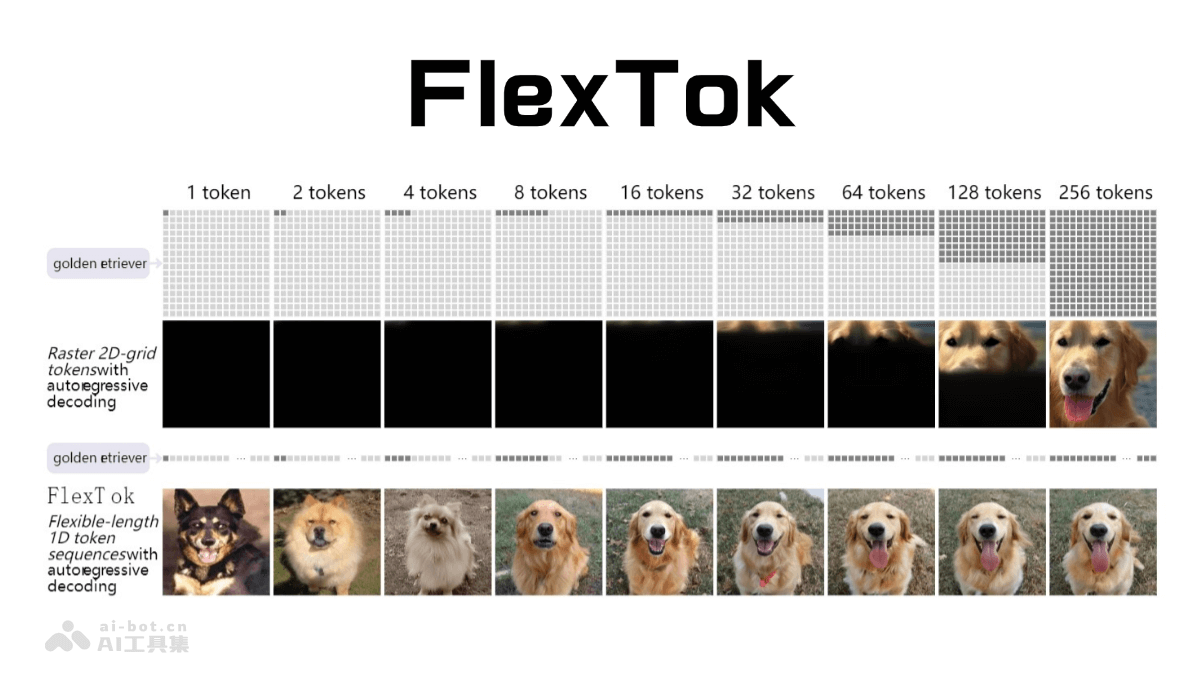
FlexTok's main features
- Efficient image compression: Through dynamic pixel reorganization technology, FlexTok can flexibly adjust the number of tokens according to image complexity, increasing the image compression rate by 300% while supporting real-time rendering of 8K video.
- Low power consumption and high performance: When processing high-resolution images, FlexTok reduces power consumption by 45%, significantly improving device energy efficiency.
- Lossless super-resolution reconstruction: FlexTok achieves lossless super-resolution reconstruction on mobile devices for the first time, and can upscale low-resolution images with high quality.
- Flexible image generation: Through a "visual vocabulary", FlexTok can describe images from coarse to fine, supporting high-fidelity image generation and text-conditioned image generation.
FlexTok's technical principles
- Dynamic pixel reorganization technology: Through dynamic pixel reorganization, FlexTok rearranges and compresses the pixel information of an image into discrete token sequences.
- Multi-scale discretization processing: FlexTok draws on the idea of multi-scale quantized autoencoders (VQ-VAE), gradually decomposing images from high resolution into low-resolution discrete token sequences. The generation process proceeds step by step from coarse to fine, similar to the hierarchical processing of human vision.
- Application of autoregressive models: FlexTok uses an autoregressive model (Autoregressive Model) to model discrete token sequences. The autoregressive model generates images by gradually predicting the next token, similar to the process by which language models generate text. It can capture the local structure and detail information of images, achieving high-quality image generation.
FlexTok's project address
- Project official website:https://flextok.epfl.ch/
- arXiv technical paper:https://arxiv.org/pdf/2502.13967
FlexTok's application scenarios
- Image processing for smart home devices: FlexTok's efficient compression technology can be used for image sensors in smart home devices, such as smart cameras or smart door locks. By optimizing the transmission and storage of image data, it can reduce storage space usage and network bandwidth consumption without reducing image quality.
- Image optimization in home entertainment systems: In home theaters or smart TVs, FlexTok's super-resolution reconstruction capability can be used to improve the picture quality of low-resolution videos, maintaining clear visual effects even on large screens.
- Smart security monitoring: For home security cameras, FlexTok's technology can achieve more efficient image compression and storage, while improving the clarity of surveillance footage through super-resolution technology, helping users more accurately identify details in the footage.
- Image management on mobile devices: On smartphones or tablets, FlexTok can help users store and manage large numbers of photos more efficiently, while improving photo display quality through lossless super-resolution technology.