
What Is FlexRAG
FlexRAG is an innovative Retrieval-Augmented Generation (RAG) framework that addresses the high computational cost and insufficient generation quality faced by traditional RAG systems when handling long contexts. By compressing retrieved context information into compact embedding representations, it significantly reduces the computational burden. The core components of FlexRAG include a compression encoder and a selective compression mechanism. The former is responsible for converting long contexts into fixed-size embeddings, while the latter selectively retains key information by evaluating the importance of information. It improves the performance of generative models and supports flexible compression ratios and multimodal data processing.
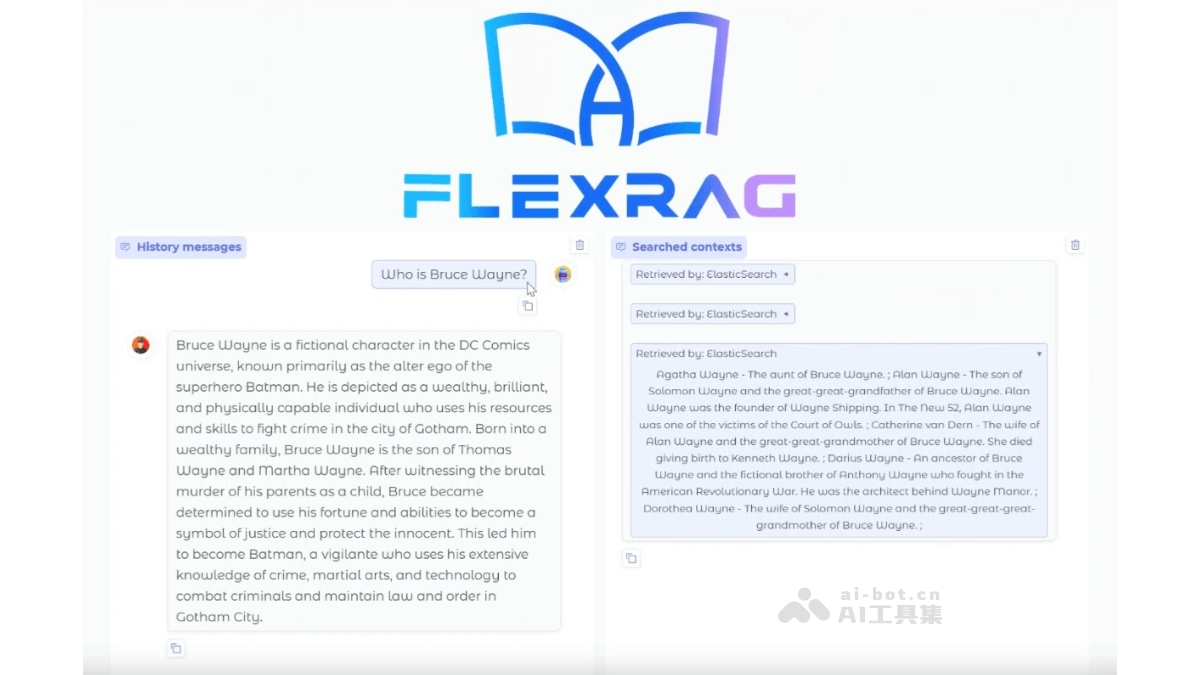
Main Features of FlexRAG
- Multimodal RAG: FlexRAG supports multimodal RAG, opening up a wide range of application possibilities for different data modalities.
- Multiple Data Types: FlexRAG supports multiple data formats, including text (e.g., CSV, JSONL), images, documents, web pages, etc., and can flexibly handle various data sources.
-
Unified Configuration Management: Based on python
dataclassand hydra-core, FlexRAG provides unified configuration management, making the configuration of RAG workflows simpler. - Context Compression: FlexRAG converts retrieved long context information into compact embedding representations through a compression encoder, reducing the computational burden. The model can process large amounts of data more efficiently.
- Support for Multiple Retriever Types: FlexRAG supports multiple types of retrievers, including sparse retrievers, dense retrievers, web-based retrievers, and multimodal retrievers. This enables FlexRAG to be flexibly applied to different data types and scenarios.
- Prompt Fine-Tuning: By learning a soft prompt, FlexRAG can improve performance on downstream tasks, enabling the model to better adapt to specific tasks.
Technical Principles of FlexRAG
- Compression Encoder
- Information Extraction and Data Compression: The compression encoder is a core component of FlexRAG, responsible for converting retrieved long context information into compact embedding representations. By extracting key information and features, it converts contexts of varying lengths into fixed-size embeddings, thereby reducing the burden on downstream models and improving computational efficiency.
- Implementation Mechanism: FlexRAG uses specific training strategies to enable the compression encoder to learn which information is most important, thereby retaining this key information during compression.
- Selective Compression Mechanism
- Importance Evaluation and Dynamic Adjustment: This mechanism evaluates the importance of different context information and prioritizes retaining the information that is most critical for generation. It allows dynamic adjustment of the retained context information according to specific task requirements, making the compression process more flexible.
- Compression Ratio Allocation: To balance compression effectiveness and retention of context information, FlexRAG groups contexts based on estimated importance and assigns different compression ratios to each group.
- Two-Stage Training Workflow
- Pre-training and Fine-Tuning: FlexRAG training is divided into two stages: pre-training and fine-tuning. The pre-training stage is conducted on large-scale datasets to establish the model's basic language understanding and generation capabilities; the fine-tuning stage is conducted on datasets for specific tasks to optimize the model's performance on those tasks.
FlexRAG Project Address
- Github Repository:https://github.com/ictnlp/flexrag
Application Scenarios of FlexRAG
- Open-Domain Question Answering: When facing complex questions in unknown domains, FlexRAG can generate accurate and detailed answers by retrieving information from relevant knowledge bases.
- Dialogue Systems: In multi-turn dialogues, FlexRAG can retrieve relevant information based on the historical dialogue content, generating coherent and in-depth responses.
- Document Summarization and Generation: Based on information in the knowledge base, FlexRAG can better extract and synthesize key information from documents, generating high-quality summaries.
- Knowledge-Intensive Tasks: In tasks that require a large amount of background knowledge, such as natural language inference, text classification, etc., FlexRAG can improve the model's accuracy and reliability by retrieving external knowledge.
- Multimodal Content Processing: FlexRAG supports the integration of multiple data types, including text, images, documents, etc., and can be applied to the generation and processing of multimodal content.