
What is FlashVideo
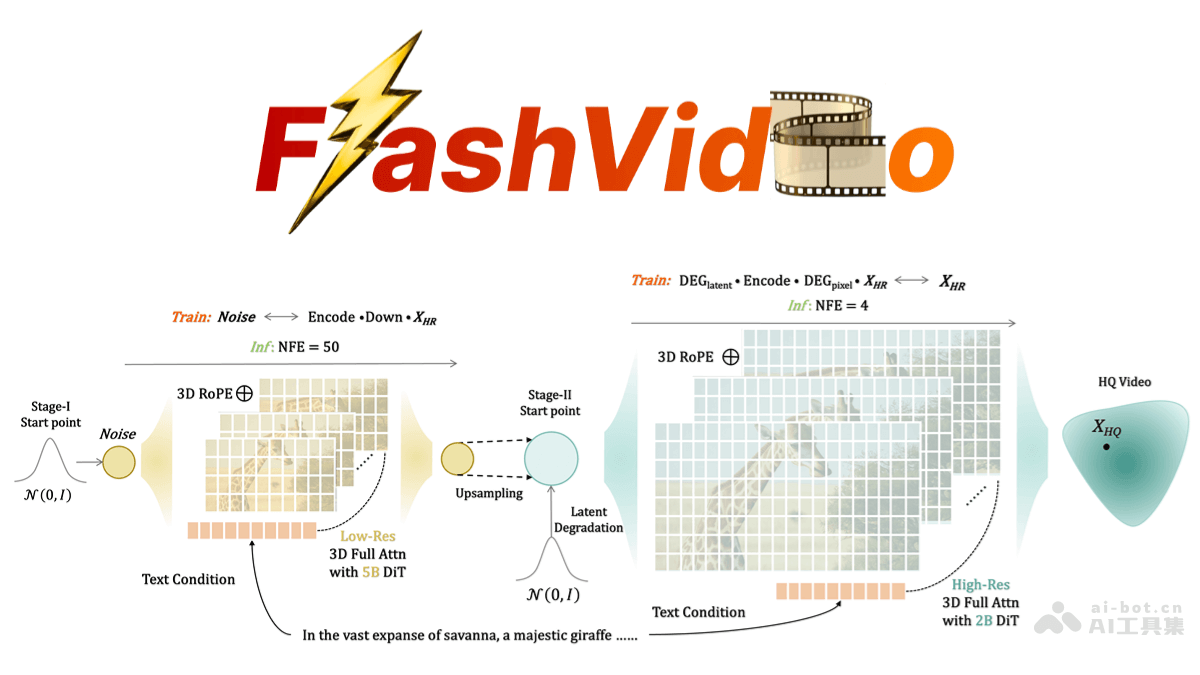
FlashVideo is an efficient high-resolutionvideo generationframework proposed by the ByteDance team, which addresses the enormous computational cost faced by traditional single-stage diffusion models in high-resolution video generation through a two-stage approach. In the first stage, FlashVideo uses a large model with 5 billion parameters to generate content and motion highly consistent with text prompts at low resolution (270p), ensuring computational efficiency based on parameter-efficient fine-tuning (PEFT) technology. In the second stage, through flow matching technology, the low-resolution video is mapped to high resolution (1080p), requiring only 4 function evaluations to generate detail-rich, high-quality video.
Main Features of FlashVideo
- Efficient High-Resolution Video Generation: FlashVideo achieves rapid generation of high-resolution videos through a two-stage framework. The first stage generates video content highly consistent with text prompts at low resolution, while the second stage enhances the low-resolution video to high resolution through flow matching technology, while maintaining consistency of details and motion.
- Rapid Preview and Adjustment: Users can preview preliminary low-resolution results before full-resolution generation. This feature allows users to quickly evaluate the generation effect and adjust input prompts if necessary, thereby significantly reducing computational costs and waiting time and improving user experience.
- Detail Enhancement and Artifact Correction: The second stage focuses on fine-grained detail processing, effectively enhancing the structural and texture details of small objects while correcting artifacts that may be produced in the first stage, significantly improving the visual quality of the video.
- Efficient Computational Strategy: While maintaining high-quality output, FlashVideo significantly reduces computational resource consumption by strategically allocating model capacity and number of function evaluations (NFEs). For example, generating a 1080p video requires only 102 seconds, far less than the 2150 seconds of traditional single-stage models.
Technical Principles of FlashVideo
- Two-Stage Framework Design: FlashVideo divides the video generation process into two stages: the low-resolution stage (Stage I) and the high-resolution stage (Stage II). This design strategically allocates model capacity and number of function evaluations (NFEs), balancing generation fidelity and quality.
- First Stage (Low-Resolution Stage)
- Parameter-Efficient Fine-Tuning (PEFT): The model is fine-tuned through low-rank adaptation (LoRA) technology to adapt to low-resolution generation tasks. LoRA is applied in attention layers, feed-forward networks (FFN), and adaptive layer normalization layers, significantly improving the robustness and efficiency of the model.
- Sufficient NFEs: Retain sufficient NFEs (50 times) at low resolution to ensure high fidelity of the generated content.
- Second Stage (High-Resolution Stage)
- Flow Matching Technology: Establish a mapping relationship between low-resolution and high-resolution latent representations through linear interpolation, directly generating high-quality video from low-quality video, avoiding the traditional diffusion process starting from Gaussian noise.
- Low-Quality Video Simulation: Generate low-quality video through pixel space degradation (DEGpixel) and latent degradation (DEGlatent), training the model to enhance details while maintaining fidelity.
- Full 3D Attention Mechanism: Ensure consistency of enhanced visual details in videos with significant motion and scale changes.
- 3D Causal Variational Autoencoder (VAE): Compresses video pixels into latent features, reducing computational complexity.
- 3D RoPE (Relative Position Encoding): Uses 3D RoPE instead of traditional absolute position embeddings in the high-resolution stage, improving the model's adaptability and scalability to resolution.
- Coarse-to-fine training strategy: First performs large-scale pre-training at low resolution, then gradually scales up to high resolution, and finally fine-tunes with a small number of high-quality samples to improve model performance.
FlashVideo's project address
- Project official website:https://jshilong.github.io/flashvideo-page/
- Github repository:https://github.com/FoundationVision/FlashVideo
- arXiv technical paper:https://arxiv.org/pdf/2502.05179
FlashVideo's application scenarios
- Advertising production: Quickly generates high-quality advertising videos to meet the needs of different brands. FlashVideo can generate video content that matches the advertising theme based on text prompts, shortening the production cycle.
- Film and television special effects: Used to generate complex visual effects, such as science fiction scenes, historical reenactments, and more. FlashVideo can quickly generate high-quality background videos, providing special effects teams with more creative space.
- Virtual scene generation: Generates high-quality virtual scenes for VR and AR applications, enhancing the user experience. FlashVideo can generate various environments according to user needs, such as virtual cities, natural landscapes, and more.
- Educational videos: Quickly generates educational videos to help students better understand and remember complex concepts. FlashVideo can generate relevant animations or video content based on the teaching syllabus.
- Product display: Generates high-quality product display videos for online marketing and advertising. FlashVideo can generate attractive video content based on product features.