
What is FineZip
FineZip is a lossless text compression system based on large language models (LLMs), combining online memorization and dynamic context size techniques to improve the speed and efficiency of text compression. Online memorization refers to parameter-efficient fine-tuning of the model before compression to improve the compressibility of the data. The dynamic context size technique provides a variable context window for each token to be compressed, enabling parallel processing and accelerating the compression and decompression processes. Compared with the LLMZip system, FineZip achieves a 54x improvement in compression speed with only a slight performance loss. In addition, FineZip improves the arithmetic coding method to further enhance compression efficiency.
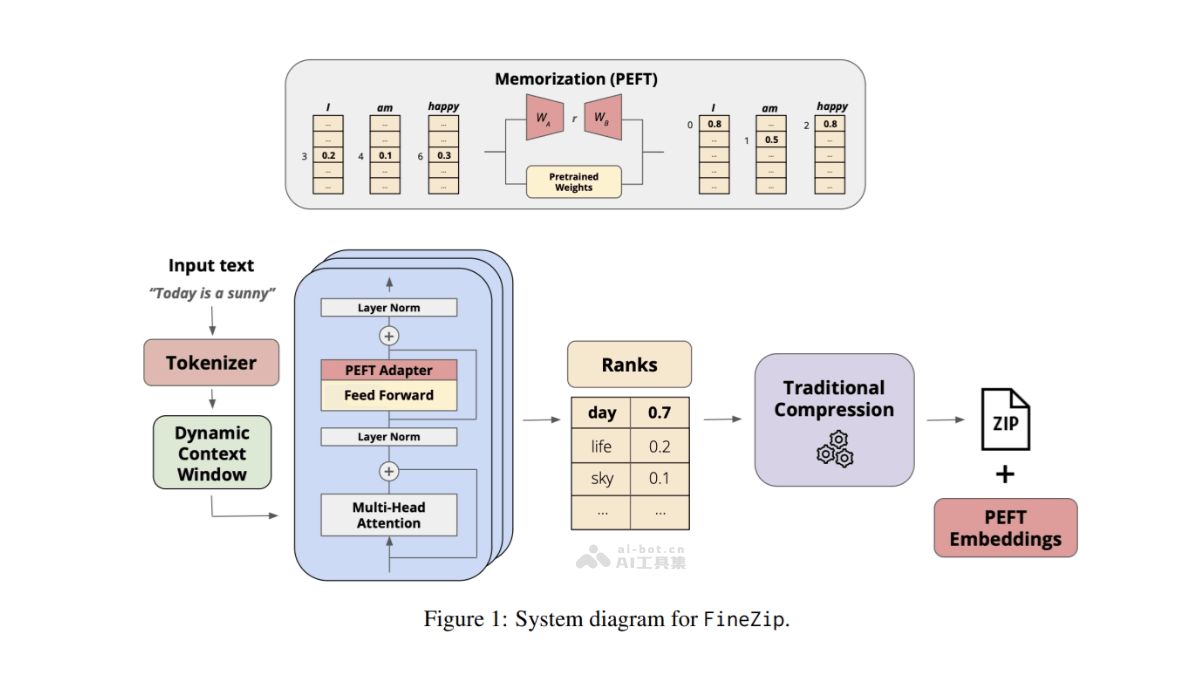
Main Features of FineZip
- Lossless Text Compression: The main feature of FineZip is lossless compression of text data, ensuring that the compressed data can be fully restored to its original state.
- Based on Large Language Models: The system is based on large pre-trained language models that predict the probability distribution of the next token in the text, which is used to effectively compress data.
- Fast Compression: Based on optimization and technological innovation, FineZip significantly improves compression speed, much faster than traditional methods and earlier LLM-based compression methods.
- High Compression Ratio: Based on advanced algorithms and model optimization, FineZip achieves a higher compression ratio than traditional compression tools.
- Dynamic Context Processing: The system dynamically adjusts the context size according to the position in the text, optimizing the compression process.
- Batch Compression Capability: Supports parallel processing of multiple text batches, further improving compression efficiency.
Technical Principles of FineZip
- Online Memorization: Before compression, FineZip performs online memorization on the model using parameter-efficient fine-tuning methods (such as LoRA) to improve the model's familiarity with a specific dataset.
- Dynamic Context Window: The context window size for each token is dynamically adjusted according to its position in the text, optimizing the compression efficiency of each token.
- Batch Processing Technology: Based on the parallel processing capability of LLMs, FineZip can process multiple data batches simultaneously, greatly improving compression speed.
- Arithmetic Coding Improvement: The probability distribution of arithmetic coding is updated based on the logits output by the LLM, optimizing the encoding process and improving the compression ratio.
- Quantization Technology: Reduces the computational precision of the model (such as using 4-bit or 8-bit models instead of traditional 32-bit models), reducing computational resource requirements while improving compression speed.
FineZip Project Address
- GitHub Repository:https://github.com/fazalmittu/FineZip
- arXiv Technical Paper:https://arxiv.org/pdf/2409.17141
Application Scenarios of FineZip
- Data Storage: In scenarios where large amounts of text data are stored, such as data centers and cloud storage services, FineZip can reduce storage space.
- Data Transmission: For applications that transmit large amounts of text data over networks, such as file sharing and online backup services, FineZip reduces data transmission time and improves transmission efficiency.
- Database Management: When storing text information in databases, FineZip can be used to optimize the use of storage space while maintaining data integrity and accessibility.
- Big Data Analytics: When processing and analyzing large-scale text datasets, such as log file analysis and social media data mining, FineZip can reduce data storage and processing time.
- Academic Research: When researchers process large text corpora, FineZip helps save storage space and speeds up data processing.
- Software Development: Software developers use FineZip during software packaging and distribution to reduce package size and speed up download and installation.