
What is FineVision
FineVision is Hugging Face an open-source vision-language dataset released to train advanced vision-language models. It contains 17.3 million images, 24.3 million samples, 88.9 million dialogue turns, and 9.5 billion answer tokens. The dataset aggregates data from more than 200 sources, features multimodality and multi-turn dialogue, and supports the combination of vision and language. Each image is paired with a text caption, which helps models understand and generate natural language. FineVision helped models improve performance by more than 20% on average across 10 benchmarks.
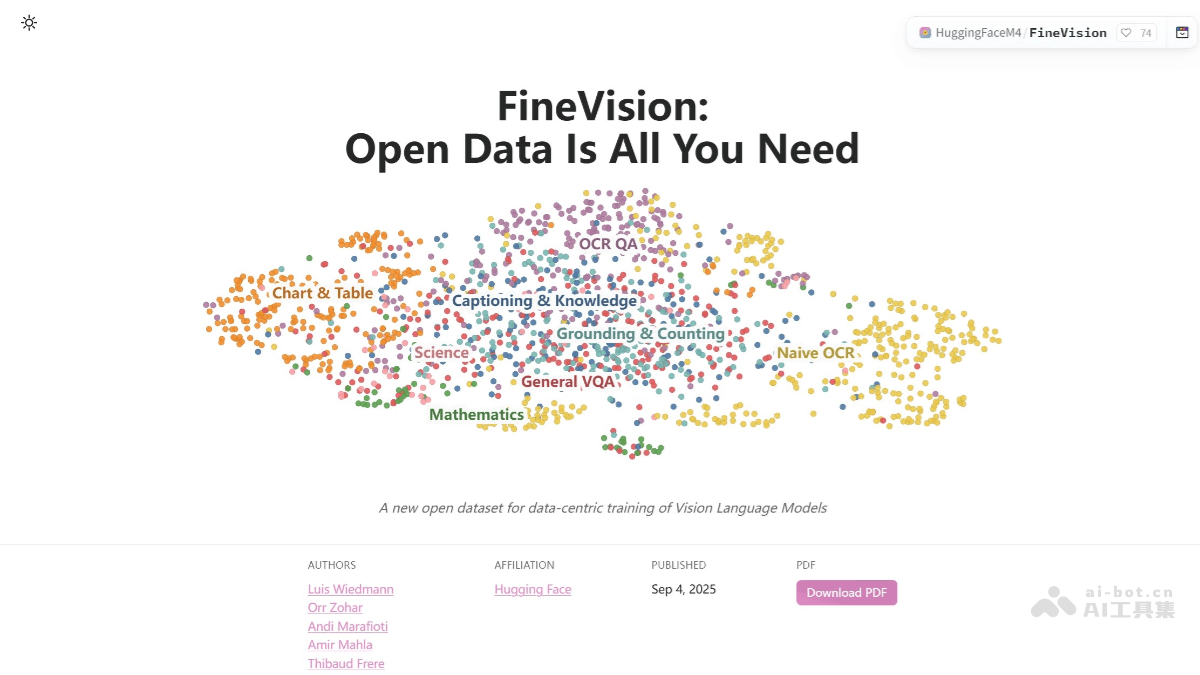
FineVision's main features
-
Multimodal data fusion: Integrates images and text, enabling models to process visual and linguistic information simultaneously and improving their understanding of complex scenes.
-
Multi-turn dialogue support: Provides rich multi-turn dialogue data, helping models learn natural language communication patterns and enhancing interaction capabilities.
-
Large-scale data resources: Has massive image and text samples, providing ample data support for model training and helping improve model generalization ability.
-
Performance improvement support: Significantly improves the performance of vision-language models across multiple benchmarks, driving the development of related technologies.
FineVision's data scale
-
Number of images: Contains 17.3 million images.
-
Number of samples: Contains 24.3 million samples.
-
Dialogue turns: Contains 88.9 million dialogue turns.
-
Answer tokens: Contains 9.5 billion answer tokens.
-
Data sources: Aggregates data from more than 200 different sources.
FineVision's project address
-
Project official website:https://huggingface.co/spaces/HuggingFaceM4/FineVision
-
HuggingFace dataset:https://huggingface.co/datasets/HuggingFaceM4/FineVision
FineVision's application scenarios
-
Visual question answering: Helps models understand and generate natural language descriptions of image content, improving the accuracy and naturalness of question answering.
-
Image caption generation: Automatically generates detailed descriptions of images, suitable for scenarios such as image annotation and assisting visually impaired people.
-
Multi-turn dialogue systems: Enhances the interaction capabilities of dialogue systems on vision-related topics, making conversations more natural and coherent.
-
Visual navigation: Supports vision-based navigation tasks, such as robot navigation and autonomous driving, by understanding images to make decisions.
-
Education and training: Used to develop educational tools that help students better understand and describe image content and improve visual cognition.
-
Content creation: Assists content creators in generating text content related to images, improving creation efficiency and quality.