
What is FilmAgent
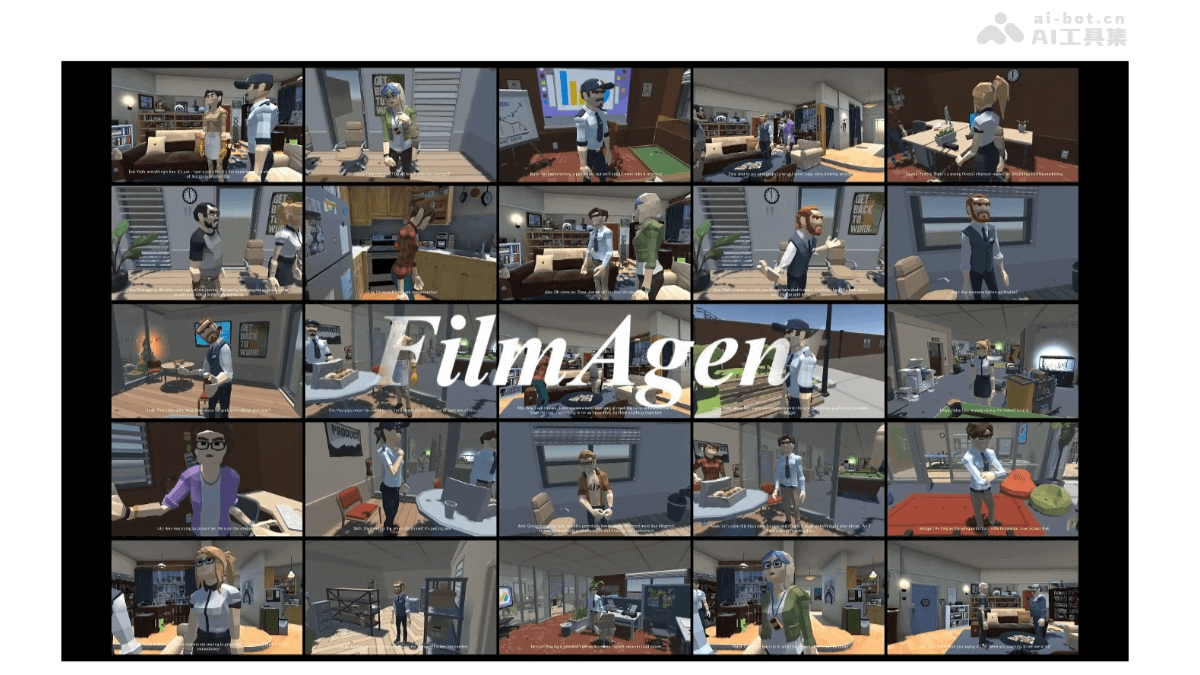
FilmAgent is a virtual film production tool developed by the research team at Harbin Institute of Technology (Shenzhen), based on a multi-agent collaboration framework, achieving end-to-end film production in a virtual 3D space through automated processes. It simulates the workflow of a traditional film studio and uses multi-agent collaboration to automate virtual film production. It simulates key roles in film production, including director, screenwriter, actors, and cinematographer, and divides the entire production process into three stages: planning, scriptwriting, and cinematography.
Main Features of FilmAgent
- Automated Scriptwriting
- Script Generation: FilmAgent can automatically generate a complete script based on the user's input theme, style, and scene requirements. The script includes character actions, dialogue, scene descriptions, and camera settings.
- Multi-Agent Collaborative Creation: The system simulates different roles in film production, such as director, screenwriter, actors, and cinematographer. These agents collaborate through the "Critique-Correct-Verify" and "Debate-Judge" strategies to optimize the script content.
- Custom Creation: Users can generate scripts that meet specific needs by modifying input parameters (such as theme, style, number of characters, etc.).
- Camera Planning and Shooting
- Camera Settings: FilmAgent can automatically generate camera settings based on the script content, including camera angle, focal length, movement trajectory, etc., ensuring that the shooting effect meets the professional requirements of film production.
- 3D Scene Execution: The generated script and camera settings can be executed in the Unity 3D environment. Users can run specific scripts to control character actions and camera movements, achieving virtual shooting.
- Multi-Camera Collaboration: The system supports simultaneous shooting from multiple cameras, can handle complex camera switching and scene transitions, and simulates the multi-camera shooting method in real film production.
- Speech Synthesis
- Character Voice Generation: FilmAgent integrates speech synthesis technology (such as ChatTTS) to generate natural voice dialogue for characters in the script. Users can choose different voice styles and tones as needed.
- Voice Synchronization: The generated voice files can be synchronized with the character actions and dialogue content, ensuring the naturalness and coherence of the shooting effect.
- Multi-Agent Collaboration Framework
- Role Simulation: The system simulates multiple key roles in film production, each with specific responsibilities and functions.
- Collaboration Strategies: FilmAgent adopts multiple collaboration strategies, such as "Critique-Correct-Verify" and "Debate-Judge", to ensure effective communication and collaboration among agents. Through these strategies, agents can criticize, correct, and verify each other, thereby improving the quality of the script and shooting.
- Dynamic Adjustment: During scriptwriting and shooting, agents can dynamically adjust content and settings based on real-time feedback, ensuring the quality and consistency of the final work.
- Agent Discussion Mechanism: Through discussion and collaboration among multiple agents, FilmAgent can optimize script content and reduce errors and inconsistencies.
Technical Principles of FilmAgent
- Critique-Correct-Verify: During the scriptwriting stage, one agent generates content, and another agent reviews it and provides suggestions for improvement. The generating agent revises based on the review suggestions, and the reviewing agent evaluates the revised result again to ensure the accuracy and coherence of the content.
- Debate-Judge: During the cinematography direction stage, multiple agents independently propose shot setup suggestions, and then resolve differences through debate. A third-party agent (usually the director) summarizes the discussion and makes the final ruling.
- LLM-based content generation: FilmAgent is based on large language models (LLMs) to drive agents' behavior and decision-making. LLMs can understand natural language instructions and generate script content that meets logical and narrative requirements.
- Virtual 3D environment support: FilmAgent runs in the Unity 3D environment and supports a variety of predefined virtual scenes, such as apartment kitchens, living rooms, and conference rooms. The scenes provide a virtual stage for the execution of the script, and agents can control character actions and camera movement through scripts.
- Iterative feedback and revision mechanism: FilmAgent verifies intermediate scripts through an iterative feedback and revision mechanism, reducing errors and inconsistencies in the generated content.
- Speech synthesis and video output: FilmAgent integrates speech synthesis technology (such as ChatTTS) to generate natural voice dialogue for characters in the script. The generated script and voice files can be executed in the Unity 3D environment and ultimately output as video content.
FilmAgent project address
- Project official website:https://filmagent.github.io/
- GitHub repository:https://github.com/HITsz-TMG/FilmAgent
- arXiv technical paper:https://arxiv.org/pdf/2501.12909
FilmAgent application scenarios
- Rapid generation of scripts and storyboards: Film production teams can use FilmAgent to quickly generate movie scripts and storyboards, saving a large amount of time and labor costs.
- Creative video generation: Creators can use FilmAgent's multi-agent collaboration feature to quickly generate creative video content without complex post-production.
- Virtual scene applications: FilmAgent supports a variety of virtual 3D scenes, and creators can choose suitable scenes for filming as needed.
- Character action design: Animation designers can use FilmAgent's agent collaboration feature to quickly generate character actions and dialogue, ensuring the coherence and naturalness of the animation.
- Filmmaking teaching: FilmAgent can serve as an auxiliary tool for filmmaking courses, helping students understand key aspects such as scriptwriting, shot setup, and character performance.