
What Is Fast3R
Fast3R is a new multi-view 3D reconstruction method proposed by researchers from Meta and the University of Michigan. Based on the Transformer architecture, it can process more than 1,000 images in a single forward pass, achieving efficient and scalable 3D reconstruction. Compared with traditional methods, Fast3R abandons the complex steps of pairwise image processing and global alignment, and improves inference speed and reduces error accumulation by processing multiple views in parallel. Its core advantages lie in parallel processing capability and support for multiple views. It can process multiple images simultaneously, and each image can attend to all other images at the same time, reducing error accumulation during reconstruction.
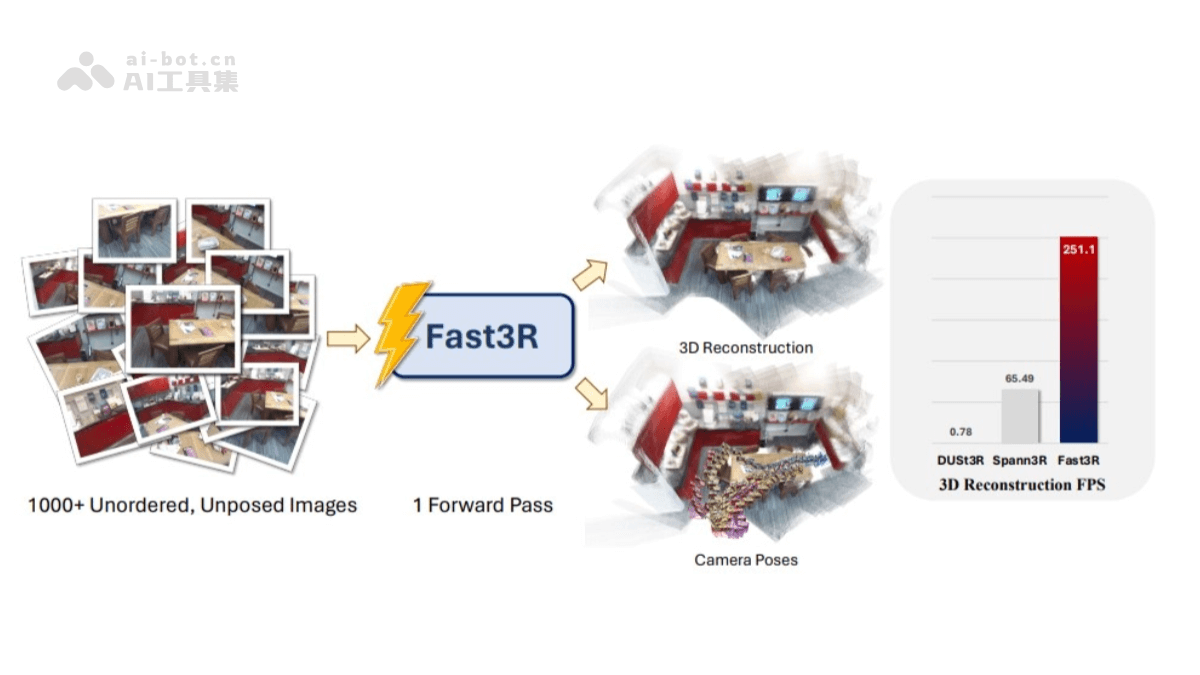
Main Features of Fast3R
- Efficient Multi-View Processing: Fast3R can process more than 1,000 images in a single forward pass and process multiple views in parallel, improving the efficiency of 3D reconstruction. It avoids the complex steps of traditional pairwise image processing and global alignment, reducing error accumulation.
- High-Precision Reconstruction: Fast3R is based on the Transformer architecture and can accurately estimate camera poses and reconstruct 3D scenes. It demonstrates state-of-the-art performance in experiments on camera pose estimation and 3D reconstruction, and performs excellently when handling complex scenes.
- Strong Scalability: Fast3R can use fewer views during training and scale to more views during inference, providing greater flexibility when handling large-scale datasets.
- Fast Inference: Compared with traditional methods, Fast3R significantly improves inference speed. For example, MV-DUSt3R (the predecessor of Fast3R) is 48x to 78x faster than DUSt3R when processing 4 to 24 input views.
Technical Principles of Fast3R
- Parallel Processing and Single Forward Pass: Fast3R can process more than 1,000 images in a single forward pass. It processes multiple views in parallel through the Transformer architecture, avoiding the complex steps of pairwise image processing and global alignment in traditional methods.
- Transformer Architecture: Fast3R adopts the Transformer architecture, supporting each image in attending to all other images simultaneously. The fully connected self-attention mechanism enables the model to better understand the relationships between different views and improve reconstruction accuracy.
- Position Embeddings and Image Index Embeddings: To handle multiple views, Fast3R introduces image index position embeddings. They help the model identify which image patches come from the same image and define a global coordinate system. This enables the model to use fewer views during training and scale to more views during inference.
- Point Map Prediction and Decoder: Fast3R uses independent decoder heads to map the Transformer output to local and global point maps. This provides a detailed representation of the 3D scene, and the model also generates confidence maps to evaluate the reliability of the reconstruction.
Fast3R Project Address
- Project Official Website:https://fast3r-3d.github.io/
- arXiv Technical Paper:https://arxiv.org/pdf/2501.13928
Application Scenarios of Fast3R
- Robot Vision: Fast3R can quickly process large numbers of images and reconstruct 3D scenes. Robots can quickly reconstruct 3D models of their surrounding environment through multi-view image input, better plan paths, identify obstacles, and perform tasks.
- Augmented Reality (AR): In augmented reality applications, Fast3R can process images from multiple viewpoints in real time and quickly generate high-precision 3D scene models.
- Virtual Reality (VR): Fast3R can efficiently reconstruct high-precision 3D scenes from multi-view images. By rapidly processing large numbers of images, Fast3R can generate realistic 3D environments, giving users a more realistic visual experience in virtual worlds.
- Cultural Heritage Preservation: Fast3R can be used for the digital reconstruction of cultural heritage. By capturing cultural relics or historical sites from multiple views, Fast3R can quickly generate high-precision 3D models, facilitating the preservation, research, and display of cultural relics.
- Autonomous Driving: In the field of autonomous driving, Fast3R can process multi-view images captured by vehicle cameras and quickly reconstruct 3D models of the surrounding environment.