
What Is Fara1.5
Fara1.5 is the latest browser-based AI agent (CUA) model series launched by Microsoft Research's AI Frontiers lab, including three parameter versions: 4B, 9B, and 27B. The models are fine-tuned based on Qwen3.5, use pure pixel-level screenshot input, and output mouse and keyboard operations through an observe-think-act loop. On the Online-Mind2Web benchmark, the 27B version achieves a 72% task success rate, surpassing OpenAI Operator and Gemini 2.5 Computer Use. The models are used with the MagenticLite sandbox browser and support complex web tasks such as form filling, cross-site price comparison, and event booking, actively requesting user confirmation before critical operations.
Fara1.5's Main Features
-
Pixel-Level Browser Control: Directly reads browser screenshots without relying on the DOM or accessibility tree, and outputs pixel-level mouse and keyboard operations such as click, type, scroll, and drag.
-
Web-Specific Shortcut Actions: Supports high-level web operations such as web_search, visit_url, and go_back, improving task execution efficiency.
-
Context Management Meta-Actions: Built-in actions such as memorize, ask_user, and finish support long-horizon task memory and collaborative human-computer interaction.
-
Secure Sandbox Execution: Runs through the MagenticLite sandbox browser, forming a security boundary with the user's device, and all operations are traceable.
-
Multi-Scale Deployment: Provides three versions, 4B, 9B, and 27B, balancing lightweight deployment on edge devices with high-performance scenario requirements.
Fara1.5's Technical Principles
-
Base Architecture: Uses Qwen3.5 as the base checkpoint and undergoes supervised fine-tuning (SFT) with approximately 2 million valid samples.
-
Observe-Think-Act Loop: Each step's input includes the full conversation history and the most recent 3 browser screenshots. The model first outputs its reasoning process (thought), then predicts the next atomic action (action).
-
Sliding Window Loss Masking: Cross-entropy loss is calculated only for the thought and action tokens of the most recent 3 turns; historical screenshots and earlier steps serve only as input context.
-
FaraGen1.5 Synthetic Data Engine: Generates trajectories through multi-turn interaction between a teacher agent (GPT-5.4 + Fara1.5 tool capability constraints) and a user simulator, then filters them through triple validators for correctness, efficiency, and user interaction, supplementing data that cannot be collected from real webpages, such as logged-in states and irreversible operations.
-
Training Data Mix: Web trajectories 60%, synthetic environments 12.8%, form filling and user interaction 12.5%, fact grounding 8.8%, visual question answering 4.9%.
How to Use Fara1.5
- Environment Preparation: Install the MagenticLite sandbox browser. This interface is designed specifically for the Fara1.5 series agents and provides an isolated execution environment.
- Load the Model: Choose the Fara1.5-4B, 9B, or 27B model according to hardware and performance requirements, and complete model loading and browser instance initialization.
- Issue a Task: Describe a web task in natural language, such as "book a hotel room in NYC for November 24-28".
- Loop Execution: The model automatically enters the Observe-Think-Act loop, reading screenshots, reasoning, and executing single-step actions until the task is completed or it actively asks the user at critical points.
- Confirmation and Intervention: When encountering missing information, ambiguous task descriptions, or irreversible operations, the model pauses and requests user confirmation to ensure operational safety.
Fara1.5's Core Advantages
-
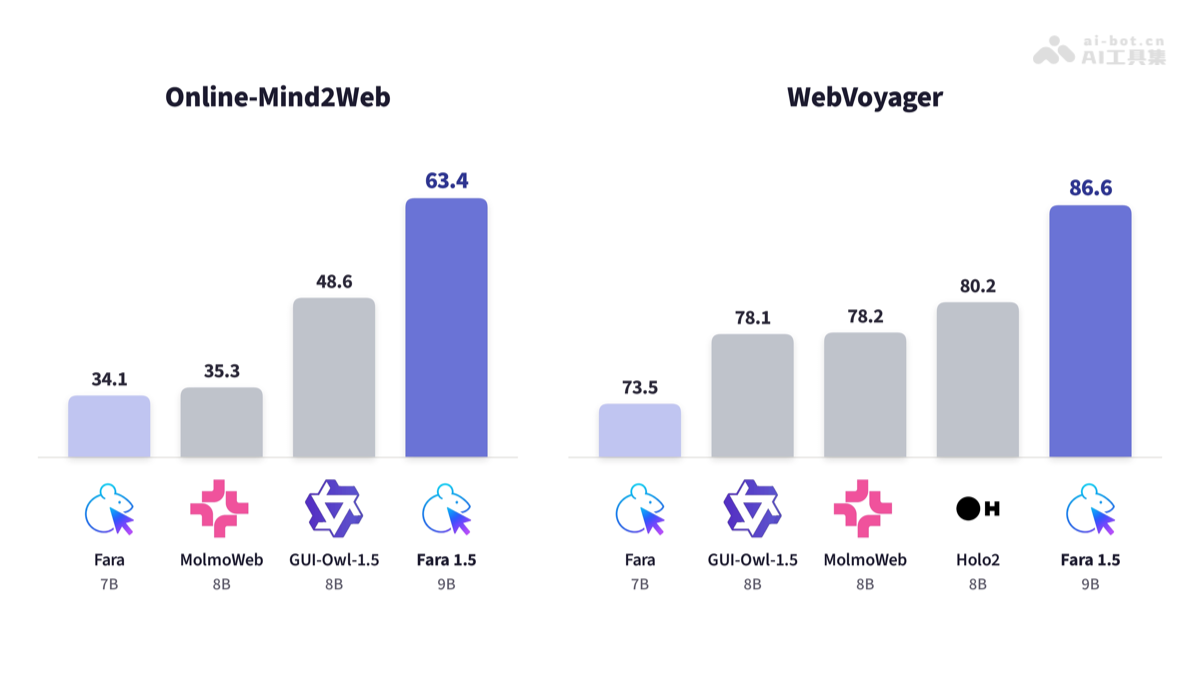
Leading performance at the same size: Fara1.5-9B achieves a 63.4% success rate on Online-Mind2Web, an improvement of nearly 15 percentage points over the same-scale GUI-Owl-1.5-8B (48.6%), setting SOTA at this parameter level; Fara1.5-4B, with a score of 57.3%, is already close to twice that of the previous generation Fara-7B (34.1%), proving that small models can also handle complex browser tasks.
-
Purely vision-driven, zero external dependencies: It does not parse the DOM tree or rely on accessibility interfaces, and understands pages only through pixel screenshots, offering stronger adaptability and freedom from changes in webpage structure or front-end frameworks.
-
Breaking through the boundaries of public webpages: Through the FaraGen1.5 synthetic data engine, it simulates scenarios such as email, calendars, and media platforms that require login or involve irreversible operations, expanding the model's capabilities from "read-only browsing" to "writable interaction."
-
Deployable on modest hardware: The 4B and 9B versions can run on ordinary consumer-grade hardware, lowering the barrier to entry for enterprises and developers, while the 27B version is used for scenarios pursuing ultimate performance.
Fara1.5's Project Address
- Project Address:https://www.microsoft.com/en-us/research/articles/fara1-5-computer-use-agent/
- GitHub Repository:https://github.com/microsoft/fara
Comparison of Fara1.5 with Similar Competitors
| Comparison Dimension | Fara1.5-27B | Fara1.5-4B | OpenAI Operator |
|---|---|---|---|
| Developer | Microsoft Research | Microsoft Research | OpenAI |
| Parameter Scale | 27B | 4B | Undisclosed (proprietary) |
| Online-Mind2Web | 72.0% | 57.3% | 58.3% |
| WebVoyager | 88.6% | 80.8% | — |
| Open Source/Deployment | Open-source weights, locally deployable | Open-source weights, edge-device friendly | Cloud proprietary API |
| Safety Boundary | MagenticLite sandbox + proactive inquiry | Same as above | Proprietary sandbox environment |
| Core Difference | Pure VLM with no DOM dependency, significant scale effect | High cost-effectiveness of small models | Strong ecosystem integration and brand recognition |
Fara1.5's Application Scenarios
-
Automated form filling: On long form pages such as recruitment, reimbursement, and appointments, it automatically identifies fields and fills in information, and proactively asks the user when items are missing.
-
Cross-site price comparison and research: It automatically jumps between multiple e-commerce or information sites, captures product parameters and prices, and summarizes comparison results.
-
Scheduling and booking operations: It completes booking processes such as hotels, flights, and meeting rooms that require multiple steps of clicking, date selection, and payment confirmation.
-
Email and content management: With the support of the synthetic environment, it can perform operations involving account permissions such as sending emails, saving drafts, and uploading attachments.
-
Accessibility assistance: It provides natural-language-driven webpage navigation and interaction agents for visually impaired users or users with limited operation capabilities.