
What is Fancy123
Fancy123 is a 3D mesh generation technology launched by Huazhong University of Science and Technology and South China University of Technology. It generates high-quality 3D meshes from a single image based on plug-and-play deformation technology. The method contains two enhancement modules and a back-projection operation, which respectively address the local inconsistency of multi-view images, improve the fidelity of the mesh to the input image, and ensure high definition. The appearance enhancement module aligns pixels based on deformed 2D multi-view images, and the fidelity enhancement module matches the input image based on the deformed 3D mesh. Fancy123 shows significant performance improvements in qualitative and quantitative experiments and can be seamlessly integrated into existing single-image-to-3D methods.
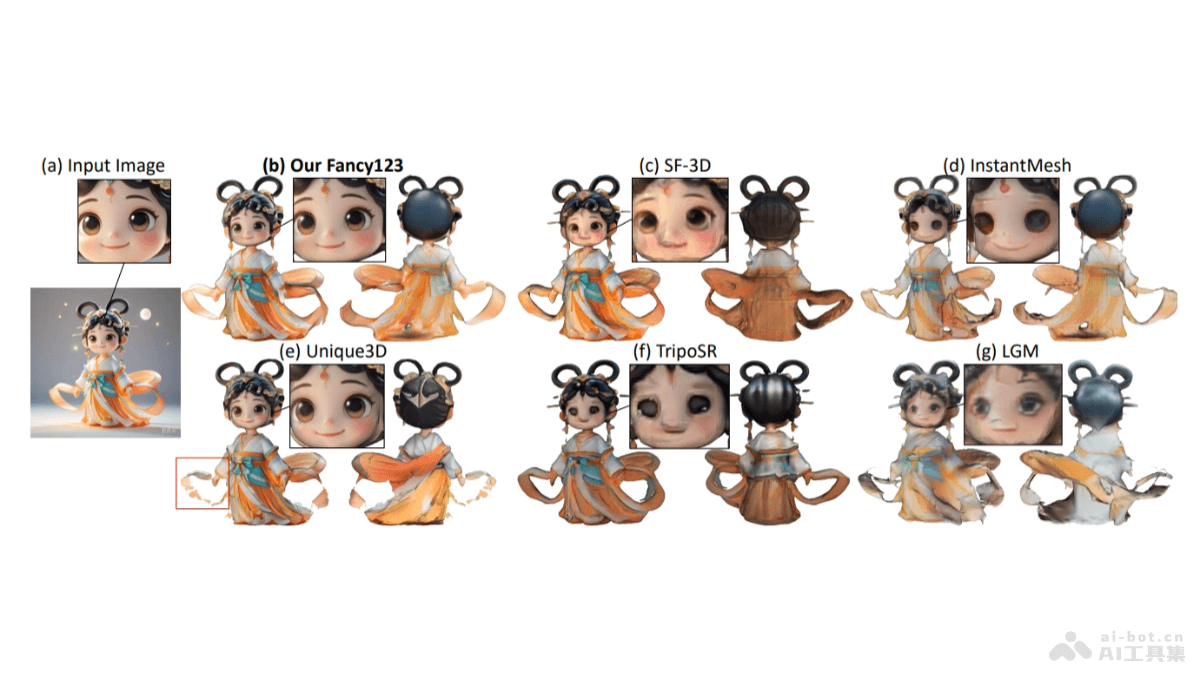
Main features of Fancy123
- Generate 3D mesh from a single image: Generate a 3D mesh model with high visual appeal, color clarity, and input fidelity from a single RGB image.
- Resolve local inconsistency of multi-view images: Based on the appearance enhancement module, correct inconsistencies in images generated by the 2D multi-view diffusion model and improve multi-view consistency.
- Improve the fidelity of the mesh to the input image: Based on the fidelity enhancement module, adjust the 3D mesh to more accurately match the input image and enhance the similarity between the mesh and the input image.
- Ensure high definition: Based on the back-projection operation, project the input image and the deformed multi-view images onto the mesh generated by LRM, improve the clarity of the mesh colors, and remove blur effects.
Technical principles of Fancy123
- Multi-view diffusion model: Use a 2D multi-view diffusion model to generate a set of multi-view images based on the input image.
- Large Reconstruction Model (LRM): Use LRM to quickly reconstruct an initial 3D mesh from multi-view images.
- Appearance enhancement module: Optimize the mesh-based 2D deformation field to align misaligned pixels in multi-view images. Back-project the deformed multi-view images onto the initial mesh to enhance appearance quality and reduce ghosting effects.
- Fidelity enhancement module: Based on parametric mesh deformation (using a Jacobian field), optimize the mesh to bring it closer to the input image. Estimate the camera parameters of the input image so as to maintain correspondence with the input image during the deformation process.
- Back-projection operation: After 2D and 3D deformation, Fancy123 performs a back-projection operation to map the input image and the deformed multi-view images onto the mesh almost losslessly, improving the clarity of the mesh colors.
- Plug-and-play module: The two enhancement modules of Fancy123 are designed to be plug-and-play, can work at inference time, and support seamless integration into various existing single-image-to-3D methods.
Project address of Fancy123
- Github repository:https://github.com/YuQiao0303/Fancy123
- arXiv technical paper:https://arxiv.org/pdf/2411.16185
Application scenarios of Fancy123
- Virtual reality (VR) and augmented reality (AR): In VR and AR applications, it is used to create 3D models from existing 2D images, providing a more immersive experience.
- Game development: Game designers can quickly generate 3D game assets, reducing the time and cost of manual modeling.
- Film and animation production: Artists can create complex 3D characters and scenes for use in film and animation production.
- 3D printing: Convert 2D designs or photos into 3D models for use in 3D printing various items, such as toys, artworks, etc.
- E-commerce: E-commerce platforms provide 3D displays for products, helping consumers understand products more intuitively.