
What is F5-TTS
F5-TTS is a high-performance text-to-speech (TTS) system open-sourced by Shanghai Jiao Tong University, based on a flow-matching non-autoregressive generation method, combined with diffusion transformer (DiT) technology. Without additional supervision, the system quickly generates natural, fluent, and faithful speech based on zero-shot learning. F5-TTS supports multilingual synthesis, including Chinese and English, and can perform effective speech synthesis on long texts. F5-TTS has emotion control capabilities and can adjust the emotional expression of synthesized speech according to the text content. F5-TTS supports speed control, allowing users to adjust the playback speed of speech as needed. The system is trained on a large-scale dataset of 100,000 hours, demonstrating excellent performance and generalization ability. F5-TTS has a wide range of application scenarios, including audiobooks, voice assistants, language learning, news broadcasting, game dubbing, etc., providing powerful speech synthesis capabilities for various commercial and non-commercial uses.
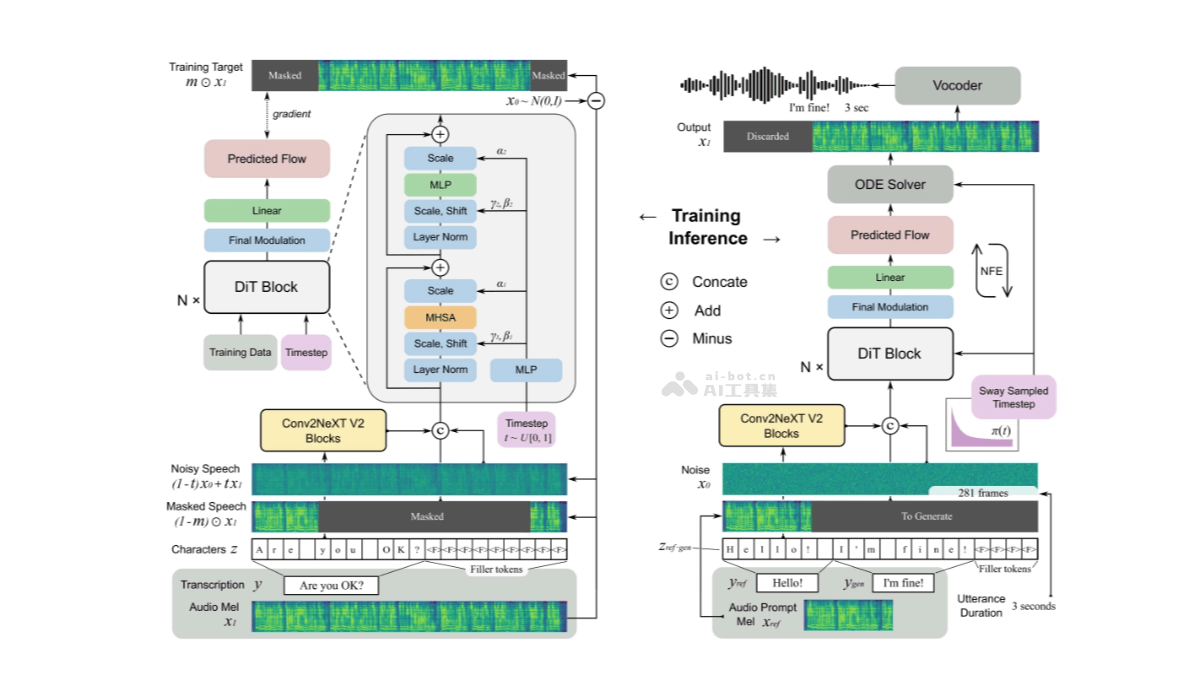
Main features of F5-TTS
- Zero-shotvoice cloning: Imitate anyone's voice without requiring data from a specific speaker.
- Speed control: Adjust the speech generation speed based on the total duration, achieving precise control over speech playback speed.
- Emotional expression control: Control the emotional tone of synthesized speech, making machine-generated speech more expressive with human emotions.
- Long text synthesis: Support continuous speech synthesis for long texts, suitable for reading and broadcasting long-form content.
- Multilingual support: Process and generate speech in multiple languages such as Chinese and English, with strong multilingual synthesis capabilities.
- Large-scale data training: Trained on a large-scale dataset of 100,000 hours, ensuring the model's generalization ability and the naturalness of synthesized speech.
Technical principles of F5-TTS
- Flow Matching: F5-TTS trains the model based on the flow matching objective. The model can transform a simple probability distribution (such as a standard normal distribution) into a complex probability distribution that approximates the data distribution. This involves training the model across the entire flow steps and data range, ensuring the entire transformation process from the initial distribution to the target distribution is handled.
- Diffusion Transformer (DiT): As the model's backbone network, DiT can process sequence data and gradually remove noise during the generation process to produce clear speech signals.
- ConvNeXt V2: F5-TTS improves text representation based on ConvNeXt V2, making it easier to align with speech features and improving the quality and naturalness of speech synthesis.
- Sway Sampling strategy: A flow step sampling strategy used during inference, based on non-uniform sampling to improve model performance and efficiency, especially in the early stages of speech generation, helping the model more accurately capture the outline of the target speech.
- End-to-end system design: The system design of F5-TTS is simple and direct, from text input to speech output, omitting traditional complex designs such as phoneme alignment and duration prediction, simplifying the model's training and inference process.
F5-TTS project addresses
- GitHub repository:https://github.com/SWivid/F5-TTS
- HuggingFace model library:https://huggingface.co/SWivid/F5-TTS
- arXiv technical paper:https://arxiv.org/pdf/2410.06885
- Online experience Demo:https://huggingface.co/spaces/mrfakename/E2-F5-TTS
Application scenarios of F5-TTS
- Audiobooks and podcasts: Convert e-books or articles into audiobooks, providing them to people with limited vision or users who like listening to books.
- Voice assistants and chatbots: Provide natural-sounding voice feedback for smart devices and online services, improving the user experience.
- Language learning and education: Help learners practice pronunciation and listening, and provide auxiliary tools for language learning.
- News and media: Automatically generate audio versions of news reports, providing automated content production for radio stations and online news platforms.
- Customer service: Used in customer service systems to provide automated voice responses and improve the customer experience.