
What is F-Lite
F-Lite is a 10B-parameter text-to-image model open-sourced by the Freepik team in collaboration with FAL. It is trained on Freepik's internal 80M copyright-safe dataset and supports commercial use. F-Lite uses T5-XXL as the text encoder and injects features extracted from its 17th layer into the DiT model. Training includes pretraining at 256 and 512 resolutions, followed by post-training at 1024 resolution, resulting in high training costs. A special version, F-Lite Texture, optimized for rich textures and detailed prompts, has also been released.
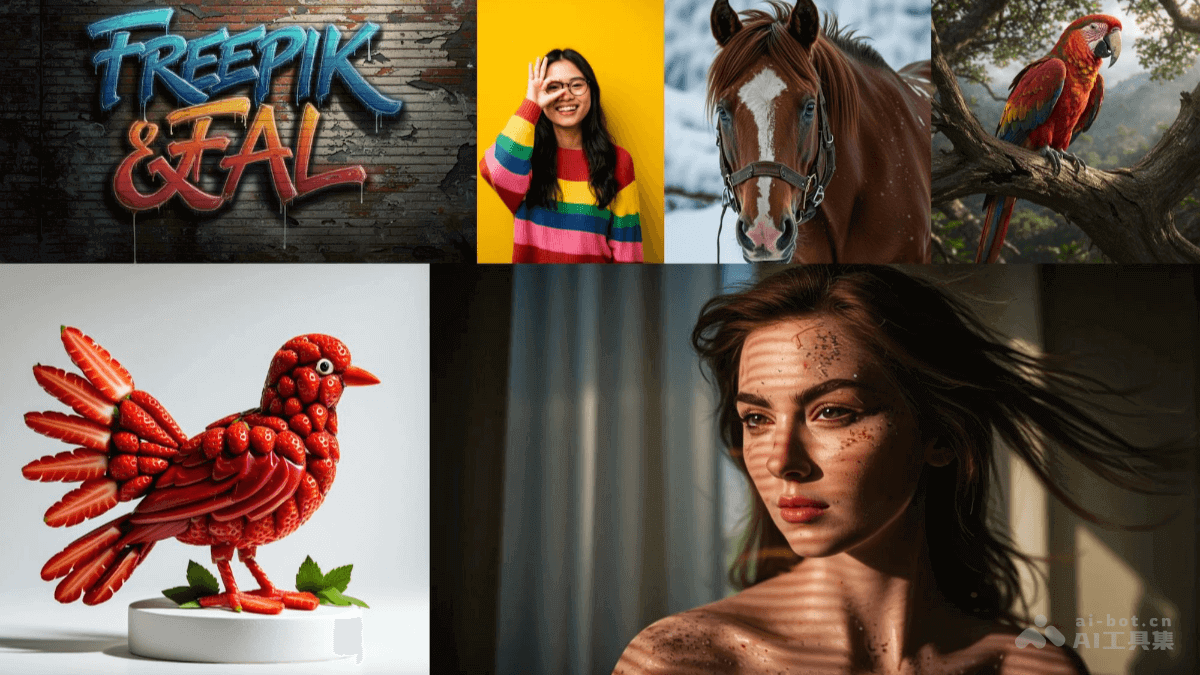
F-Lite's main features
- Text-to-image generation: Users input a text description, and the model generates an image matching the description.
- Commercial license: The model is trained on a copyright-safe dataset provided by Freepik, so the generated images can be used for commercial purposes.
- Multi-resolution training: Supports image generation at 256, 512, and 1024 resolutions to meet the needs of different scenarios.
- Special version optimization: The F-Lite Texture version has been released, optimized for rich textures and detailed prompts.
F-Lite's technical principles
- Diffusion model architecture: Based on the reverse diffusion process, it gradually transforms random noise into meaningful images. It uses a text-conditional diffusion model, combining a text encoder to inject text features into the image generation process.
- Text encoder: Uses T5-XXL as the text encoder to extract text features. Features are extracted from the 17th layer of T5-XXL rather than the last layer, to better capture the semantic information of the text. The text features are injected into the diffusion model using a cross-attention mechanism, ensuring that the generated images are highly relevant to the text descriptions.
- Training strategy:
- Multi-resolution pretraining: The model is pretrained at 256 and 512 resolutions to learn the basic features of images.
- High-resolution post-training: Post-training at 1024 resolution to generate higher-quality images.
- Reinforcement learning training: Reinforcement learning training based on GRPO (Gradient-based Reinforcement Policy Optimization) to improve the diversity and quality of generated images.
- Optimization techniques: Introduces learnable register tokens to better align text and image features. Based on residual connections, it improves the model's training stability and efficiency. Uses μ-Parameterization technology to optimize the diffusion process and improve the quality of generated images.
F-Lite's project address
- GitHub repository:https://github.com/fal-ai/f-lite
- HuggingFace model library:https://huggingface.co/Freepik/F-Lite
- Technical paper:https://github.com/fal-ai/f-lite/blob/main/assets/F%20Lite%20Technical%20Report.pdf
- Online experience Demo:https://huggingface.co/spaces/Freepik/F-Lite
F-Lite's application scenarios
- Creative design: Provides inspiration and visual materials for advertising, posters, illustrations, and other designs, improving design efficiency and creative diversity.
- Content creation: Generates social media images, blog images, etc., enriching the visual effects of content and improving its appeal and reach.
- Game development: Quickly generates game characters, scenes, and complex textures, accelerating the game design and development process.
- Education and learning: Generates relevant images based on teaching content to help students better understand and remember, improving learning outcomes.
- Business and enterprise: Generate product display images, brand promotional images, etc., for commercial promotion and brand building, enhancing brand image and market competitiveness.