
What is Evo 2
Evo 2 is a DNA language model jointly launched by the Arc Institute, NVIDIA, Stanford University, and other institutions. It is used for genome modeling and design, covering all domains of life. Evo 2 is developed based on the StripedHyena 2 architecture and processes context lengths of up to 1 million base pairs at single-nucleotide resolution. Evo 2 is autoregressively pretrained on the OpenGenome2 dataset, which contains 8.8 trillion tokens from all domains of life. It supports functions such as long-sequence modeling, DNA sequence generation, and embedding vector extraction, and provides multiple model checkpoints to meet different needs. Evo 2 advances genomics research and applications, providing powerful tool support for fields such as biomedicine and synthetic biology.
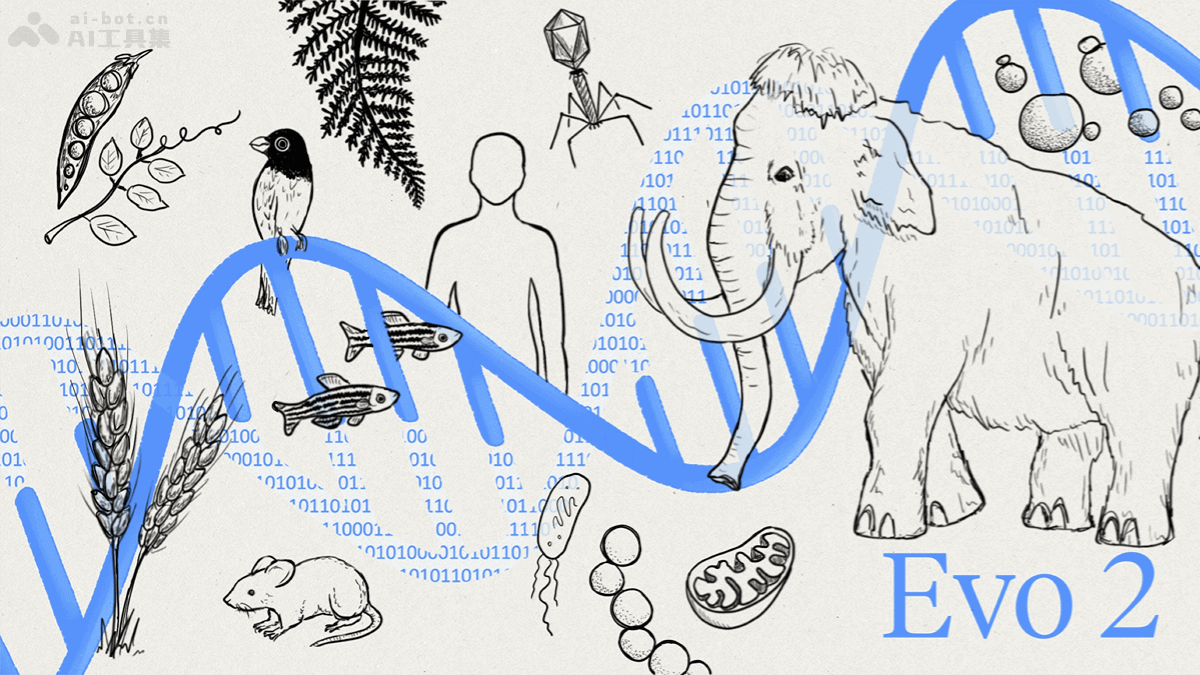
Main features of Evo 2
- Long-context modeling: Processes DNA sequences of up to 1 million base pairs, supporting high-precision genome modeling.
- DNA sequence generation: Generates new DNA sequences based on a given prompt, suitable for synthetic biology and gene editing.
- Embedding vector extraction: Extracts embedding vectors of DNA sequences for downstream analysis, such as gene function prediction and variant effect analysis.
- Zero-shot prediction: Supports zero-shot learning, such as predicting the impact of gene variants on function (e.g., prediction of BRCA1 gene variant effects).
- Sequence scoring: Calculates likelihood scores of DNA sequences to evaluate sequence stability and functional potential.
Technical principles of Evo 2
- Large-scale data training: Trained on data of more than 9.3 trillion nucleotides, from more than 128,000 genomes, covering organisms across multiple domains of life such as bacteria, archaea, and eukaryotes.
- Unique AI architecture: Based on the StripedHyena 2 architecture, it processes gene sequences of up to 1 million nucleotides and understands relationships between distant parts of the genome.
- Deep learning and generative biology: Based on deep learning technology, it understands nucleic acid sequences like understanding language. It uses learned biological sequence patterns formed during evolution to predict the impact of gene mutations and generate new genomes.
- Powerful computing support: The training of Evo 2 uses NVIDIA's DGX Cloud AI platform and more than 2,000 H100 GPUs, demonstrating powerful computing capability and efficient model training.
Evo 2 project address
- Project official website:https://arcinstitute.org/news/blog/evo2
- GitHub repository:https://github.com/ArcInstitute/evo2
- HuggingFace model library:https://huggingface.co/arcinstitute
- Technical paper:https://arcinstitute.org/manuscripts/Evo2
Application scenarios of Evo 2
- Disease prediction: Identifies whether gene mutations are pathogenic, assisting disease diagnosis.
- Gene therapy: Designs cell-specific gene therapy tools to reduce side effects.
- Synthetic biology: Designs new genomes to support artificial life research.
- Evolution research: Identifies gene sequence patterns and studies biological evolution.
- Biological tool development: Designs tools such as biosensors to promote the development of biotechnology.