
What Is EVI 3
EVI 3 is a new speech language model introduced by Hume AI. The model can process both text and speech tokens simultaneously, enabling natural and expressive voice interaction. The model supports a high degree of personalization, generating any voice and personality based on user prompts, and adjusting emotion and speaking style in real time. In comparative tests withGPT-4oand other models, EVI 3 performs better in emotion understanding, expressiveness, naturalness, and response speed. EVI 3 has low-latency response capability and can generate voice responses within 300 milliseconds.
Main Features of EVI 3
- Multimodal Interaction: EVI 3 supports processing both text and speech input simultaneously, generating natural and expressive speech and language responses, achieving a seamless combination of speech and text.
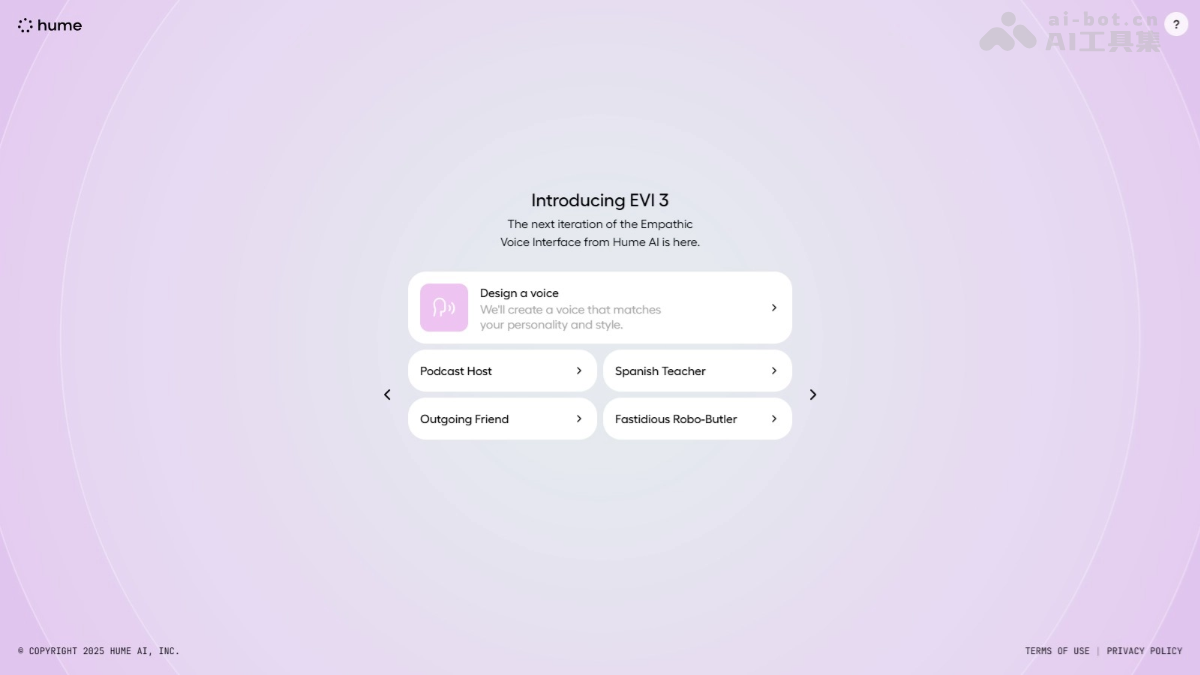
- High Personalization: Users create any voice and personality based on prompts. EVI 3 generates the corresponding voice and style in real time according to the prompt, supporting more than 100,000 custom voices.
- Emotion and Style Adjustment: EVI 3 supports real-time adjustment of emotion and speaking style according to user instructions, supporting a variety of emotions from "excited" to "sad," as well as unique speaking styles such as "pirate" or "whispering."
- Real-Time Interaction: EVI 3 supports generating speech and language responses within conversational latency.
Technical Principles of EVI 3
- Autoregressive Model: Based on a single autoregressive model, it processes both text (T) and speech (V) tokens simultaneously. The model can uniformly process text and speech input and generate natural and fluent speech output.
- System Prompt: The system prompt contains text and speech tokens, provides language instructions, shapes the assistant's speaking style, and generates different voices and styles according to different prompts.
- Reinforcement Learning: Based on reinforcement learning methods, it identifies and optimizes the preferred traits of any human voice, achieving highly personalized voice generation.
- Streaming Processing: EVI 3 uses streaming processing technology to generate speech responses within conversational latency, ensuring the smoothness of real-time interaction.
EVI 3 Project Address
- Project Official Website:https://www.hume.ai/blog/introducing-evi-3
- Online Experience Demo:https://demo.hume.ai/
Application Scenarios of EVI 3
- Intelligent Customer Service: Provide customers with natural and fluent voice interaction and quickly answer questions.
- Voice Assistant: Integrate into devices to provide personalized voice services.
- Educational Tutoring: Simulate conversations to assist language learning and improve social skills.
- Emotional Support: Respond according to emotions and provide psychological comfort.
- Content Creation: Generate voice content with specific emotions and styles, used in audiobooks, etc.