
What is EverMemOS
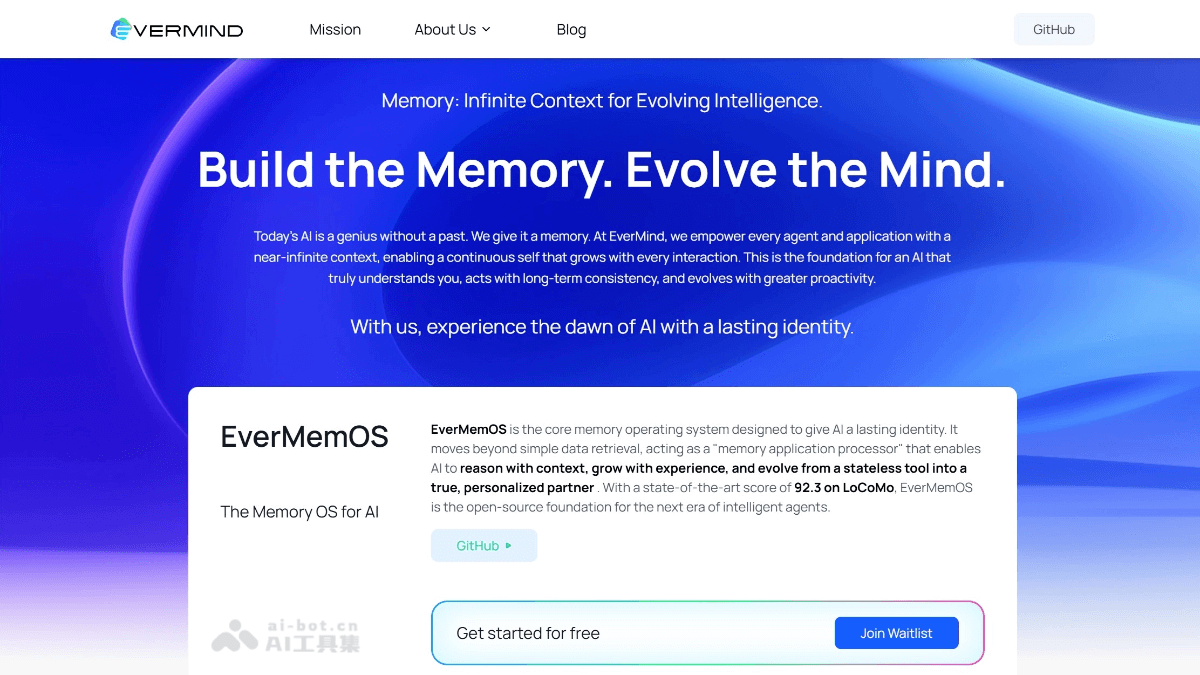
EverMemOS is an open-source long-term memory operating system launched by the Shanda team led by Chen Tianqiao, providing AI assistants with persistent, retrievable memory capabilities. Inspired by the human brain's memory mechanisms, it adopts a four-layer architecture design, including the agent layer, memory layer, index layer, and interface layer. The system integrates data from tools such as Slack, Gmail, and Notion, transforming fragmented information into unified, retrievable memory. The core innovation lies in it being not just a memory "database," but an "application processor" that can influence the model's thinking and responses in real time and proactively. EverMemOS achieved a high score of 92.3% on the long-term memory evaluation set LoCoMo, significantly surpassing existing levels. It supports dynamic and static memory management and can adapt to the diverse needs of teams and individuals.
EverMemOS's main features
-
Memory extraction and structuring: Extracts key information from conversations and transforms it into structured memory units (MemCells) and user profiles, helping AI maintain context and recall past interactions during conversations.
-
Multi-scenario memory management: Supports collaborative management of dynamic memory and static memory, personal memory and team memory, providing optimal memory organization and application strategies according to different scenarios.
-
Proactive intelligence and reasoning: Possesses the ability to proactively discover problems, advance decisions, and follow up on execution, using "multi-hop reasoning" to traverse complex information chains and discover deep knowledge relationships.
-
Technical architecture design: Adopts a four-layer architecture (agent layer, memory layer, index layer, interface layer), integrates multiple technologies such as retrieval-augmented generation (RAG), vector retrieval, knowledge graphs, etc., integrates mainstream large models, and intelligently selects the optimal AI capabilities.
-
Memory portability: Users can export all data and knowledge at any time, including structured memories and insights, avoiding data being "held hostage."
-
Supports multiple applications: Through integration with tools such as Slack, Gmail, and Notion, it supports team collaboration and personal knowledge management, improving team efficiency and personal productivity.
EverMemOS's technical principles
-
Inspired by the human brain's memory mechanisms: EverMemOS's design draws on the human brain's memory mechanisms and uses a layered architecture to achieve memory storage, retrieval, and application, enabling the system to efficiently process and manage memory data.
-
Four-layer architecture design: The system adopts a four-layer architecture consisting of the agent layer, memory layer, index layer, and interface layer. The agent layer is responsible for task understanding and allocation, the memory layer manages long-term memory, the index layer optimizes memory retrieval, and the interface layer implements integration with external applications.
-
Multi-model integration: Integrates multiple technologies such as retrieval-augmented generation (RAG), vector retrieval, keyword retrieval, and knowledge graphs, and integrates mainstream large models such as Gemini, Claude, and ChatGPT, intelligently selecting the optimal AI capabilities according to different scenarios.
-
Layered memory extraction: Extracts continuous semantic chunks from conversations, transforms them into episodic memory units, and then dynamically organizes them into structured memory, solving the limitations of pure text similarity retrieval and improving the accuracy and efficiency of memory.
-
Dynamic and static memory management: Supports collaborative management of dynamic memory (such as real-time conversations) and static memory (such as documents and knowledge bases), and can provide optimal memory organization and application strategies according to different scenarios.
-
Portability and Security of Memory: Users can export all data and knowledge at any time, including structured memories and insights, ensuring data portability and security and preventing data from being "hijacked."
-
Proactive Intelligence and Reasoning Capabilities: The system has the ability to proactively identify problems, drive decisions, and follow up on execution. Through "multi-hop reasoning," it spans complex information chains and discovers deep knowledge relationships.
EverMemOS Project Address
- Project Official Website:https://evermind-ai.com/
- Github Repository:https://github.com/EverMind-AI/EverMemOS/
EverMemOS Application Scenarios
-
Team Collaboration: Integrates the tools used by teams (such as Slack, Gmail, Notion, etc.), unifies the management of team knowledge, improves collaboration efficiency, and ensures information sharing and knowledge retention.
-
Personal Knowledge Management: Helps individuals transform fragmented information and deep thinking into a structured knowledge system, supports the transformation from ideas to detailed plans, and improves personal productivity.
-
Enterprise-Level Applications: Provides enterprises with long-term memory management solutions, supports persistent storage and intelligent retrieval of enterprise data, and assists enterprise knowledge management and decision support.
-
Education: Provides knowledge management and learning assistance for educators and students, helps record the learning process, organize knowledge points, and improve learning efficiency.
-
Intelligent Customer Service: Improves the response quality and efficiency of customer service systems through memory management, quickly retrieves historical conversation records, and provides more precise customer service.
-
Content Creation: Supports creators in managing inspiration and creative materials, assists in content generation, and improves creative efficiency and quality.