
What is Ev-DeblurVSR
Ev-DeblurVSR is a video enhancement model jointly launched by the University of Science and Technology of China, the Institute of Artificial Intelligence of the Hefei Comprehensive National Science Center, and the National University of Singapore. It can recover high-resolution, clear video from low-resolution and blurry video input. Ev-DeblurVSR introduces event signals captured by event cameras, using high temporal resolution and rich motion information to enhance video deblurring and super-resolution performance. The core of Ev-DeblurVSR includes the Reciprocal Feature Deblurring module (RFD) and the Hybrid Deformable Alignment module (HDA), which are used for intra-frame deblurring and inter-frame alignment, respectively. Ev-DeblurVSR performs excellently on multiple datasets, outperforming existing methods, especially on real data, with higher accuracy and faster processing speed.
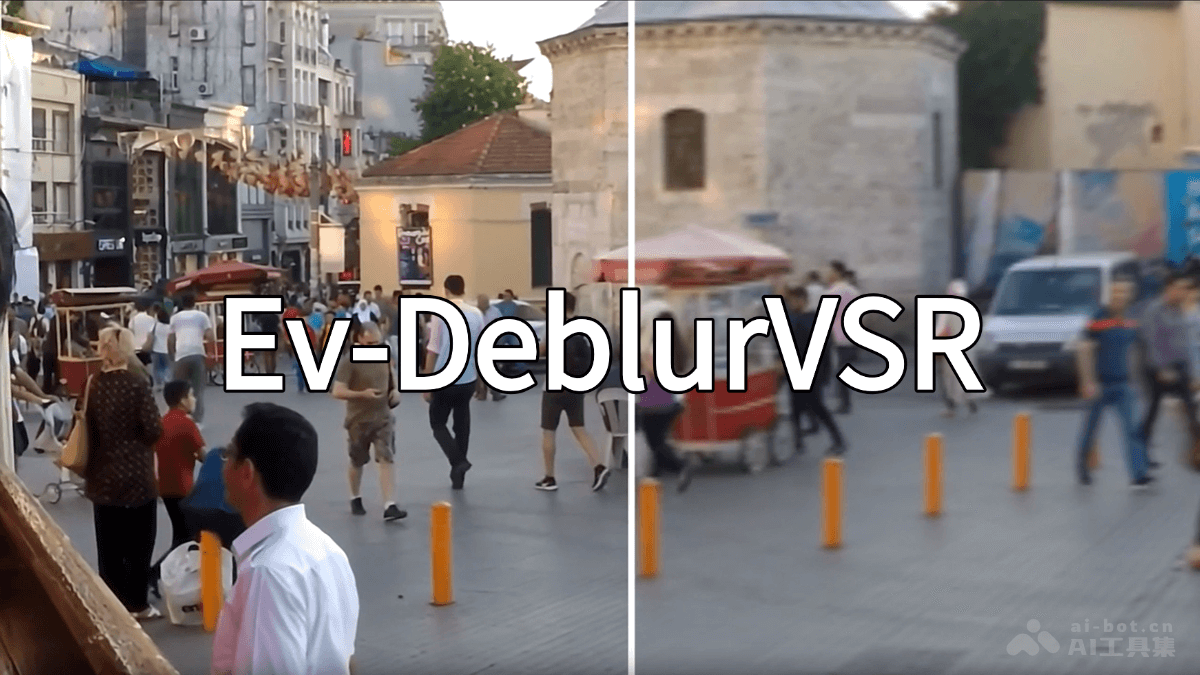
Main features of Ev-DeblurVSR
- Blurry video super-resolution processing: Restores low-resolution and blurry video frames to high-resolution and clear images.
- Assisted by event camera data: With the high temporal resolution and brightness change information captured by event cameras, it restores lost motion details and textures.
- Anti-motion blur and high dynamic range: Effectively reduces motion blur and preserves details in high-contrast areas, suitable for motion scenes and low-light scenes.
- Provides development and testing support: Open-source code, providing pre-trained models, test datasets, and scripts, making it convenient for developers to quickly get started and verify results.
Technical principles of Ev-DeblurVSR
- Classification and utilization of event signals:
- Intra-frame Events: Records motion information within the exposure time of video frames, used for deblurring frame features.
- Inter-frame Events: Records continuous motion trajectories between frames, used for temporal alignment.
- Reciprocal Feature Deblurring module: Deblurs video frame features based on motion information from intra-frame events, feeds the global scene context information of video frames back into event features, and enhances the expressive ability of event features. Based on multi-head channel attention mechanism and cross-modal attention mechanism, it achieves reciprocal enhancement of frame and event features.
- Hybrid Deformable Alignment module: Combines inter-frame events and optical flow information, using the continuous motion trajectories of events and the spatial information of optical flow to improve motion estimation in the deformable alignment process. Based on two branches, Event-Guided Alignment (EGA) and Flow-Guided Alignment (FGA), it achieves alignment, and uses a Deformable Convolutional Network (DCN) to complete the final feature alignment.
- Edge enhancement loss function: Weights the pixel reconstruction error based on high-frequency information in event signals, making the model pay more attention to the recovery of edges and high-frequency areas, improving the details and clarity of the restored video.
Project address of Ev-DeblurVSR
- Project official website:https://dachunkai.github.io/ev-deblurvsr.github.io/
- GitHub repository:https://github.com/DachunKai/Ev-DeblurVSR
- arXiv technical paper:https://arxiv.org/pdf/2504.13042
Application scenarios of Ev-DeblurVSR
- Video surveillance: Improves the clarity of blurry surveillance videos, helping to identify details more accurately.
- Sports events: Clearly restores fast-moving scenes, improving referees' decisions and viewers' viewing experience.
- Autonomous driving: Reduce blurry images captured by cameras to provide clearer environmental perception for autonomous driving systems.
- Film and television production: Repair blurry images caused by poor shooting conditions to improve the quality of film and television works.
- Industrial inspection: Improve blurry images caused by high-speed motion or equipment vibration to increase the accuracy of industrial inspection.