
What is EnerVerse
EnerVerse is the first robot 4D world model developed by the AgiBot team, which guides robots to complete complex tasks by generating future embodied spaces. The model adopts an autoregressive diffusion model, combined with a Sparse Memory mechanism and Free Anchor View (FAV), significantly improving 4D generation capability and action planning performance. Experimental results show that EnerVerse has achieved the current state of the art in robot action planning tasks. EnerVerse's project homepage and paper are already online, and the model and dataset will be open-sourced soon.
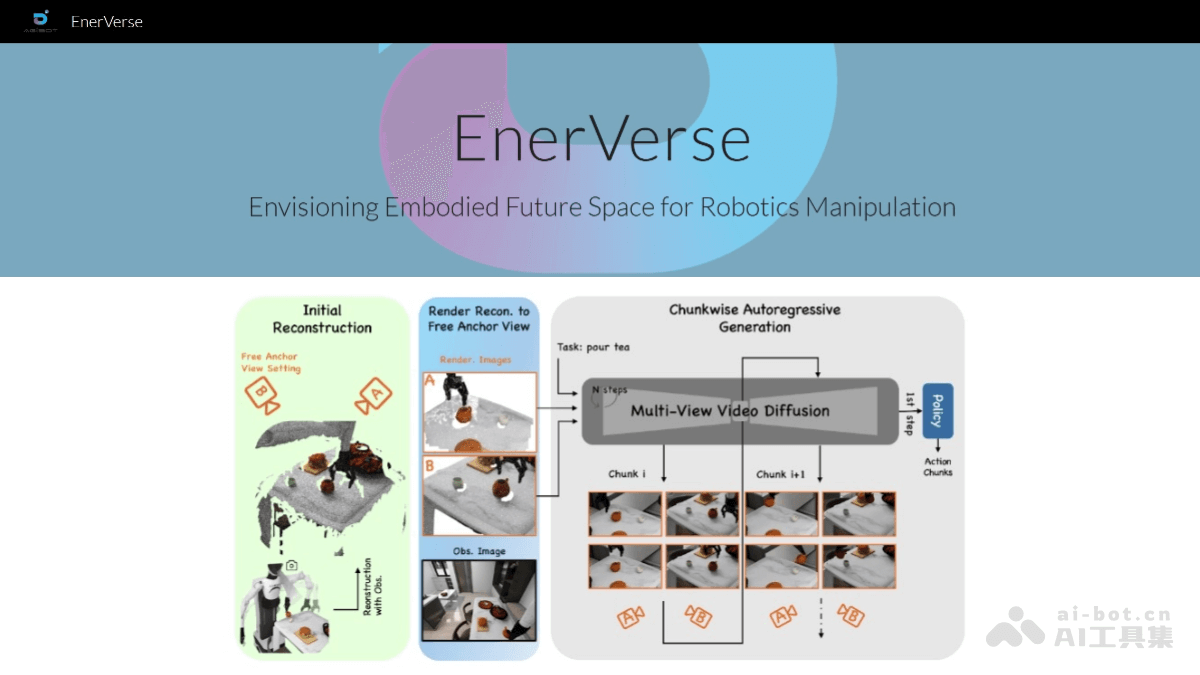
Main features of EnerVerse
- Future space generation: Through an autoregressive diffusion model, EnerVerse can generate future embodied spaces, helping robots plan future actions based on task guidance and real-time observations.
- Efficient action planning: EnerVerse adds a Diffusion policy head composed of multiple layers of Transformer downstream of the generation network, which can output future action sequences at the first step of reverse diffusion, ensuring the real-time performance of action prediction.
Technical principles of EnerVerse
- Autoregressive diffusion model
- Chunk-wise generation: EnerVerse adopts a chunk-wise autoregressive diffusion model, modeling future embodied spaces through a diffusion model. This model generates spatial information at each moment step by step, enabling robots, when performing complex tasks, not only to rely on local information but also to integrate environmental data from multiple moments.
- Diffusion model architecture: Based on a UNet structure combined with spatiotemporal attention, each spatial chunk is internally modeled through convolution and bidirectional attention; chunks are connected through unidirectional causal logic to maintain temporal consistency.
- Sparse Memory mechanism
- Memory management: Drawing on the contextual memory of large language models, EnerVerse applies a high proportion of random masking to historical frames during training, and updates the memory queue at relatively large time intervals during inference. This mechanism effectively reduces computational overhead while significantly improving the generation capability for long-horizon tasks.
- Free Anchor View (FAV)
- Viewpoint flexibility: FAV allows robots to flexibly adjust their viewpoints according to the scene, overcoming the limitations of fixed multi-view setups in narrow or occluded environments. For example, in scenarios such as kitchens, FAV can easily adapt to dynamic occluded environments.
- Spatial consistency: Based on the principle of ray casting, EnerVerse uses a viewing direction map as the viewpoint control condition and extends 2D spatial attention to cross-view 3D spatial attention, ensuring the geometric consistency of generated videos.
- Diffusion policy head
- Efficient action prediction: A Diffusion policy head composed of multiple layers of Transformer is added downstream of the generation network, which can output future action sequences at the first step of reverse diffusion, ensuring the real-time performance of action prediction.
- Sparse memory support: In action prediction inference, the sparse memory queue stores real or reconstructed FAV observation results, which is used to improve the model's planning capability for long-horizon tasks.
EnerVerse project address
- Project homepage:https://sites.google.com/view/enerverse/home
- arXiv technical paper:https://arxiv.org/pdf/2501.01895
EnerVerse application scenarios
- Environmental perception and decision-making: In the field of autonomous driving, EnerVerse can assist vehicles in environmental perception and decision-making by generating future spaces.
- Robotic manipulation and assembly: On industrial production lines, EnerVerse can guide robots in completing complex assembly tasks. By generating future spaces, robots can better understand the spatial relationships between parts and the assembly sequence, thereby improving assembly efficiency and precision.
- Quality inspection and maintenance: EnerVerse can also be applied to quality inspection and maintenance of industrial equipment. Robots can use the generated future spaces to conduct more comprehensive inspections of equipment and promptly detect potential faults and problems.
- Home services: In home environments, EnerVerse can help service robots better understand and plan tasks. For example, in tasks such as tidying rooms and carrying items, robots can predict the placement positions and movement paths of objects by generating future spaces.
- Medical assistance: In the medical field, EnerVerse can assist medical robots in performing surgical operations or rehabilitation training. By generating future spaces, robots can more accurately plan surgical steps or rehabilitation movements.