
What is Emotion-LLaMA
Emotion-LLaMA is a multimodal emotion recognition and reasoning model that integrates audio, visual, and text inputs, consolidating information through emotion-specific encoders. The model is based on a modified version of LLaMA, instruction-tuned to enhance emotion recognition capabilities. Researchers constructed the MERR dataset to aid training and evaluation, enabling the model to learn from multiple scenarios and apply to reality. Emotion-LLaMA performs excellently in multiple datasets and challenges, such as surpassing other teams with an 84.52% WAF in the MER-NOISE track of the MER2024 Challenge. Its architecture is ingeniously designed, fully leveraging LLaMA's advantages and incorporating key emotional cues.
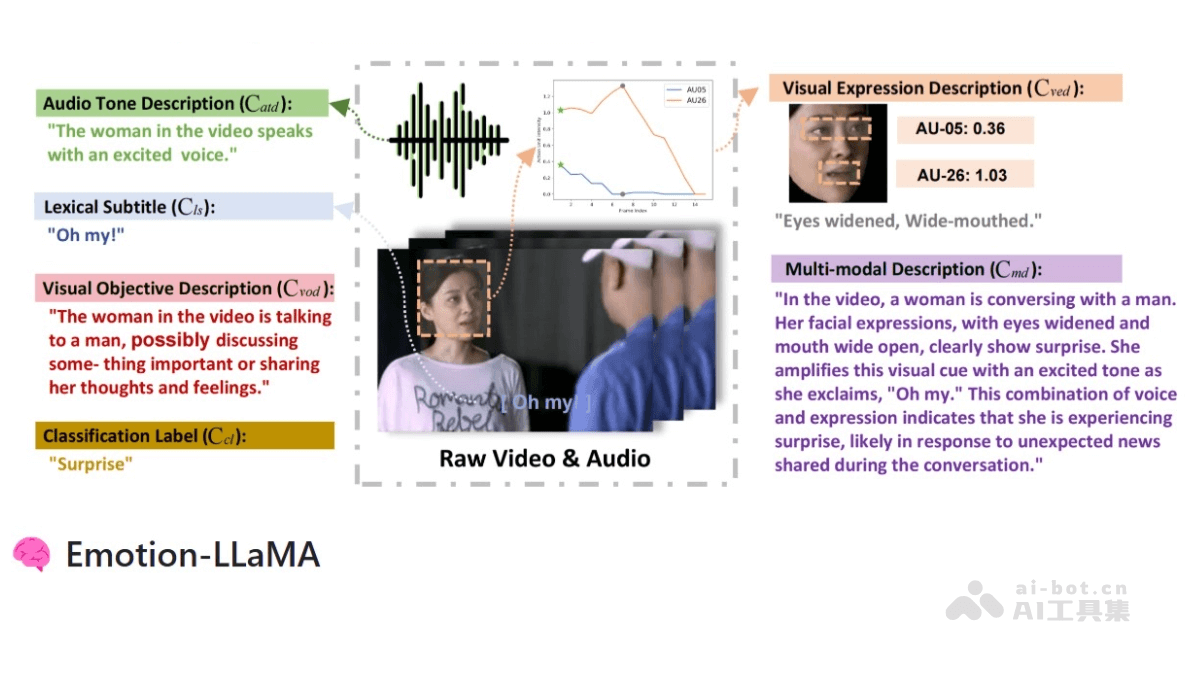
Main Features of Emotion-LLaMA
- Multimodal Emotion Recognition: It can seamlessly integrate audio, visual, and text inputs through emotion-specific encoders, more accurately recognizing complex emotional expressions. It can process images or videos containing characters' facial expressions, body language, and contextual cues, predict the most likely emotion categories, and display predicted emotion labels with corresponding confidence scores.
- Emotion Reasoning: When provided with multimodal inputs (such as video clips accompanied by audio and text), Emotion-LLaMA can generate natural language explanations, analyze facial expressions, vocal cues, and linguistic content in the data, and generate coherent and human-like explanations, highlighting specific cues and patterns contributing to predicted emotions, providing value for applications requiring transparent and interpretable emotion understanding.
- Dataset Construction and Training Support: The MERR dataset was constructed, containing 28,618 coarse-grained and 4,487 fine-grained annotated samples, covering multiple emotion categories, enabling the model to learn from different scenarios and generalize to real-world applications, providing valuable resources for large-scale multimodal emotion model training and evaluation.
- Excellent Performance: It performs excellently in multiple datasets and challenges, such as achieving the highest cue overlap and label overlap scores on the EMER dataset, an F1 score of 0.9036 in the MER2023-SEMI Challenge, an F1 score of 0.8452 in the MER2024-NOISE Challenge, and surpassing ChatGPT-4V in zero-shot evaluation on the DFEW dataset.
Technical Principles of Emotion-LLaMA
- Multimodal Input Fusion: Through emotion-specific encoders, Emotion-LLaMA can seamlessly integrate audio, visual, and text inputs. Based on the HuBERT model as the audio encoder, and multi-view visual encoders (such as MAE, VideoMAE, EVA) to capture facial details, dynamics, and context, it understands emotional expressions more comprehensively.
- Feature Alignment and Instruction Tuning: The model aligns features from different modalities into a shared space, adopting an instruction-tuned modified version of the LLaMA model. This helps the model better understand and process emotion-related tasks, enhancing emotion recognition and reasoning capabilities.
- Dataset Construction: To support model training and evaluation, researchers constructed the MERR dataset, containing 28,618 coarse-grained and 4,487 fine-grained annotated samples, covering multiple emotion categories. The dataset enables the model to learn from different scenarios and generalize to real-world applications.
- Based on Transformer Architecture: The core architecture of Emotion-LLaMA is based on Transformer, utilizing techniques such as autoregressive generation mechanisms, multi-head self-attention mechanisms, feedforward neural networks (FFN), residual connections, and positional encoding to achieve efficient natural language generation and emotion reasoning.
Emotion-LLaMA Project Address
- Github Repository:https://github.com/ZebangCheng/Emotion-LLaMA
- arXiv Technical Paper:https://arxiv.org/pdf/2406.11161
- Online Demo:https://huggingface.co/spaces/ZebangCheng/Emotion-LLaMA
Application Scenarios of Emotion-LLaMA
- Human-Computer Interaction: In scenarios such as intelligent assistants and chatbots, by analyzing the user's emotional state in real time, it generates responses based on the user's emotions, providing a more personalized interactive experience and enabling machines to better understand and respond to human users' emotional needs.
- Education: Teachers can use Emotion-LLaMA to understand students' emotional states and provide more targeted teaching support.
- Mental Health Support: In mental health counseling and intervention, the model can help identify users' emotional states, provide counselors with more accurate emotional analysis, offer timely psychological intervention and support, and assist the treatment process.
- Customer Service: Enterprises can apply Emotion-LLaMA to customer service systems to provide customers with more personalized and considerate service by analyzing their emotional states.
- Social Media Analysis: By performing sentiment analysis on comments, posts, and more on social media, it is possible to understand users' emotional trends and provide enterprises with valuable market insights.