
What is EmDash
EmDash is an AI-native content management system launched by Cloudflare, positioned as the successor to WordPress. EmDash uses a TypeScript + Serverless architecture, supports AI agents directly operating the website, stores data as structured JSON, and runs plugins in isolated sandboxes for greater security. EmDash has a built-in x402 payment protocol to support content monetization and must be deployed on Cloudflare Workers, making it suitable for developers pursuing AI workflows and security.
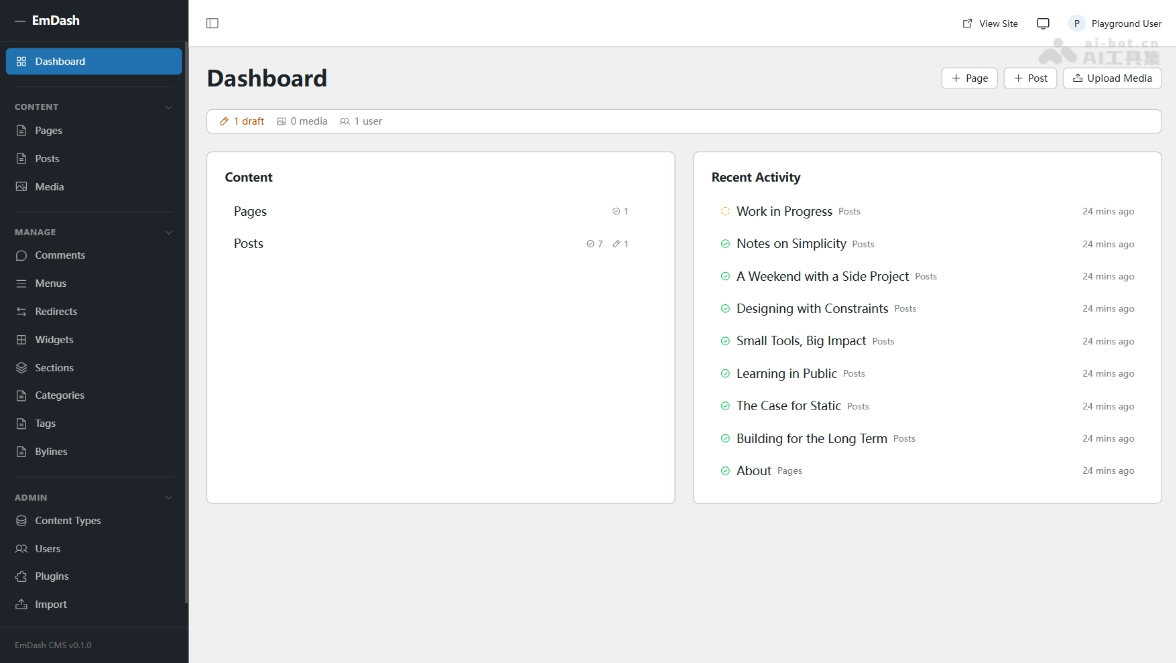
EmDash's main features
-
AI-native management: The system has a built-in MCP protocol and operation manual, supporting AI agents such as Claude and Cursor to directly take over the website backend, completing the entire workflow of publishing articles, updating data, and more through natural language instructions, without the need for manual step-by-step clicking.
-
Structured content storage: All content is saved in pure JSON format, making data easier for AI processing, cross-platform migration, and secondary development calls.
-
Independent content type management: Different content types such as articles, products, and events are each stored and managed independently, completely solving the architectural flaw of traditional CMSs that mix all content into a single data table.
-
Out-of-the-box feature set: Core features such as multilingual support, full-text search, SEO settings, URL redirect management, and frontend visual editing are all natively built in.
-
Sandboxed plugin security mechanism: Each plugin runs in an independent isolated environment and must declare specific permissions in advance (such as read-only content access or send-email-only), eliminating from the source the risk of malicious code gaining unauthorized access to the database.
-
Built-in content monetization capability: Natively integrates the x402 payment protocol, supporting readers to pay per content through cryptocurrency wallets, providing creators with a direct monetization channel with zero subscription threshold.
-
Seamless migration support: Provides one-click import of WordPress WXR files or a dedicated export plugin, allowing existing articles, media libraries, custom fields, and other data to be fully migrated to the new system.
How to use EmDash
- Online experience: Directly visit the EmDash backend experience addresshttps://emdashcms.com/_emdash/admin , no installation required to preview the management interface.
- Local development: You need to create a local project using Node.js package management tools and bind it to a Cloudflare account for deployment.
-
Deployment and launch: Must be deployed to Cloudflare Workers (cannot run on an ordinary VPS or virtual host); Cloudflare's free plan can support a personal blog or small website.
-
AI automated operations: Connect to the MCP server through AI tools such as Claude and Cursor, and directly issue natural language instructions (such as "publish an article" or "update all product prices"), and the AI will automatically complete the backend operations.
-
Data migration: Supports one-click import of WordPress WXR files, or install the EmDash Exporter plugin to migrate old site data (articles, media libraries, custom fields, etc.).
EmDash's project addresses
- Project official website:https://emdashcms.com/
- GitHub repository:https://github.com/emdash-cms/emdash
EmDash's key information and usage requirements
- Product positioning: An AI-native content management system launched by Cloudflare in March 2026, redesigned with a TypeScript + Serverless architecture, positioned as the "spiritual successor to WordPress".
- Core capabilities: Built-in MCP protocol support allows AI such as Claude/Cursor to directly manage content publishing and data updates through natural language instructions; content is stored as structured JSON rather than HTML mixed with styles; plugins run in isolated sandboxes and must declare permissions, eliminating security risks; native integration with the x402 payment protocol supports cryptocurrency pay-per-content; provides one-click migration of WordPress WXR files.
-
Technical barrier: At the current stage, projects must be created via command-line tools (
npm create emdash) to complete deployment configuration, requiring users to have basic development skills; a visual installation wizard is not yet provided.
EmDash's Core Advantages
- AI-native architecture: Built-in MCP protocol and AI operation manual; Claude/Cursor can directly take over the backend and complete the entire workflow such as publishing and updating through natural language instructions, completely overturning the traditional "human clicks buttons" model.
- Plugin security revolution: Plugins run in isolated sandboxes and must declare permissions (such as read-only/send email only), bidding farewell to WordPress's "trust equals authorization" security risks and fundamentally solving the industry pain point that 96% of vulnerabilities come from plugins.
- Modern data architecture: Content is stored in pure structured JSON (not HTML mixed with styles), with types managed independently (articles/products separated), combined with TypeScript + Cloudflare Workers Serverless to achieve automatic scaling and extreme performance.
- Built-in content monetization: Native integration with the x402 protocol supports cryptocurrency pay-per-content, allowing creators to complete the business loop of the AI era directly within the CMS without relying on ads or subscriptions.
- Zero-cost migration: One-click import of WordPress WXR files, with complete migration of historical data, media library, and custom fields; old sites can be upgraded to a modern tech stack without being rebuilt.
Comparison of EmDash with Similar Competitors
| Comparison dimension | EmDash | WordPress | Sanity |
|---|---|---|---|
| Core positioning | AI-native CMS (AI directly takes over the website) | Traditional all-purpose CMS (humans operate the backend) | Enterprise content operating system |
| Technical architecture | TypeScript + Cloudflare Workers Serverless | PHP + MySQL monolithic architecture | React + Node.js + Content Lake architecture |
| AI capabilities | Built-in MCP server; AI agents directly perform publishing/updating/deleting | Relies on external plugins (such as Jetpack AI), no native MCP | AI Assist + Content Agent, supports MCP tools and batch operations |
| Deployment method | Locked to Cloudflare Workers platform | Any PHP virtual host/VPS | Official cloud hosting or private cluster deployment |
| Data storage | Pure structured JSON | MySQL mixed HTML fragments | Structured Content Lake (JSON) |
| Plugin security | Sandbox isolation+ permission declaration (only declared operations allowed) | Full-permission trust(plugins can access the entire database) | Controlled environment, configurable permissions |
| Content monetization | Built-in x402 protocol(cryptocurrency micropayments) | Requires WooCommerce/membership plugin installation | Requires third-party integration |
EmDash Use Cases
- AI-Automated Content Operations: Suitable for teams that need high-frequency updates but have limited manpower, such as news aggregation sites and e-commerce promotion pages. By issuing commands directly through Claude/Cursor such as "batch-publish this week's promotional articles," AI automatically completes the backend operations, with no need for manual entry one by one.
- High-Security Enterprise Websites: For industries such as finance and healthcare that have extremely high requirements for plugin security, the sandbox isolation and permission declaration mechanisms eliminate the risk of malicious plugins and replace the high-maintenance-cost solutions of traditional WordPress.
- Platforms for Creators to Monetize Directly: Independent writers, photographers, and course instructors build personal sites and, through the built-in x402 protocol, implement "pay-per-article reading" or "single-image purchase," without needing to integrate complex third-party payment systems, and with support for instant cryptocurrency settlement.
- Technical Documentation and Developer Blogs: Developers use TypeScript + Astro to build high-performance technical blogs, enjoying the version control convenience brought by structured JSON data, as well as the zero-maintenance and automatic scaling experience brought by serverless architecture.