
What is ELLA
ELLA (Efficient Large Language Model Adapter) is a new method launched by researchers at Tencent, aimed at improving the semantic alignment capability of text-to-image generation models when handling complex text prompts. Existing diffusion models usually rely on CLIP as the text encoder and have limitations when handling long text prompts containing information such as multiple objects, detailed attributes, and complex relationships. Therefore, the research team proposed ELLA, using a Timestep-Aware Semantic Connector (TSC) to dynamically extract the temporally dependent conditions from a pretrained LLM, thereby improving the model's ability to interpret complex prompts.
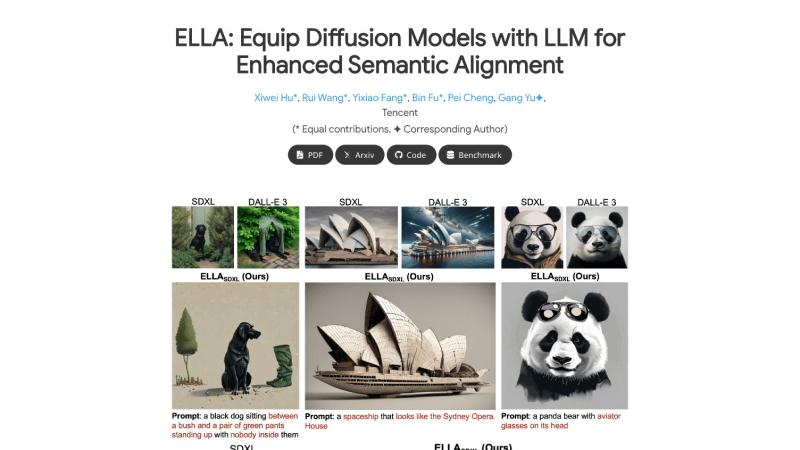
ELLA official website entry
- Official project homepage:https://ella-diffusion.github.io/
- GitHub code repository:https://github.com/ELLA-Diffusion/ELLA
- arXiv research paper:https://arxiv.org/abs/2403.05135
ELLA's functional features
- Enhanced semantic alignment: By combining with a large language model (LLM), ELLA improves the diffusion model's ability to understand multiple objects, detailed attributes, and complex relationships contained in text prompts, thereby generating images that better match the text.
- Timestep-aware semantic extraction: ELLA's Timestep-Aware Semantic Connector (TSC) module can dynamically extract semantic features according to different timesteps in the diffusion process, enabling the model to focus on different textual information at different stages of image generation.
- No retraining required: ELLA's design allows it to be directly applied to pretrained LLMs and U-Net models without additional training of these models, thereby saving a large amount of computing resources and time.
- Compatibility: ELLA can seamlessly integrate with existing community models (such as Stable Diffusion) and downstream tools (such as ControlNet), improving the performance of these models and tools when handling complex text prompts.
ELLA's working principle
ELLA's main working principle is to combine the powerful semantic understanding capability of an LLM with existing image generation diffusion models through a lightweight, trainable Timestep-Aware Semantic Connector (TSC) module, thereby improving the model's understanding of complex text prompts and the quality of image generation without retraining the entire system.
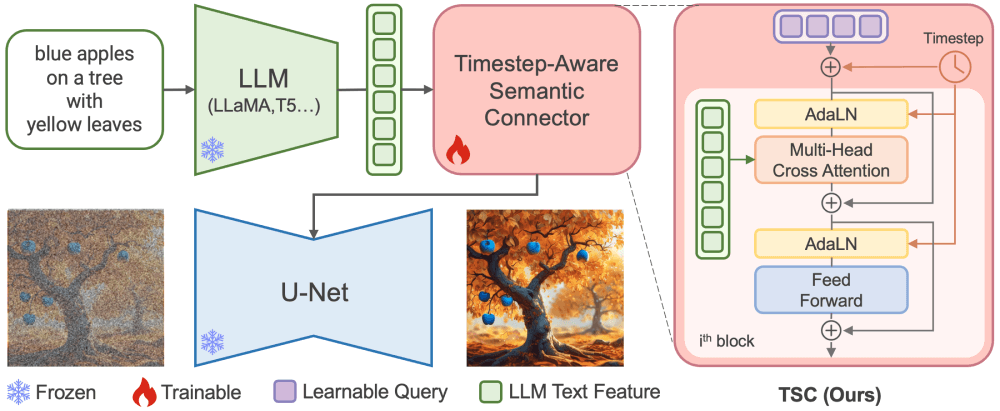
- Text encoding: First, ELLA uses a pretrained large language model (LLM) to encode the input text prompt. This LLM can understand complex text, including multiple objects, attributes, and relationships, and extract rich semantic features.
- Timestep-Aware Semantic Connector (TSC): ELLA's core is a module called TSC, which is responsible for combining the text features extracted by the LLM with the diffusion process of the image generation model (such as U-Net). The TSC module dynamically extracts and adjusts semantic features according to different timesteps in the generation process, so as to better align the text prompt and the generated image content.
- Frozen U-Net: In ELLA's architecture, the U-Net model (the diffusion model used for image generation) and the LLM remain frozen, that is, their parameters are not updated during ELLA's training process. This avoids retraining the entire model, saves resources, and maintains the performance of the original models.
- Semantic feature adaptation: The TSC module receives the text features and timestep embeddings from the LLM, and then outputs fixed-length semantic queries. These queries interact with the U-Net model through a cross-attention mechanism, guiding the noise prediction and denoising steps in the image generation process.
- Train the TSC module: Although the LLM and U-Net remain frozen, the TSC module needs to be trained. It is trained on a dataset of text-image pairs containing high information density, learning how to extract and adapt semantic features according to different parts of the text prompt and different stages of the diffusion process.
- Generate images: When generating images, ELLA's TSC module provides conditional features to the U-Net model based on the text prompt and the current diffusion timestep. These features help the U-Net generate images that are more closely aligned with the text at each timestep.
- Evaluate and optimize: Use benchmarks such as Dense Prompt Graph Benchmark (DPGBench) to evaluate the performance of the enhanced model. Based on the evaluation results, it may be necessary to fine-tune the TSC module or the training process to further optimize the model's performance.