
What is Elements Claw
ElementsClaw is the industry's first superconducting material discovery AI agent, launched by Alibaba DAMO Academy in collaboration with Renmin University of China and the University of Chinese Academy of Sciences. It adopts a specialized-general integrated architecture, combining the 1-billion-parameter atomic foundation model Elements with a large language model to achieve fully automated material screening from literature retrieval and property prediction to experimental protocol design. The agent completed screening of 2.4 million crystal structures in only 28 GPU hours, predicted 68,000 superconducting candidate materials, and successfully experimentally validated 4 entirely new superconducting materials.
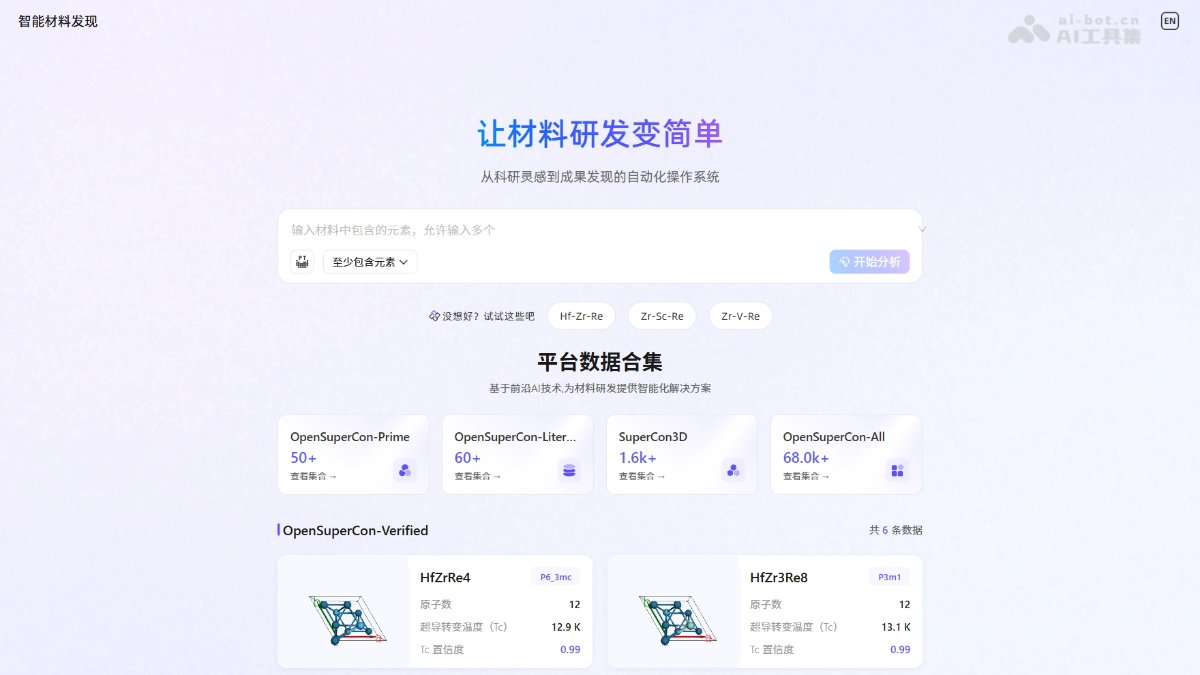
Main features of Elements Claw
-
Superconducting critical temperature prediction: Based on the Elements-T model, it accurately predicts material Tc values, with an average error controlled within 1K.
-
Binary classification of superconductivity: Uses Elements-C to determine whether a material is superconducting, with an AUC as high as 0.996.
-
Thermodynamic stability assessment: Uses Elements-E to assess the synthesis feasibility and structural stability of candidate materials.
-
Crystal structure generation: Achieves de novo structure design through Elements-G, supporting motif-guided and entirely new phase exploration.
-
Intelligent literature synthesis: The LLM automatically retrieves, reads, and distills scientific literature, mining scattered experimental knowledge.
-
Experimental protocol design: Integrates numerical computation and semantic reasoning to output executable synthesis pathways and validation strategies.
Technical principles of Elements Claw
- Atomic foundation model Elements: A 1-billion-parameter model pretrained on 125 million molecules and crystal structures, adopting an EquiformerV2 equivariant architecture to achieve unified representation of periodic crystals and non-periodic molecules. The dataset contains 85.1% periodic crystals and 14.9% non-periodic molecules, while covering both equilibrium stable structures and high-energy unstable configurations, ensuring the model learns robust cross-chemical-domain representations.
- Multi-task pretraining strategy: Performs coordinate/lattice parameter denoising tasks on equilibrium inputs; simultaneously predicts system energy and atomic forces on non-equilibrium inputs. The strategy enables the model to master both the static structural features of stable matter and the dynamic force fields driving structural evolution.
- Specialized-general integrated Agent architecture: The specialized model layer (Elements-T/C/E/G) handles atomic-scale numerical computation; the general LLM layer handles high-level semantic reasoning, literature synthesis, and decision planning. The two coordinate through function calls, with the LLM orchestrating task chains and adaptively combining internal and external tools.
- Self-evolution mechanism: The Agent can distill new insights from literature and autonomously create new skill tools (such as Elements-C) through fine-tuning Elements, realizing closed-loop capability expansion of "discover need—build tool—validate effect".
How to use Elements Claw
- Access the open database: Researchers log in to https://science.damo-academy.com,免费获取 the complete data of 2.4 million stable crystals predicted by ElementsClaw.
- Set exploration goals: Enter research requirements into the system, for example, "screen superconducting candidates with Tc greater than 4K in the Hf-Zr-Re ternary system".
- Launch intelligent screening: ElementsClaw automatically calls Elements-T for high-throughput property prediction, while the LLM retrieves and synthesizes relevant literature evidence.
- Obtain candidate list: The system outputs a list of high-confidence candidate materials, with predicted Tc, stability metrics, synthesis feasibility, and literature support.
- Experimental synthesis validation: Based on the synthesis scheme recommended by the Agent, prepare the target material in the laboratory and test the resistance-temperature curve and magnetic susceptibility.
Core advantages of Elements Claw
-
Efficiency revolution: 28 GPU hours complete the screening workload that traditional methods would take decades, covering 2.4 million crystal structures.
-
Leading accuracy: Superconductivity determination AUC reaches 0.996, and Tc prediction MAE is only 0.992K, significantly outperforming existing baselines.
-
Self-evolution: No manual development of new tools is needed; the Agent can autonomously learn from literature and create new skills.
-
Closed-loop validation: The first batch of 4 AI-designed materials all passed experimental validation, achieving real implementation from prediction to synthesis.
-
Open data: The complete prediction database is freely open to the global academic community, promoting subsequent mining and collaboration.
Project address of Elements Claw
- Project website:https://developer.damo-academy.com/material
- arXiv technical paper:https://arxiv.org/pdf/2604.23758
Comparison of Elements Claw with similar competitors
| Comparison dimension | ElementsClaw | GNoME(Google DeepMind) |
|---|---|---|
| Core positioning | AI agent framework (decision + prediction + experimental closed loop) | Foundation model for material stability prediction |
| Technical route | Specialized-general fusion of atomic models and LLMs | Large-scale stability screening with graph neural networks |
| Validation depth | Experimentally validated 4 entirely new superconducting materials | Predicted 2.2 million stable crystals, with relatively little experimental validation |
| Self-evolution | Supported; can autonomously create new skills from literature | Does not support dynamic skill expansion |
| Application focus | Complex functional materials (superconductivity, catalysis, batteries) | Broad stability assessment of inorganic crystals |
Application scenarios of Elements Claw
-
Superconducting material discovery: Quickly identify high-critical-temperature superconducting candidates, greatly shortening the "trial-and-error" experimental cycle.
-
Solid-state battery electrolyte development: Predict the stability and transport performance of ionic conductor materials, accelerating next-generation battery R&D.
-
Multiphase catalyst design: Discover new compounds with efficient catalytic active sites, advancing chemical engineering and energy conversion.
-
Thermoelectric material exploration: Screen energy conversion materials that combine excellent Seebeck coefficients with low thermal conductivity.
-
Database knowledge completion: Automatically recover known functional materials missed by mainstream databases from scattered literature.