
What is Eino
Eino is an open-source large model application development framework from ByteDance, helping developers efficiently build AI applications based on large models. Eino is based on the Go language and features a stable core, flexible extensibility, and a comprehensive tool ecosystem. The core of Eino is its component-based design. By defining different components (such as ChatModel, Lambda, etc.) and orchestration methods (such as Chain and Graph), developers can flexibly build complex business logic. Eino supports streaming processing, automatically handling details such as stream concatenation and copying, improving application performance. Eino provides a visual development tool, EinoDev, lowering the development threshold, and integrates with the Langfuse platform for runtime observability.
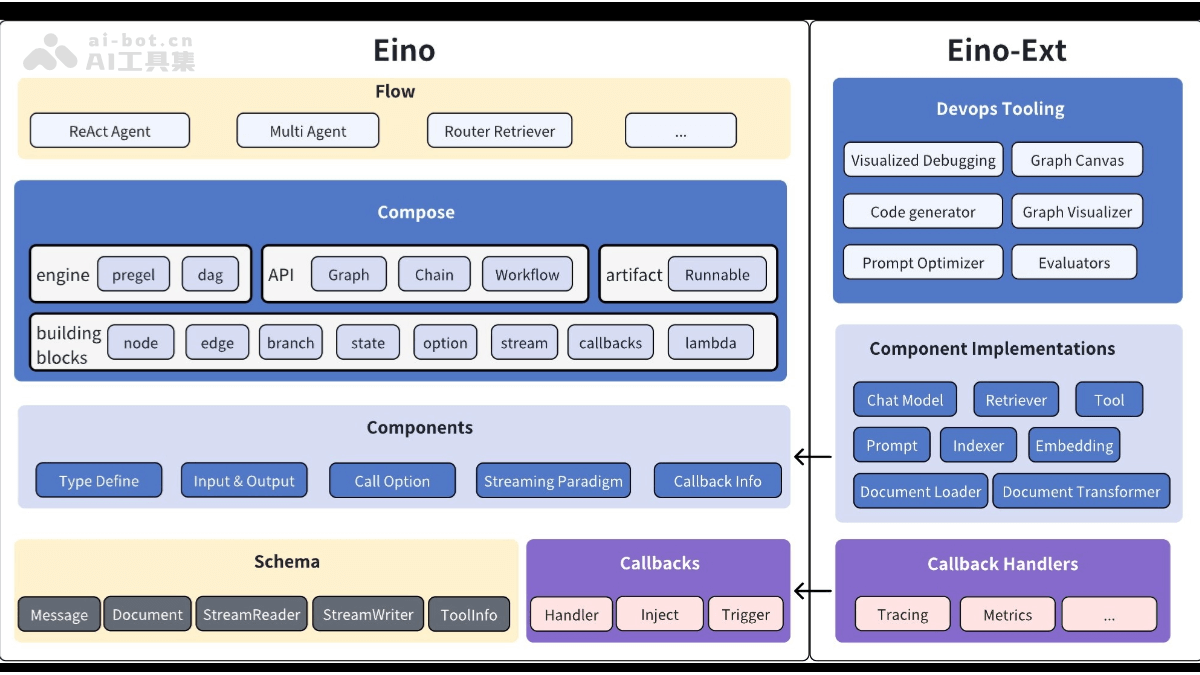
Eino's main features
- Rich components: Abstracts common building blocks into components, each with multiple implementations, supporting nesting and complex business logic.
- Powerful orchestration: Implements directed, controllable data flow transmission based on graph orchestration, supporting type checking, stream processing, concurrency management, etc.
- Comprehensive stream processing: Automatically handles conversion, concatenation, merging, and copying between streaming and non-streaming data.
- Highly extensible aspects (Callbacks): Supports multiple aspects, used for logging, tracing, metric statistics, etc., exposing internal details of component implementations.
Eino's technical principles
- Component-based architecture: Eino splits application logic into multiple components, each responsible for specific functionality (such as text generation, data retrieval, tool invocation, etc.). Components interact based on defined interfaces, and developers choose or implement specific components according to requirements.
- Graph orchestration engine:
- Uses graphs (Graph) to represent dependencies and execution order between components.
- Each component is a node (Node), and the connections between nodes (edges, Edge) define the data flow paths.
- Supports branch logic (Branch), dynamically selecting different execution paths based on conditions.
- Stream processing mechanism: Supports streaming input and output, using components to process real-time data streams. Based on stream processing, automatically handles stream concatenation (Concat) and streaming (T -> StreamReader[T]), improving application real-time performance and efficiency.
- Callback mechanism (Callbacks): Provides a Callbacks mechanism, supporting developers to insert custom logic at the start and end of component execution. Based on callback functions, developers implement features such as logging and performance monitoring.
- Vectorized knowledge base: Provides tools to vectorize knowledge base content and store it in a vector database (such as Redis). At application runtime, retrieves relevant information from the knowledge base based on semantic search, enhancing the application's knowledge background support.
- Visual development tool: Provides the EinoDev plugin, supporting visual interfaces for component selection and orchestration. Developers can quickly build application logic by dragging and dropping components, and generate corresponding code.
Eino's project address
- Project website:https://www.cloudwego.io/
- GitHub repository:https://github.com/cloudwego/eino
Eino's application scenarios
- Intelligent customer service and chatbots: Provide users with efficient and intelligent customer service, quickly answering common questions and handling complex requests.
- Intelligent office assistant: Help employees efficiently schedule meetings, generate meeting minutes, manage files, etc., improving work efficiency.
- Knowledge Management System: Build an enterprise internal knowledge Q&A system to help employees quickly obtain the information they need and improve knowledge sharing efficiency.
- Content Creation and Generation: Provide content creators with an intelligent assistant that efficiently generates articles, stories, scripts, etc., improving creation efficiency and quality.
- Intelligent Medical Assistant: Help patients obtain medical advice, make appointments, etc., improving the convenience of medical services.