
What is EDTalk
EDTalk is an audio-driven lip-sync model developed by Shanghai Jiao Tong University in collaboration with NetEase, enabling independent control of mouth shape, head pose, and emotional expression. Simply upload an image, an audio clip, and a reference video to drive the person in the image to speak, with support for custom emotions such as happiness, anger, sadness, and more. EDTalk decomposes facial dynamics into three independent latent spaces representing mouth shape, pose, and expression through three lightweight modules, each represented by a set of learnable basis vectors whose linear combinations define specific actions. This efficient decoupled training mechanism improves training efficiency and reduces resource consumption, allowing even beginners to quickly get started and explore innovative applications.
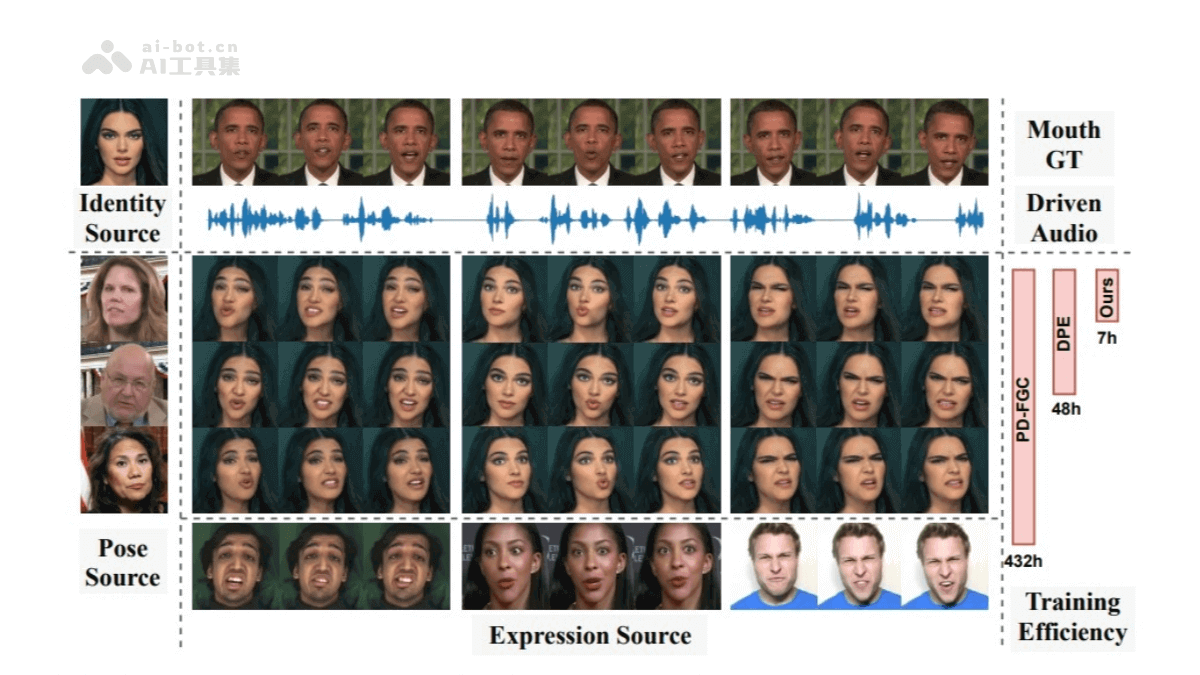
EDTalk's Main Features
- Audio-driven lip synchronization: EDTalk can drive the person in an uploaded image to speak based on the image and audio, achieving lip synchronization.
- Custom emotional expression: EDTalk supports custom emotions such as happiness, anger, sadness, and more, with the facial expressions in the synthesized video highly consistent with the audio's emotional tone.
- Audio-to-Motion module: EDTalk's Audio-to-Motion module can automatically generate lip movements synchronized with the audio rhythm and context-appropriate expressions based on audio input.
- Supports video and audio input: EDTalk can achieve precise emotional talking head generation with video and audio input.
EDTalk's Technical Principles
- Efficient decoupled framework: EDTalk decomposes facial dynamics into three different latent spaces through three lightweight modules, representing mouth shape, head pose, and emotional expression respectively. This decoupling technique allows independent control of these facial actions without mutual interference.
- Learnable basis vector representation: Each latent space is represented by a set of learnable basis vectors, and the linear combinations of these basis vectors define specific actions. This design enables EDTalk to flexibly synthesize talking head videos with specific mouth shapes, head poses, and expressions.
- Orthogonality and efficient training strategy: To ensure independence and accelerate training, EDTalk enforces orthogonality between basis vectors and designs an efficient training strategy that assigns action responsibility to each space without relying on external knowledge.
EDTalk's Project Address
- Project Website:https://tanshuai0219.github.io/EDTalk/
- Github Repository:https://github.com/tanshuai0219/EDTalk
- arXiv Technical Paper:https://arxiv.org/pdf/2404.01647
EDTalk's Application Scenarios
- Personalized customization of personal digital assistants: EDTalk can be used to create personalized digital assistants, enhancing the interaction experience by synthesizing dynamic facial videos that match the user's voice.
- Film and television post-production: In film and television production, EDTalk can be used for character dialogue synthesis, generating mouth shapes and expressions that match the character's emotions through audio-driven generation, enhancing character expressiveness.
- Development of interactive teaching assistants for educational software: EDTalk can be applied in educational software to create interactive teaching assistants, enhancing the learning experience through emotional expression.
- Remote communication: In the field of remote communication, EDTalk can provide more realistic and emotionally resonant video communication experiences, improving communication effectiveness.
- Virtual reality interaction: In a virtual reality environment, EDTalk can be used to generate virtual characters with emotional expression, enhancing the user's sense of immersion.