
What is Edicho
Edicho is an image editing method based on diffusion models, launched by the Hong Kong University of Science and Technology, Ant Group, Stanford University, and the Chinese University of Hong Kong, capable of achieving consistent editing across multiple images. Edicho uses a training-free approach and can be applied without additional training. The core of Edicho lies in using explicit image correspondences to guide the editing process, based on the Attention Operation Module (Corr-Attention) and the Classifier-Free Guidance (CFG) denoising strategy, ensuring that edits remain consistent across different images. Corr-Attention leverages explicit correspondences to enhance the self-attention mechanism, effectively transferring features from the source image to the target image. Corr-CFG is based on a modified CFG computation, combined with precomputed correspondences, to guide the generation process closer to the desired edit while maintaining high image quality.
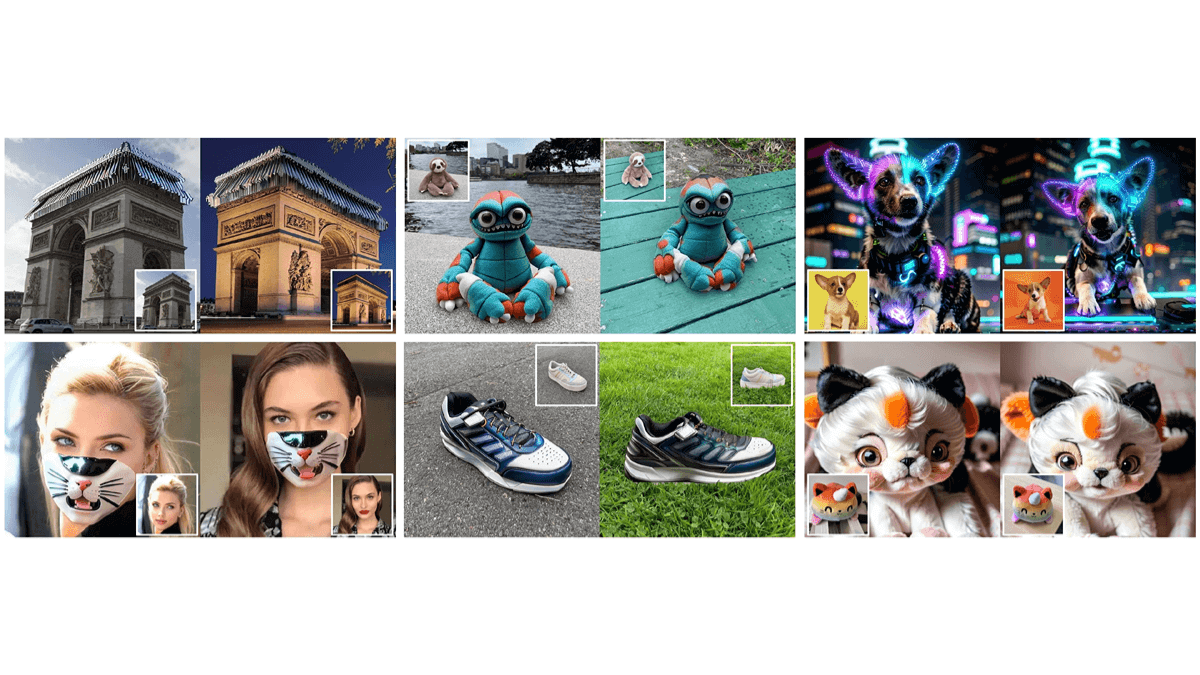
Main Features of Edicho
- Consistent Image Editing: Achieves consistent editing across multiple images, including local editing (such as image inpainting) and global editing (such as image style transfer), ensuring that editing results remain highly coordinated across various scenarios.
- Plug-and-Play Compatibility: As an inference-time algorithm, it can seamlessly integrate with most diffusion-based editing methods (such as ControlNet and BrushNet), requiring no additional training data and can be directly applied to practical tasks.
- Broad Task Applicability: Suitable for image editing, and can also be extended to more fields such as personalized content creation, 3D reconstruction, and consistent texture application, expanding the scope of application of editing tools.
Technical Principles of Edicho
- Explicit Image Correspondence Guidance: Guides the editing process based on explicit image correspondences, avoiding the limitations of traditional implicit correspondence methods. It uses pretrained correspondence extractors (such as DIFT and Dust3R) to extract robust correspondences from input images, and then injects the precomputed explicit correspondences into the denoising process of the diffusion model to ensure editing consistency.
- Attention Operation Module (Corr-Attention): Enhances the attention mechanism by guiding feature transfer based on correspondences between images. In the self-attention module, query features are transformed according to explicit correspondences, borrowing relevant features from the source image to form a new query matrix, achieving editing consistency during the denoising process.
- Optimized Classifier-Free Guidance (CFG) Denoising Strategy (Corr-CFG): Combines precomputed correspondences to maintain high quality and consistency during the editing process. It modifies the computation method of CFG, manipulating the unconditional branch in the CFG framework under the guidance of correspondences, fusing unconditional embedding features to further enhance consistency effects, while preserving the integrity of the powerful generative priors of the pretrained model.
Edicho Project Address
- Project Website:https://ezioby.github.io/edicho
- GitHub Repository:https://github.com/EzioBy/edicho
- arXiv Technical Paper:https://arxiv.org/pdf/2412.21079
Application Scenarios of Edicho
- Product Marketing: Sellers on e-commerce platforms can perform consistent editing on product images taken from different angles to improve click-through rates and conversion rates.
- Themed Events: During Christmas, users can edit multiple family photos into images with a Christmas style and share them on social media to enjoy with family and friends.
- Personalized Content Generation: Users can edit multiple personal photos into avatars with a unified style according to their preferences, for use on different social media platforms.
- Virtual Reality: In game development, designers perform consistent editing on multiple design sketches of virtual characters to improve the completeness and recognizability of the character image.
- Medical imaging dataset augmentation: In the field of medical imaging analysis, perform consistent editing on images in medical imaging datasets to improve the training effectiveness of medical imaging recognition models.