
What is EcomBench
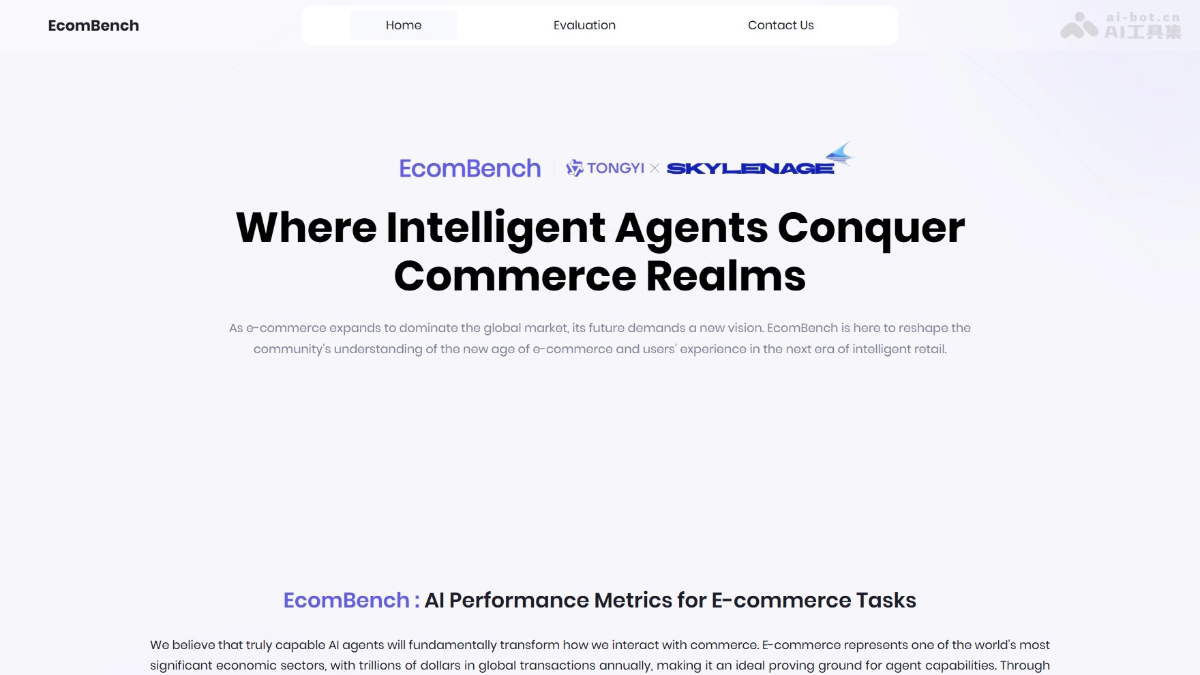
EcomBench is an AI capability evaluation benchmark for e-commerce scenarios launched by the Tongyi Lab in collaboration with SKYLENAGE. Built on real-world data, EcomBench covers seven major categories of e-commerce tasks, including policy consultation, cost estimation, and product selection decisions, comprehensively measuring agents' overall capabilities in e-commerce environments. EcomBench can effectively evaluate the actual performance of AI assistants in complex business scenarios, provide direction for model optimization, and drive e-commerce AI toward greater intelligence and reliability.
Main features of EcomBench
-
Comprehensive capability evaluation: Covers seven major categories of typical tasks in e-commerce operations, such as policy compliance, cost and pricing, fulfillment execution, marketing strategy, intelligent product selection, business opportunity discovery, and inventory management, ensuring a multi-dimensional evaluation of AI assistants' overall capabilities.
-
Realistic scenario simulation: Built from real user questions and business requests on major global e-commerce platforms, every evaluation task is derived from real-world scenarios and truly reflects the actual needs of e-commerce practitioners.
-
Difficulty grading: Sets three levels of task difficulty, from basic common sense to complex reasoning, clearly depicting the model's capability boundaries and helping developers understand the strengths and weaknesses of AI assistants.
-
Dynamic updates: Adopts a quarterly update mechanism to promptly incorporate the latest policies and regulations, market dynamics, and business hotspots, ensuring the timeliness and challenge of evaluation tasks.
-
Professional annotation and verification: Through a rigorous human-machine combined process, including question screening, polishing and rewriting, and expert annotation verification, it ensures high data quality and answer accuracy.
Technical principles of EcomBench
- Data collection and screening: Collects data from real user interactions on major global e-commerce platforms (such as Amazon), ensuring the authenticity and diversity of the data. Uses large language models to perform preliminary screening of massive user questions, eliminating subjective, open-ended, or unsolvable requests, and retaining representative questions with clear answers.
- Question optimization and annotation: Experienced e-commerce experts manually polish the screened data to ensure clear question wording, complete context, and clear objectives. Each question is independently annotated by at least three experts for cross-validation, and questions with inconsistent answers are eliminated, ensuring data accuracy and reliability.
- Task design and grading: Divides questions into seven major categories of e-commerce tasks, covering all key aspects of e-commerce operations. Based on task complexity, questions are divided into three difficulty levels, and high-difficulty tasks are screened through the "tool capability hierarchy," ensuring that level-three tasks are sufficiently challenging.
- Dynamic update mechanism: Iterates the question bank every three months, promptly incorporating the latest policies and regulations, market dynamics, and business hotspots, maintaining the benchmark's timeliness and challenge.
- Evaluation and feedback: Through multiple task types and difficulty levels, comprehensively evaluates AI assistants' information integration, logical reasoning, rule application, and decision-making coherence in e-commerce scenarios. Provides developers with detailed evaluation reports to help them understand the model's shortcomings and provide clear direction for subsequent optimization.
Project address of EcomBench
- Project official website:https://ecombench.ai/
- HuggingFace model library:https://huggingface.co/datasets/Alibaba-NLP/EcomBench
- arXiv technical paper:https://arxiv.org/pdf/2512.08868
Application scenarios of EcomBench
-
AI assistant capability evaluation: Provide standardized evaluation tools for developers and enterprises, accurately identifying the strengths and weaknesses of AI assistants in e-commerce scenarios, and supporting optimization and selection.
-
E-commerce Operations Optimization: Through functions such as policy compliance, cost pricing, and intelligent product selection, help e-commerce enterprises optimize operational processes and improve decision-making efficiency and profitability.
-
E-commerce Education and Training: As a teaching resource, provide practical cases for practitioners and developers, and promote the popularization of e-commerce AI knowledge and skills training.
-
Industry Standard Formulation: Set capability standards for e-commerce AI assistants, standardize the industry evaluation system, and promote best practice cases.
-
Market Dynamics Monitoring: The quarterly update mechanism promptly reflects policies, regulations, and market trends, helping enterprises and developers quickly adapt to market changes.