
What is EchoMimicV3
EchoMimicV3 is an efficient multimodal, multitaskdigital human video generationframework launched by Ant Group. The framework has 1.3 billion parameters and is based on a task-mixing and modality-mixing paradigm, combined with novel training and inference strategies, to achieve fast, high-quality, and highly generalizable digital human video generation. EchoMimicV3 is based on multitask masked input and a counterintuitive task allocation strategy, as well as a coupled-decoupled multimodal cross-attention module and a timestep phase-aware multimodal allocation mechanism, enabling the model to perform excellently across multiple tasks and modalities with only 1.3 billion parameters, bringing a major breakthrough to the field of digital human animation.
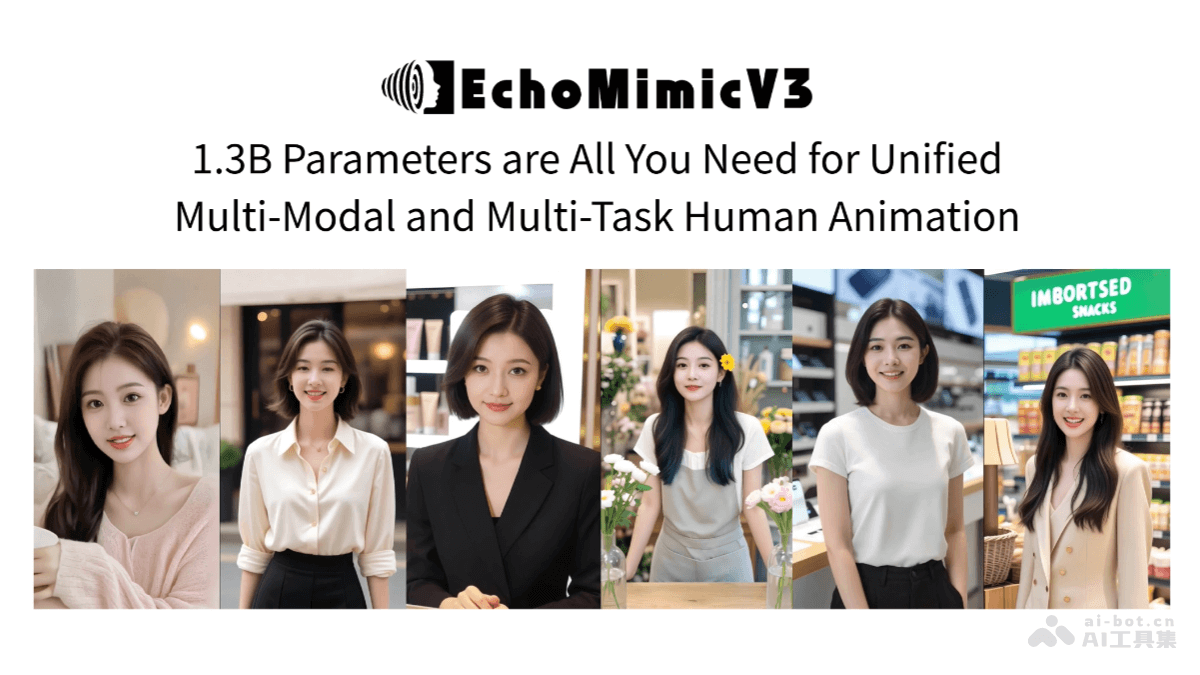
Main Features of EchoMimicV3
- Multimodal Input Support: The model can process inputs from multiple modalities, including audio, text, images, etc., enabling richer and more natural human animation generation.
- Unified Multitask Framework: Integrates multiple tasks into one model, such as audio-driven facial animation, text-to-motion generation, image-driven pose prediction, etc.
- Efficient Inference and Training: While maintaining high performance, it achieves efficient model training and fast animation generation based on optimized training strategies and inference mechanisms.
- High-Quality Animation Generation: Supports the generation of high-quality, natural, and smooth digital human animations. The animations generated by the framework perform excellently in detail and coherence, and can meet the needs of various application scenarios.
- Strong Generalization Ability: The model has good generalization ability and can adapt to different input conditions and task requirements.
Technical Principles of EchoMimicV3
- Soup-of-Tasks Paradigm: EchoMimicV3 uses multitask masked input and a counterintuitive task allocation strategy. The model can learn multiple tasks simultaneously during training, achieving multitask gains without the pain of multiple models.
- Soup-of-Modals Paradigm: Introduces a coupled-decoupled multimodal cross-attention module for injecting multimodal conditions. Combined with a timestep phase-aware multimodal allocation mechanism, it dynamically adjusts multimodal mixing.
- Negative Direct Preference Optimization and Phase-aware Negative Classifier-Free Guidance: Two techniques ensure the stability of the model during training and inference. Based on preference learning and guidance mechanisms in the optimized training process, the model can better handle complex inputs and task requirements, avoiding instability during training and degradation of generated results.
- Transformer Architecture: EchoMimicV3 is built on the Transformer architecture, using powerful sequence modeling capabilities to process time-series data. The self-attention mechanism of the Transformer architecture enables the model to effectively capture long-range dependencies in input data, generating more natural and coherent animations.
- Large-Scale Pretraining and Fine-Tuning: The model learns general feature representations and knowledge through pretraining on large-scale datasets. It is fine-tuned on specific tasks to adapt to specific animation generation needs. The pretraining plus fine-tuning strategy enables the model to fully utilize large amounts of unsupervised data and improve the model's generalization ability and performance.
EchoMimicV3 Project Address
- Project Website:https://antgroup.github.io/ai/echomimic_v3/
- GitHub Repository:https://github.com/antgroup/echomimic_v3
- HuggingFace Model Library:https://huggingface.co/BadToBest/EchoMimicV3
- arXiv Technical Paper:https://arxiv.org/pdf/2507.03905
Application scenarios of EchoMimicV3
- Virtual character animation: In games, animated films, and virtual reality (VR), generate facial expressions and body movements of virtual characters based on audio, text, or images, making the characters more vivid and realistic and enhancing immersion.
- Special effects production: In film and television special effects, quickly generate high-quality dynamic facial expressions and body movements of characters, reducing the time and cost of manual modeling and animation production and improving production efficiency.
- Virtual spokespersons: In advertising and marketing, create virtual spokespersons and generate animation content that matches the brand image according to brand needs, for use in advertising and social media promotion to enhance brand influence.
- Virtual teachers: On online education platforms, generate animations of virtual teachers and present corresponding expressions and movements according to teaching content and voice explanations, making the teaching process more vivid and interesting and increasing students' interest in learning.
- Virtual social interaction: On social platforms, users generate their own virtual avatars, and expressions and movements are generated in real time based on voice or text input, enhancing the interactivity and fun of social interaction.