
What is DynVFX
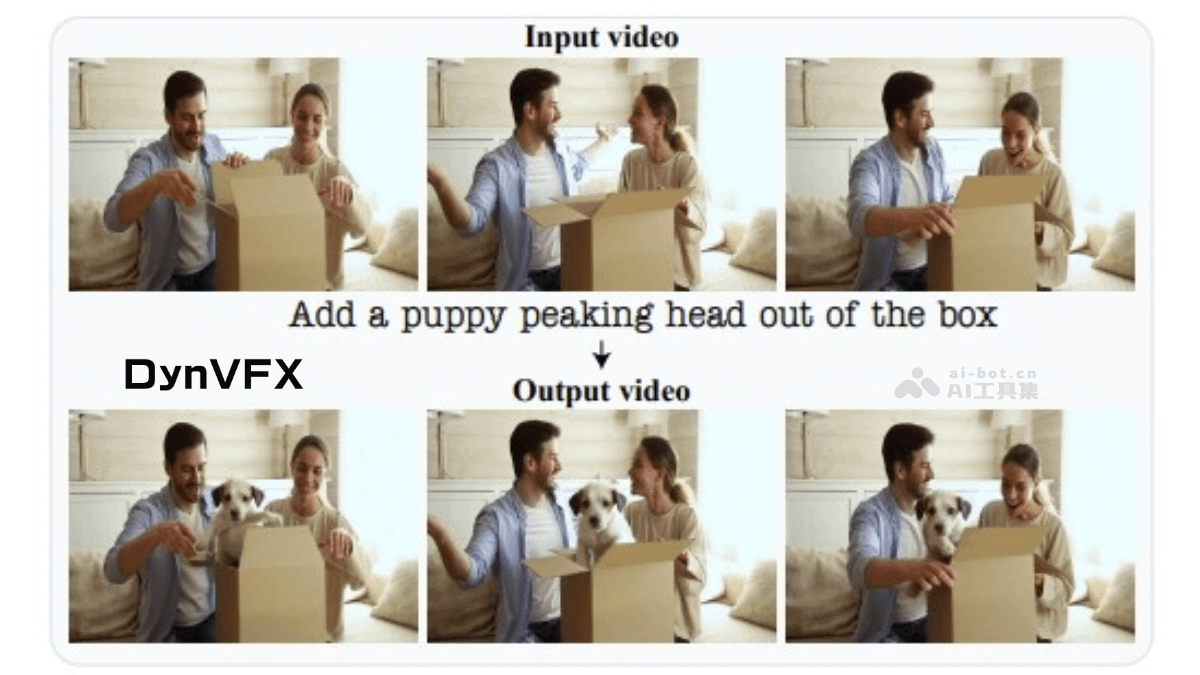
DynVFX is an innovative video enhancement technology that can seamlessly integrate dynamic content into real videos based on simple text instructions. By combining pre-trained text-to-video diffusion models and vision-language models (VLMs), it naturally blends new dynamic elements with the original video scene without relying on complex user input. Users only need to provide a brief text instruction, such as "add a dolphin swimming in the water," and DynVFX automatically parses the instruction, generates a detailed scene description based on the VLM, precisely locates the position of the new content through the Anchor Extended Attention mechanism, and ensures pixel-level alignment and natural integration of the new content with the original video through iterative refinement.
Main Features of DynVFX
- Natural Integration of New Dynamic Elements: DynVFX can naturally integrate newly generated dynamic content into the original video scene based on user-provided text instructions (such as "add a whale flying in the sky"). The position, appearance, and motion of the new content remain consistent with the camera motion, occlusions, and interactions with other dynamic objects in the original video, generating coherent and realistic output videos.
- Automated Content Generation and Localization: Automated operation is achieved through pre-trained text-to-video diffusion models and vision-language models (VLMs). The VLM acts as a "VFX assistant," capable of understanding user instructions and generating detailed scene descriptions to guide the generation of new content. DynVFX precisely locates the position of the new content based on the Anchor Extended Attention mechanism, aligning it with the spatial and dynamic features of the original scene.
- Pixel-Level Alignment and Content Integration: Through an iterative refinement process, DynVFX gradually updates the residual latent representation of the new content, ensuring that the newly generated content perfectly aligns with the original video at the pixel level, avoiding unnatural transitions or misalignments.
- High-Fidelity Video Editing: While preserving the original video content, DynVFX can naturally add new dynamic elements, achieving high-fidelity video editing.
Technical Principles of DynVFX
- Pre-trained Text-to-Video Diffusion Models: DynVFX uses pre-trained text-to-video diffusion models (such as CogVideoX), which can generate video content based on text prompts. The diffusion model generates video by gradually removing noise. Specifically, the model starts from Gaussian noise and progressively generates clear video frames.
- Vision-Language Models (VLMs): Vision-language models (such as GPT-4o) are used as "VFX assistants," responsible for interpreting user text instructions and generating detailed scene descriptions. The VLM can describe the content of the original video and also provide guidance on how to naturally integrate new content into the scene.
- Anchor Extended Attention: To ensure accurate localization of newly generated content, DynVFX introduces the Anchor Extended Attention mechanism. By extracting keys and values from specific positions in the original video and using them as anchors, it guides the generation of new content. This helps the model understand how the new content should align with the spatial and dynamic features of the original scene, achieving natural integration.
- Iterative Refinement: To further improve the integration of new content with the original video, DynVFX adopts an iterative refinement method. Specifically, the model updates the residual latent representation through multiple iterations, gradually reducing the noise level. Each iteration adjusts the details of the new content to better align with the original video, achieving pixel-level precise integration.
- Residual Estimation and Update: DynVFX adjusts the difference between new content and the original video by estimating a residual. The residual represents the difference between the newly generated content and the original video. By iteratively updating the residual, the model can gradually optimize the generation of new content and seamlessly blend it with the original video.
- Zero-Shot, No Fine-Tuning Required: DynVFX adopts a zero-shot approach and requires no additional fine-tuning or training of pretrained text-to-video models. Users only need to provide simple text instructions to achieve high-quality video editing.
- Automated Evaluation: To evaluate the quality of generated videos, DynVFX introduces VLM-based automated evaluation metrics. The metrics assess the quality of generated videos from multiple aspects, including the preservation of original content, the blending of new content, overall visual quality, and dynamic effects.
DynVFX Project Address
- Project Website:https://dynvfx.github.io/
- arXiv Technical Paper:https://arxiv.org/pdf/2502.03621
DynVFX Application Scenarios
- Video Special Effects Production: Quickly add special effects such as flames, water flows, and magical effects to video content such as movies, TV dramas, and advertisements.
- Content Creation: Help creators add creative elements to existing videos, enhancing the appeal and fun of the videos.
- Education and Training: Add dynamic annotations or demonstration effects to educational videos to enhance the learning experience.