
What is DUSt3R
DUSt3R (Dense and Unconstrained Stereo 3D Reconstruction) is a 3D reconstruction framework launched by researchers from Aalto University in Finland and Naver Labs Europe, designed to simplify the process of reconstructing 3D scenes from arbitrary image collections without prior knowledge of camera calibration or viewpoint positions. The method treats the pairwise reconstruction problem as a pointmap regression problem, relaxing the constraints of traditional projective camera models, and also introduces a global alignment strategy to handle multiple image pairs.
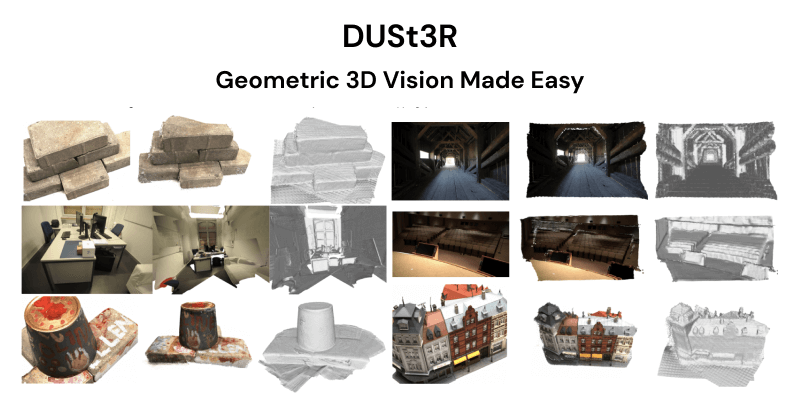
DUSt3R Official Website Entry
- Official project homepage:https://dust3r.europe.naverlabs.com/
- GitHub codebase:https://github.com/naver/dust3r
- arXiv research paper:https://arxiv.org/abs/2312.14132
Main Features of DUSt3R
- Fast 3D Reconstruction: DUSt3R can reconstruct a 3D model from input images in an extremely short time (less than 2 seconds), which is very useful for real-time applications or rapid prototyping.
- No Camera Calibration Required: Unlike traditional 3D reconstruction techniques, DUSt3R does not require any prior information about camera calibration or viewpoint poses. This means users do not need to perform complex setups; they only need to provide images.
- Multi-View Stereo Reconstruction (MVS): DUSt3R can handle multi-view stereo reconstruction tasks. Even when more than two input images are provided, it can effectively represent all pairwise pointmaps in a common reference frame.
- Monocular and Binocular Reconstruction: DUSt3R unifies monocular and binocular reconstruction cases, meaning 3D reconstruction can be performed using a single image or a pair of images.
- Generates Multiple Types of 3D Visual Maps: In addition to 3D reconstruction, DUSt3R can generate depth maps, which help understand the relative positions and distances of objects in the scene. Furthermore, DUSt3R can output confidence maps for evaluating the accuracy of reconstruction results, as well as point clouds for 3D modeling and visualization.
Technical Principles of DUSt3R
- Pointmaps: DUSt3R uses pointmaps as its core representation, which is a dense 2D field containing 3D point information. A pointmap provides a corresponding 3D point for each pixel, thereby establishing a direct correspondence between image pixels and 3D scene points.
- Transformer Network Architecture: DUSt3R builds its network architecture based on standard Transformer encoders and decoders. This architecture allows the model to leverage powerful pre-trained models, thereby learning rich geometric and appearance information from input images without explicit geometric constraints.
- End-to-End Training: DUSt3R is trained in an end-to-end manner, enabling it to directly learn pointmaps from image pairs without the need for complex multi-step processing, such as feature matching, triangulation, etc.
- Global Alignment Strategy: When processing more than two images, DUSt3R proposes a global alignment strategy that can express all pairwise pointmaps in a common reference frame. It can handle multiple image pairs, which is particularly important for multi-view 3D reconstruction.
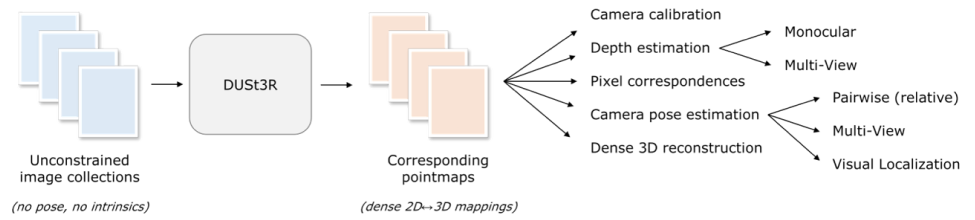
- Multi-Task Learning: DUSt3R can simultaneously learn multiple related tasks during training, such as depth estimation, camera parameter estimation, pixel correspondence, etc. This multi-task learning strategy enables the model to more comprehensively understand the geometric structure of the scene.