
What is DriveDreamer4D
DriveDreamer4D is a framework for improving the quality of 4D reconstruction of autonomous driving scenes, enhancing the representation of 4D driving scenes based on world model priors. The framework can synthesize new trajectory videos based on real-world driving data, using explicit structured conditions to control the spatiotemporal consistency of foreground and background elements, ensuring that the generated data strictly adheres to traffic constraints. DriveDreamer4D is the first framework based on video generation models to improve 4D reconstruction in driving scenes, enhancing rendering quality in complex scenarios and under new trajectory viewpoints.
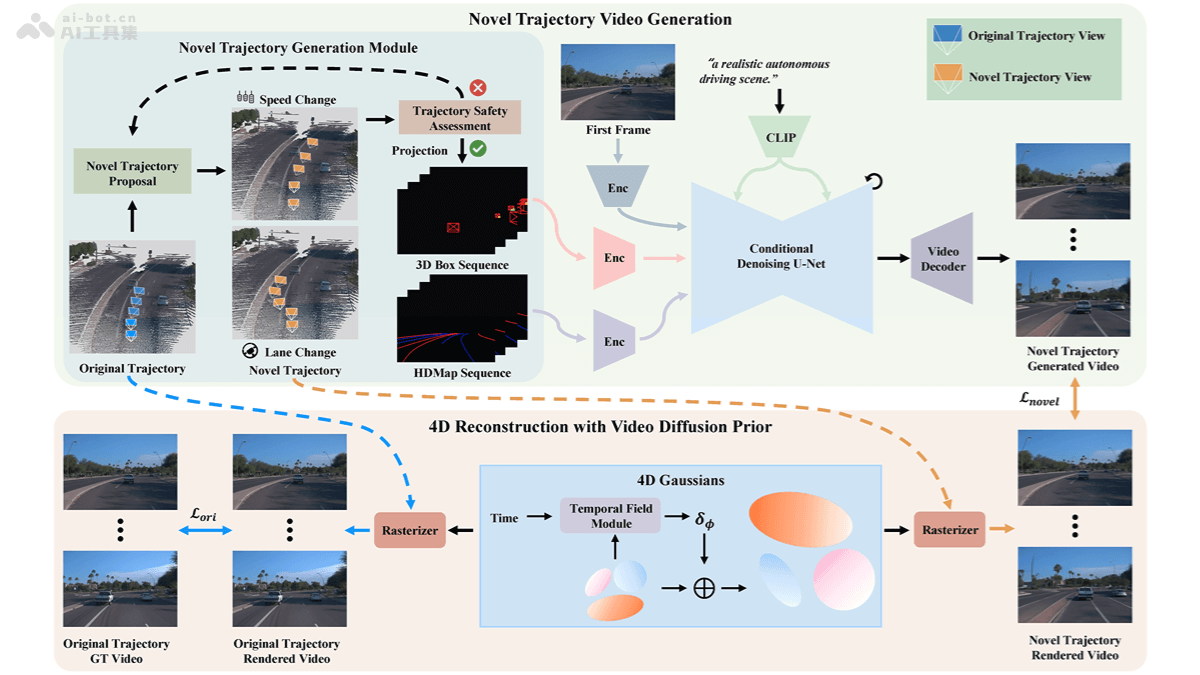
Main Features of DriveDreamer4D
- 4D Scene Reconstruction: DriveDreamer4D can reconstruct complex dynamic driving environments and provide detailed representations of 4D (3D space + time) driving scenes.
- New Trajectory Video Synthesis: Based on world models as data machines, it synthesizes new trajectory videos from real-world driving data to enhance the training dataset.
- Spatiotemporal Consistency Control: It controls the spatiotemporal consistency of foreground and background elements through structured conditions, ensuring that the synthesized data complies with traffic rules and the complexity of dynamic driving environments.
- Improved Rendering Quality: Under new trajectory viewpoints, it improves rendering quality, especially in complex maneuvers such as lane changes, acceleration, and deceleration.
- Enhanced Data Diversity: It automatically generates new trajectory videos with complex maneuvers, increasing data diversity and improving the evaluation of end-to-end autonomous driving systems.
- Closed-Loop Simulation Support: It provides a foundation for closed-loop simulation that requires high-fidelity reconstruction of dynamic driving scenes.
Technical Principles of DriveDreamer4D
- World Model Integration: DriveDreamer4D integrates autonomous driving world models and uses the models as a generation engine to synthesize new trajectory video data.
- New Trajectory Generation Module (NTGM): It proposes NTGM to automatically generate diverse structured traffic conditions, enabling DriveDreamer4D to produce new trajectory videos containing complex maneuvers.
- Spatiotemporal Constraint Synchronization: It synchronizes view projections based on vehicle maneuvers to ensure that the synthesized data strictly adheres to the spatiotemporal constraints of 4D driving scenes.
- 4D Gaussian Representation: It uses 4D Gaussian representation (4DGS) to model driving scenes, where each Gaussian component is controlled by a center position, opacity, covariance matrix, and view-dependent RGB color.
- Differentiable Rendering: It uses a differentiable Gaussian splatting renderer to project 4D Gaussians into the camera coordinate system and compute the color of each pixel.
Project Address of DriveDreamer4D
- Project Website:drivedreamer4d.github.io
- GitHub Repository:https://github.com/GigaAI-research/DriveDreamer4D
- arXiv Technical Paper:https://arxiv.org/pdf/2410.13571
Application Scenarios of DriveDreamer4D
- Autonomous Driving System Development: It is used to develop and test end-to-end planning algorithms for autonomous vehicles, evaluating algorithm performance based on simulated complex real-world driving scenarios.
- Closed-Loop Simulation Testing: In a closed-loop simulation environment, it simulates various driving maneuvers and traffic situations to test the reaction and handling capabilities of autonomous vehicles under different conditions.
- Dataset Augmentation: It uses synthesized new trajectory videos to expand and enrich the training dataset, enhancing the adaptability and robustness of autonomous driving systems to diverse scenarios.
- Complex Maneuver Simulation: Simulate complex driving operations such as lane changes, acceleration, and deceleration to provide a more comprehensive testing environment for autonomous driving systems.
- Sensor Data Simulation: Simulate various sensor data, such as camera, radar, and LiDAR data, for use in sensor fusion and processing in autonomous driving systems.