
What is DreaMoving
DreaMoving is a diffusion model-based human video generation framework developed by the research team at Alibaba Group. DreaMoving achieves precise control over character motion and appearance through a Video ControlNet and a Content Guider, enabling users to generate personalized video content through simple text descriptions or image prompts. The goal of this framework is to generate high-quality customized human videos, especially the ability to generate videos of a target identity moving or dancing based on a given target identity and pose sequence.
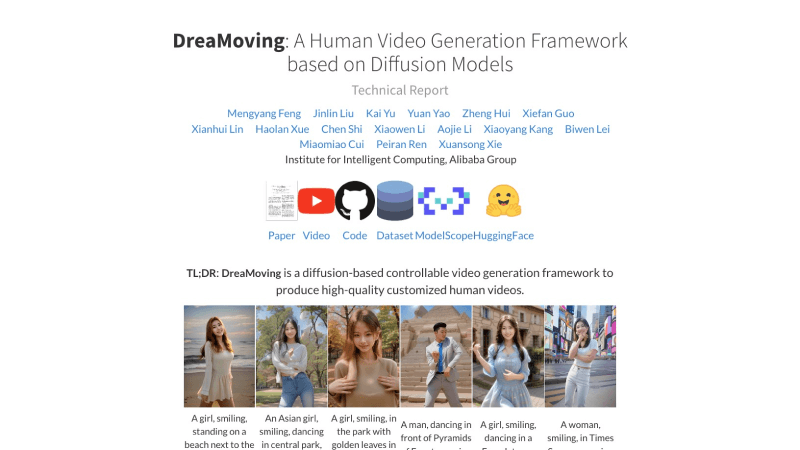
DreaMoving Official Website Entry
- Official Project Homepage:https://dreamoving.github.io/dreamoving/
- arXiv Research Paper:https://arxiv.org/abs/2312.05107
- GitHub Address:https://github.com/dreamoving/dreamoving-project
- ModelScope Community:https://www.modelscope.cn/studios/vigen/video_generation/summary
- Hugging Face Demo:https://huggingface.co/spaces/jiayong/Dreamoving
DreaMoving's Features
- Customized Video Generation: DreaMoving can generate videos of a character moving or dancing based on the target identity and pose sequence provided by the user, meeting the production needs of personalized video content.
- High Controllability: Through the Video ControlNet, DreaMoving can precisely control the motion details of the character in the video, ensuring that the generated video has high temporal consistency and motion realism.
- Identity Preservation: Utilizing the Content Guider, the framework can preserve the identity features of the character in the video, such as the face and clothing, ensuring that the generated video highly matches the target identity.
- Diverse Input Methods: Users can guide video generation through text prompts, image prompts, or a combination of both, providing flexible creative methods.
- Easy to Use and Adapt: DreaMoving is designed to be simple and easy to operate, and can be adapted to various stylized diffusion models to generate video results in diverse styles.
DreaMoving's Technical Architecture
DreaMoving's architecture is built on the Stable Diffusion model and mainly consists of three core parts, each undertaking different functions and tasks, working together to achieve high-quality human video generation.
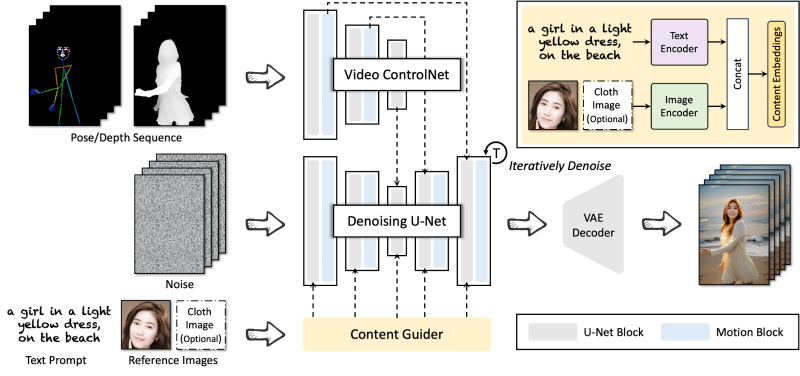
- Denoising U-Net: As the base network of DreaMoving, it is responsible for the video generation process. The Denoising U-Net gradually recovers clear video frames from noise through iterative denoising. After each U-Net block, a Motion Block is inserted to enhance the temporal consistency and motion realism of the video.
- Video ControlNet: This network is specifically responsible for controlling the motion of the character in the video. It serves as a plug-in module, used in combination with the Denoising U-Net, to control the character's actions by processing pose or depth sequences. Video ControlNet enables the generated video to exhibit precise motion patterns according to the input control sequence.
- Content Guider: The purpose of the Content Guider is to preserve the identity features of the character in the video, such as the face and clothing. It uses an image encoder to precisely guide the character's appearance, while combining text prompts to generate background content. The Content Guider combines the input text prompts and image features through a cross-attention mechanism to generate video content with specific identity features.
These three networks work together, enabling DreaMoving to generate high-quality human videos that possess both personalized identity features and precise motion control. In addition, DreaMoving's architectural design makes it easy to use and adapt, allowing it to be combined with a variety of stylized diffusion models to produce diverse video generation results.
Application scenarios of DreaMoving
- Film and television production: In film and television production, DreaMoving can be used to create complex action scenes, especially when specific character performances or dance movements are required. It can help production teams quickly generate high-quality video content under limited budget and time constraints.
- Game development: Game designers can use DreaMoving to generate realistic character animations, providing players with a richer and more authentic gaming experience. This is especially important in role-playing games or action games, where it can enhance the sense of immersion.
- Personalized video creation: Content creators can use DreaMoving to produce personalized videos, such as dance challenges on social media, impersonation shows, or other creative videos. Users can quickly generate video content with personal characteristics through simple text or image input.
- Advertising and marketing: Marketers can use DreaMoving to create attractive advertising videos, attracting target audiences through customized character movements and scenes, and improving advertising reach and brand awareness.