
What is DreamOmni?
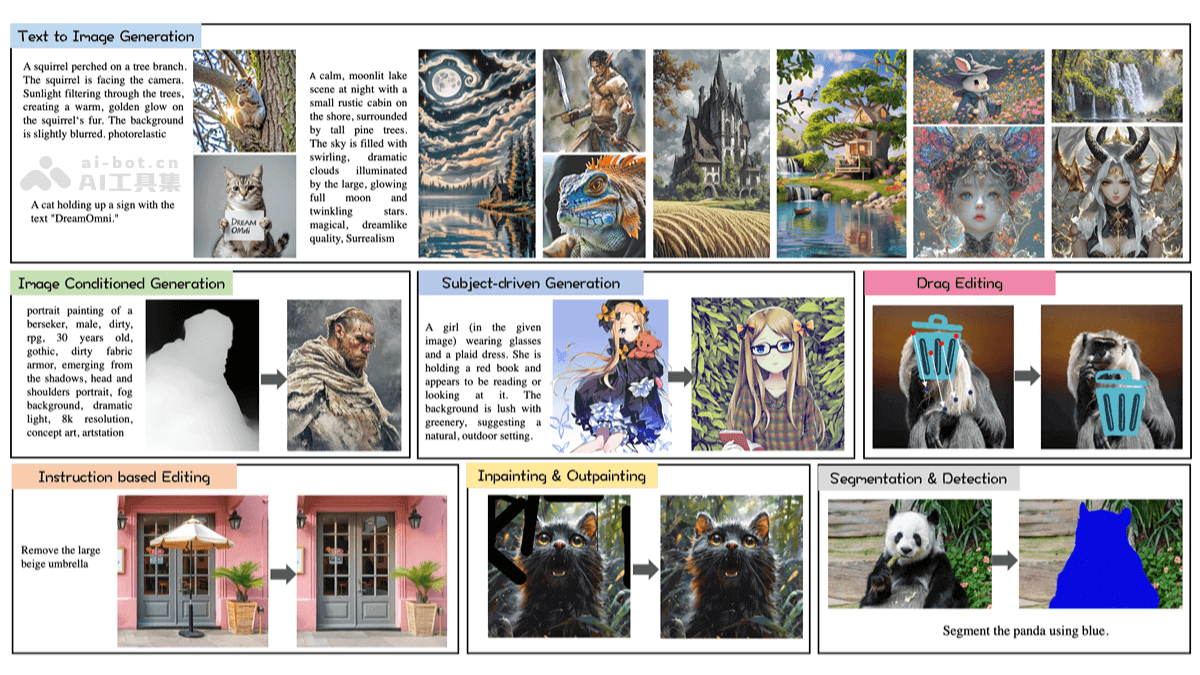
DreamOmni is a unified image generation and editing model jointly launched by The Chinese University of Hong Kong, ByteDance, and The Hong Kong University of Science and Technology. The model integrates text-to-image (T2I) generation and multiple editing tasks, including instruction-based editing, inpainting, drag-based editing, and reference image generation. DreamOmni is based on an efficient synthetic data pipeline to solve the challenge of creating high-quality editing data, supporting model training and scaling. Based on joint training of T2I and editing tasks, it strengthens understanding of concepts and improves image generation quality. In extensive experimental evaluations, DreamOmni demonstrates significant advantages in image generation and editing tasks with outstanding performance.
DreamOmni's Main Features
- Unified Image Generation and Editing: DreamOmni can handle text-to-image generation (T2I) as well as multiple image editing tasks, such as instruction-based editing, inpainting (e.g., inpainting and outpainting), drag-based editing, and reference image generation.
- Synthetic Data Pipeline: Using sticker-like elements, it efficiently and accurately synthesizes large-scale, high-quality editing data, supporting the training of a unified model.
- Joint Training: Combining T2I data and data from various editing tasks for training, it enhances the model's understanding of specific concepts, improves generation quality, and strengthens editing performance.
- Multi-Task Support: The model can understand and execute operations such as adding, removing, and replacing, as well as handle image translation, rotation, and scaling editing tasks.
DreamOmni's Technical Principles
- Framework Design: Integrating the T2I model with various editing tasks to achieve multi-task learning.
- Vision-Language Model (VLM): Based on VLM, it uniformly encodes visual and language prompts, combining the encoded prompts with noisy latent representations to achieve joint computation.
- Synthetic Data Generation: Based on a synthetic collage data pipeline, DreamOmni can create precise editing data, supporting add, delete, and replace operations, as well as drag-based editing and reference image generation.
- Multimodal Input Compatibility: The framework design is simple and compatible with multimodal inputs, enabling DreamOmni to handle complex prompts and image conditions.
- Training Strategy: DreamOmni adopts a phased training strategy, progressively training from low resolution to high resolution, optimizing model performance and training efficiency.
- Optimization Techniques: Using techniques such as Rectified Flow to optimize the model, performing the forward process between noise and data via linear interpolation, improving generation quality and efficiency.
DreamOmni's Project Address
- Project Website:zj-binxia.github.io/DreamOmni-ProjectPage
- arXiv Technical Paper:https://arxiv.org/pdf/2412.17098
DreamOmni's Application Scenarios
- Digital Art Creation: Artists and designers generate or edit images, quickly transforming creative concepts into visual works.
- Game Development: Game developers create game assets, such as characters, environments, and props, or edit existing game elements.
- Film and Entertainment Industry: Generate special effect backgrounds or edit existing scene images in film production, saving cost and time.
- Advertising and Marketing: Marketers quickly generate attractive advertising images and marketing materials, adapting to different advertising channels.
- Education and Training: In the field of education, it is used to create teaching materials, such as diagrams and simulated scenarios, to enhance the learning experience.