
What Is DreamGen
DreamGen is an innovative robot learning technology introduced by NVIDIA, based on an AI video world model to generate synthetic data, allowing robots to learn new skills in dreams. DreamGen requires only a small amount of real video data and can generate large-scale realistic training data, enabling behavior generalization and environment generalization for robots in new environments. DreamGen's four-step process includes fine-tuning a video world model, generating virtual data, extracting virtual actions, and training downstream policies. DreamGen allows robots to complete complex tasks based on text instructions without the support of real-world data, significantly improving learning efficiency and generalization ability.
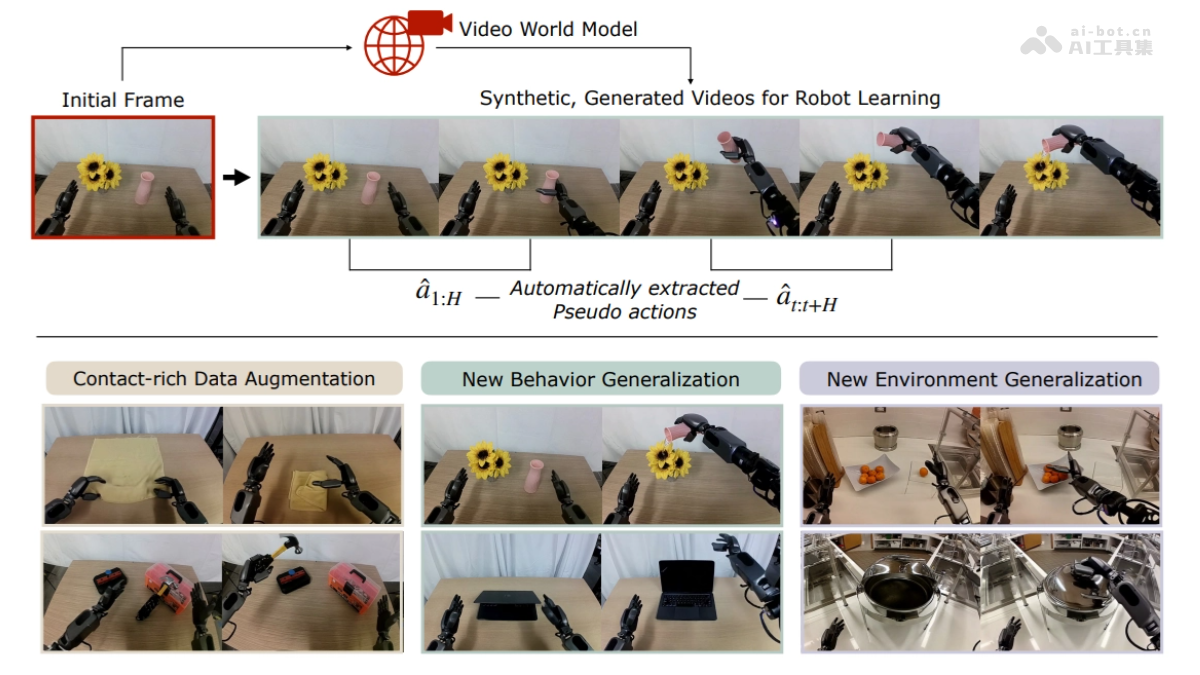
DreamGen's Main Features
- Behavior Generalization: Allows robots to learn and execute new behaviors without collecting large amounts of real-world data for each new behavior.
- Environment Generalization: Allows robots to execute tasks in unseen environments. Based on data collected in a single environment, robots can successfully execute tasks in multiple new environments.
- Data Augmentation: Generates large-scale synthetic training data to improve the success rate of robots in complex tasks.
- Multi-Robot System Support: Supports a variety of robot systems (such as Franka, SO-100, etc.) and different policy architectures (such as Diffusion Policy, GR00T N1, etc.), with broad applicability.
DreamGen's Technical Principles
- Fine-Tuning the Video World Model: Uses teleoperation trajectory data from the target robot to fine-tune the video world model (such as Sora, Veo, etc.), capturing the robot's kinematic and dynamic characteristics. Based on low-rank adaptation (LoRA) technology, it reduces the model's forgetting of the original data and adapts to new robot characteristics.
- Virtual Data Generation: Given an initial frame and a language instruction, the video world model generates a large number of robot video sequences describing the expected behavior. The videos include not only known behaviors, but also new behaviors in new environments. By filtering out "nightmare" videos that do not conform to the instructions, the quality of the generated data is ensured.
- Virtual Action Extraction: Uses a latent action model (LAPA) or inverse dynamics model (IDM) to parse the generated video sequences, extract pseudo-action sequences, and form neural trajectories. The pseudo-action sequences are used to train downstream visuomotor policies.
- Policy Training: Uses the generated video-action sequence pairs (i.e., neural trajectories) to train downstream visuomotor policies. Based on neural trajectories, robots learn new tasks without real-world data, achieving zero-shot generalization.
DreamGen's Project Address
- Project Website:https://research.nvidia.com/labs/gear/dreamgen/
- arXiv Technical Paper:https://arxiv.org/pdf/2505.12705
DreamGen's Application Scenarios
- Industrial Production: Helps robots quickly master complex tasks such as assembly and welding, improving production efficiency and quality.
- Home Services: Enables robots to adapt to different home environments and complete diverse household chores such as cleaning and organizing.
- Medical Care: Assists medical robots in precise operations, improving the efficiency and safety of medical procedures such as surgery and rehabilitation.
- Logistics and Warehousing: Helps robots efficiently handle the sorting and transportation of various items, optimizing logistics processes.
- Agricultural Production: Supports agricultural robots in completing tasks such as planting and harvesting in complex environments, increasing agricultural output.