
What is DreamFit
DreamFit is avirtual try-onframework launched by the ByteDance team in collaboration with Tsinghua University Shenzhen International Graduate School and Sun Yat-sen University Shenzhen Campus, specifically designed for lightweight clothing-centric human image generation. The framework can significantly reduce model complexity and training costs, and based on optimized text prompts and feature fusion, it improves the quality and consistency of generated images. DreamFit can generalize to various clothing, styles, and prompt instructions, generating high-quality human images. DreamFit supports seamless integration with community control plugins, lowering the barrier to use.
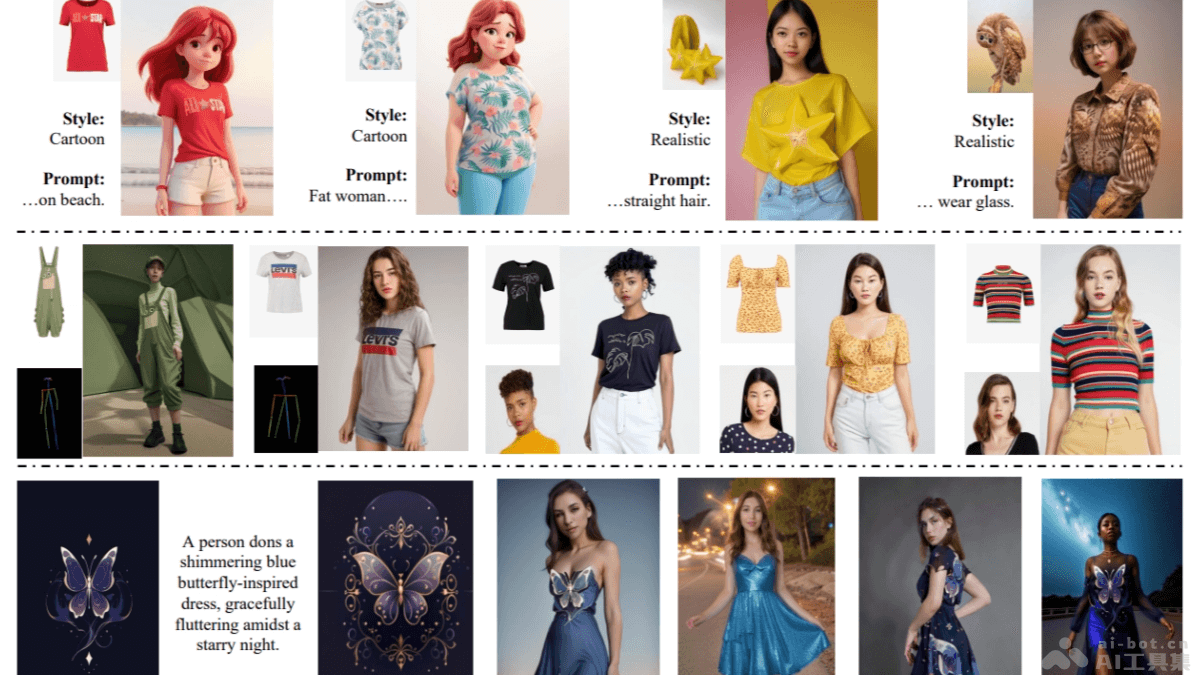
DreamFit's main features
- Plug-and-play: Easy to integrate with community control plugins, lowering the barrier to use.
- High-quality generation: Based on large multimodal models to enrich prompts, generating highly consistent images.
- Pose control: Supports specifying the subject's pose, generating images that match a specific pose.
- Multi-subject clothing transfer: Combines multiple clothing elements into a single image, suitable for scenarios such as e-commerce clothing display.
DreamFit's technical principles
- Lightweight encoder (Anything-Dressing Encoder): Based on LoRA layers, it extends a pretrained diffusion model (such as Stable Diffusion's UNet) into a lightweight clothing feature extractor. Only the LoRA layers are trained, rather than the entire UNet, greatly reducing model complexity and training costs.
- Adaptive Attention: Introduces two trainable linear projection layers to align reference image features with latent noise. Based on the adaptive attention mechanism, reference image features are seamlessly injected into the UNet, ensuring that the generated images are highly consistent with the reference images.
- Pretrained multimodal models (LMMs): During the inference stage, LMMs are used to rewrite the user's input text prompts, adding fine-grained descriptions of the reference images and reducing the difference between text prompts in the training and inference stages.
DreamFit's project address
- GitHub repository:https://github.com/bytedance/DreamFit
- arXiv technical paper:https://arxiv.org/pdf/2412.17644
DreamFit's application scenarios
- Virtual try-on: Consumers can try on clothing virtually online, saving time and cost and improving the shopping experience.
- Clothing design: Designers can quickly generate clothing renderings, accelerating the design process and improving work efficiency.
- Personalized advertising: Generates customized ads based on user preferences, improving ad appeal and conversion rates.
- Virtual reality (VR)/augmented reality (AR): Provides virtual try-on experiences, enhancing user immersion and interactivity.
- Social media content creation: Generates personalized images to attract more attention and enhance the diversity and appeal of content.