
What is Dreamer 4
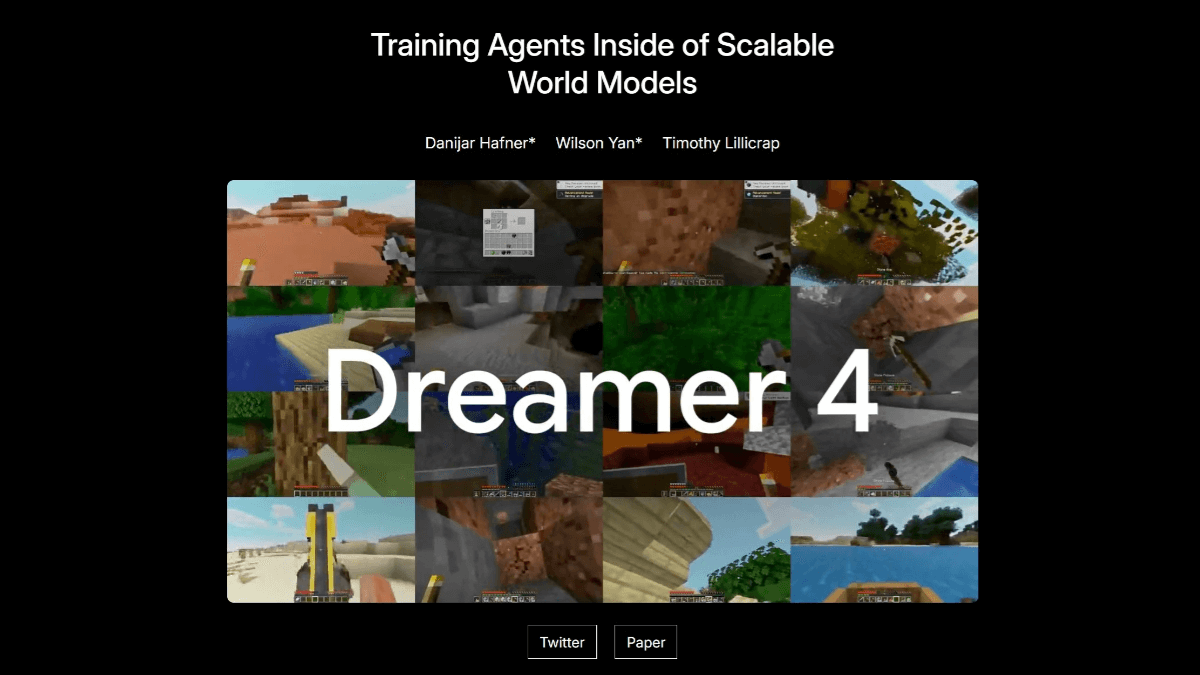
Dreamer 4 is a new type of agent developed by DeepMind that solves complex control tasks by training through imagination in a fast and accurate world model. In the game Minecraft, Dreamer 4 successfully obtained a diamond using only offline data, which is an important breakthrough in this field. By training behavior through reinforcement learning in a world model, online interaction with the environment is not required. In practical applications (such as robotics), it offers higher safety and efficiency, because online interaction may pose safety risks and be inefficient.
Dreamer 4's world model is based on an efficient Transformer architecture and a new shortcut forcing objective, and can achieve real-time interactive inference on a single GPU. It can learn general action conditioning from a small amount of data, and can absorb most of its knowledge from a large amount of unlabeled video.
Main features of Dreamer 4
-
Solving complex tasks through imagination training: Dreamer 4 performs reinforcement learning in its fast and accurate world model to solve complex control tasks without the need for online interaction with the environment. In the game Minecraft, this is demonstrated by successfully obtaining a diamond using only offline data, showcasing its powerful learning ability.
-
Efficient real-time interactive inference: Based on an efficient Transformer architecture and a new shortcut forcing objective, Dreamer 4's world model can achieve real-time interactive inference on a single GPU, offering higher efficiency and practicality in real-world applications, especially in scenarios that require rapid response.
-
Learning action conditioning from a small amount of data: Dreamer 4 can learn action conditioning from a small amount of labeled action data, and can absorb most of its knowledge from a large amount of unlabeled video. This paves the way for learning general world knowledge from diverse unlabeled online videos in the future, reducing dependence on large amounts of annotated data.
-
Supporting diverse tasks and generalization ability: Dreamer 4's world model can learn specific tasks and generalize to unseen scenarios and tasks. For example, in Minecraft, it can learn from action data containing only the Overworld, and generalize to unseen dimensions such as the Nether and the End.
-
Providing the potential for general world knowledge learning: Dreamer 4's design provides a foundation for future research, including pretraining on general internet videos, integrating long-term memory, language understanding, and utilizing a small amount of online correction data, etc., promoting the development of agents in broader application scenarios.
Technical principles of Dreamer 4
-
World model and imagination training: Dreamer 4 builds a world model that can simulate environment dynamics, and performs imagination training within that model to learn and optimize policies. This training approach allows the agent to learn complex control tasks through simulated experience without the need for online interaction with the real environment, improving learning efficiency and safety.
-
Efficient Transformer architecture: An efficient Transformer architecture is used as the foundation of the world model. The architecture has strong parallel computing capabilities and the ability to process long sequence data, enabling the model to efficiently handle complex video inputs and action sequences, providing the agent with more accurate environment prediction and decision support.
-
Shortcut Forcing Objective: A new training objective, the Shortcut Forcing Objective, is introduced. By forcing the model to learn shorter reasoning paths during training, it reduces error accumulation during the generation process, improves the model's stability and generation quality, and also supports fast interactive inference.
-
Masked Autoencoding and Action-Conditioned Learning: Masked autoencoding techniques are used to train the Tokenizer so that it can learn more robust visual representations from partially masked images. Dreamer 4 can learn action conditioning from a small amount of labeled action data, generalize it to unlabeled video data, extract useful information from large-scale unlabeled data, and expand the model's range of applications.
-
Multi-Task Learning and Policy Optimization: By inserting task inputs into the world model, Dreamer 4 can perform multi-task learning, enabling the agent to adjust its policy according to different task objectives. It uses reinforcement learning in imagination training to optimize the policy, further improving the agent's performance on complex tasks and enabling it to better adapt to different environments and task requirements.
Dreamer 4 Project Address
- Project Official Website:https://danijar.com/project/dreamer4/
- arXiv Technical Paper:https://www.arxiv.org/pdf/2509.24527v1
Dreamer 4 Application Scenarios
-
Agent Training in Complex Game Environments: In complex game environments such as Minecraft, Dreamer 4 successfully obtained diamonds using only offline data, demonstrating its learning and decision-making capabilities in complex environments.
-
Robotics: Dreamer 4's world model can achieve real-time interactive inference on a single GPU and has potential application value in robotics. Robots can be trained in simulated environments without online interaction with the real environment, improving the safety and efficiency of training.
-
Generalization to Unseen Scenarios: Dreamer 4 can learn action conditioning from a small amount of labeled action data and generalize to unseen scenarios. It has a certain degree of adaptability when handling new, unseen tasks, providing possibilities for the application of agents in dynamic environments.
-
General World Knowledge Learning: The design of Dreamer 4 provides a foundation for learning general world knowledge from diverse unlabeled web videos. It can be applied to scenarios that require broad world knowledge, such as autonomous driving, intelligent surveillance, and other fields, providing intelligent systems with a more comprehensive understanding of the environment.
-
Multi-Task Learning and Policy Optimization: Dreamer 4 supports multi-task learning and can adjust its policy according to different task objectives. It has advantages in scenarios that need to handle multiple tasks, such as smart homes, smart factories, and others, and can make flexible adjustments according to different task requirements.