
What is DreamClear
DreamClear is a high-performance image restoration technology jointly launched by the Institute of Automation of the Chinese Academy of Sciences and the ByteDance team, focusing on privacy-safe dataset management, capable of restoring low-quality (LQ) images to high-quality (HQ) images. It improves image details and quality, ensures data privacy, and meets the privacy protection needs of modern society.
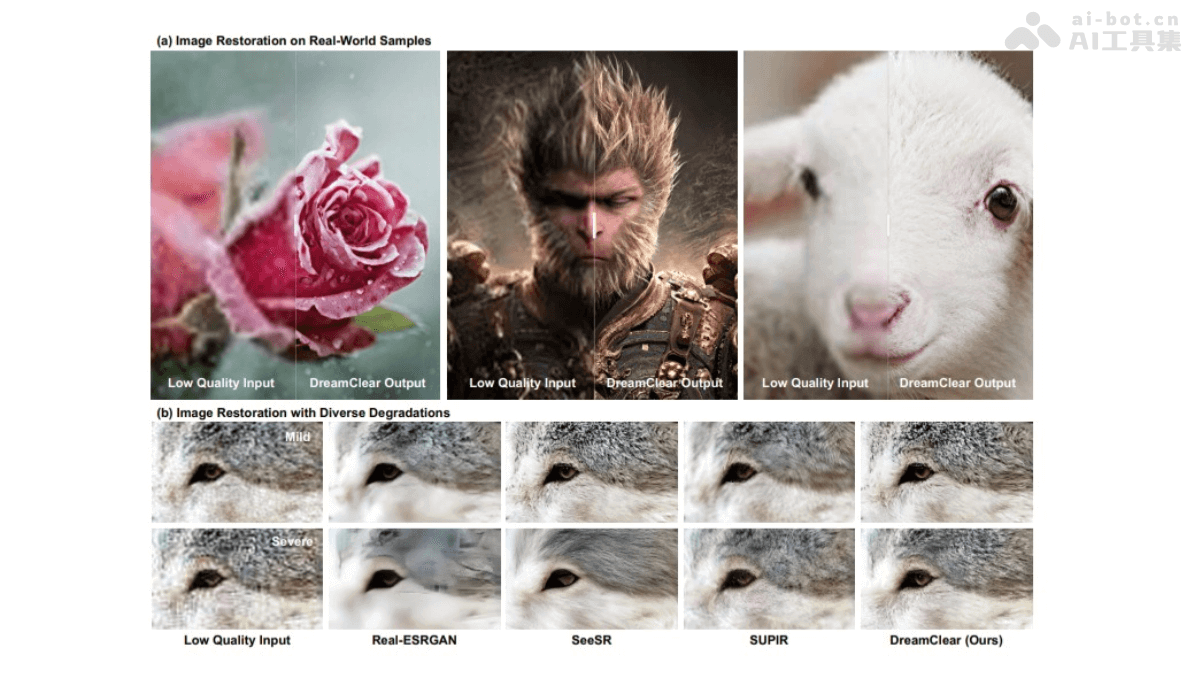
Main Features of DreamClear
- Image Restoration: DreamClear can restore low-quality images to high-quality images, improving image details and quality.
- Privacy Protection: While performing image restoration, DreamClear takes data privacy protection into account, ensuring user privacy and security during use.
- Deep Learning Model: Based on deep learning technology, DreamClear can intelligently identify and repair problems in images, improving restoration results.
Technical Principles of DreamClear
- Deep Diffusion Prior: The core idea of DreamClear is to search within the distribution of clean images, represented by a diffusion prior, to find clear images while remaining faithful to the input degraded image. It does not require explicit prior knowledge of the type of image degradation. By embedding the degraded image into the latent space of a pretrained diffusion model and carefully designing resampling of the diffusion process that generates clear images, image restoration is achieved.
- Variance Preservation Sampling (VPS) Technology: DreamClear is based on a novel variance preservation sampling technology, which helps maintain the variance of the image during the diffusion process and is crucial for generating high-quality restored images. The VPS technology guides damaged low-probability latent variables toward nearby high-probability regions, enabling the generation of clear samples. As a general solution, VPS can ensure fidelity even without knowing the specific degradation model.
- Unsupervised and Training-Free Method: DreamClear is an unsupervised and training-free blind image restoration method. It does not require degradation prior knowledge and can produce high fidelity and broad applicability, making it suitable for various types of image degradation. DreamClear embeds the degraded image back into the latent space of a pretrained diffusion model and resamples through a carefully designed diffusion process, imitating the process of generating clear images.
- Mixture of Adaptive Modulators (MoAM): DreamClear's "Mixture of Adaptive Modulators" module can dynamically adapt to multiple image restoration models and accommodate different types of image degradation, further expanding the model's applicability. The design of this module enables DreamClear to perform excellently when handling different types of image degradation (such as blur, noise, and low light).
DreamClear Project Address
- Github Repository:https://github.com/shallowdream204/DreamClear
- HuggingFace Model Library:https://huggingface.co/shallowdream204/DreamClear/tree/main
- arXiv Technical Paper:https://arxiv.org/pdf/2410.18666
Application Scenarios of DreamClear
- Image Quality Improvement: Suitable for scenarios that require improving image quality, such as old photo restoration and low-resolution image enhancement.
- Detail Restoration: In fields such as surveillance video enhancement and medical imaging processing, DreamClear can effectively restore image details and help professionals obtain clearer information.
- Privacy Protection: DreamClear is suitable for image processing scenarios with high data privacy requirements, such as medical imaging and surveillance data processing. While improving image quality, it ensures users' privacy and security, meeting modern society's demand for data protection.
- Commercial Applications: DreamClear uses an open-source license, allowing enterprises and developers to freely use, modify, and distribute the software. It is suitable for various commercial projects, driving innovation and application in image processing technology.
-
High-Resolution Image Generation: DreamClear can generate 1024×1024-pixel high-resolution images from 256×256-pixel low-quality images, making it suitable for content creation fields that require high-quality images, such as game and film production.