
What is DragAnything
DragAnything is a controllablevideo generationmethod based on entity representation, launched by Kuaishou in collaboration with Zhejiang University and the Show Lab of the National University of Singapore. It achieves precise motion control of any object in a video based on simple trajectory input. DragAnything uses the latent features of a diffusion model to represent each entity in the video, overcoming the limitation of traditional methods in which simply dragging pixels cannot precisely control object motion. DragAnything provides a user-friendly interaction method and supports flexible control of foreground, background, and camera motion, achieving new state-of-the-art performance on evaluation metrics such as FID, FVD, and user studies.
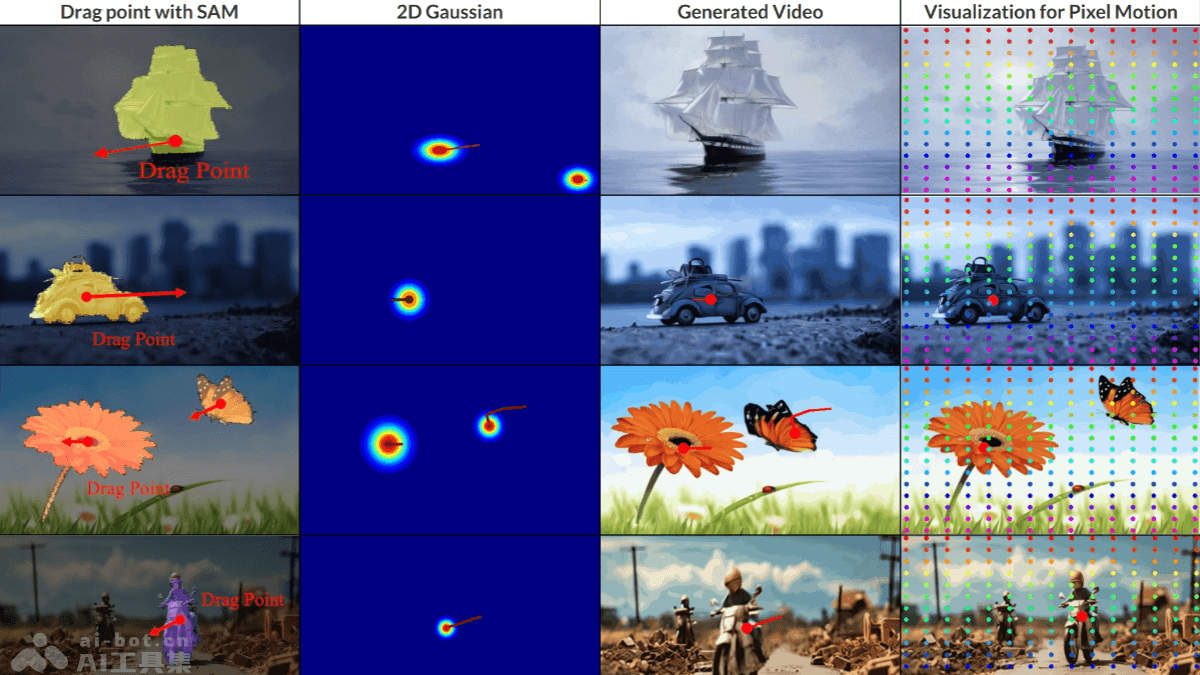
Main Features of DragAnything
- Entity-level motion control: Precise motion control of any entity in the video (including foreground and background), not just pixel-level operations.
- Independent control of multiple entities: Supports independent motion control of multiple objects simultaneously, with each object moving differently according to user-defined trajectories.
- User-friendly interaction method: Users can achieve complex motion control based on simple interactions (such as selecting a region and dragging), without complex input signals (such as segmentation masks or depth maps).
- Camera motion control: In addition to controlling objects in the video, DragAnything can achieve camera motion control, such as zooming and panning.
- High-quality video generation: While maintaining motion control accuracy, it generates high-quality video content and is suitable for a variety of application scenarios.
Technical Principles of DragAnything
- Entity representation: Introduces a new entity representation method that extracts semantic information from the latent features of the diffusion model to represent each object in the video. It combines the object's semantic features with motion trajectories to achieve precise entity-level motion control.
- 2D Gaussian representation: Introduces a 2D Gaussian representation that assigns higher weights to the central region of the object based on a Gaussian distribution, reducing the influence of edge pixels and achieving more natural motion control.
- Diffusion model: Based on a diffusion model architecture (such as Stable Video Diffusion), it uses powerful generation and denoising capabilities to generate high-quality video content. The diffusion model reconstructs video frames by gradually removing noise, combining the user-input motion trajectories and entity representations.
- Trajectory-guided motion control: Users define the object's motion path by drawing simple trajectories. DragAnything combines the trajectories with entity representations to generate video content that matches user intent, avoiding the limitations of directly manipulating pixels and achieving more natural and precise motion control.
- Loss function and optimization: During the training stage, a masked mean squared error (MSE) loss function is used, focusing on optimizing motion control in user-specified regions while maintaining the generation quality of other regions.
Project Addresses of DragAnything
- Project website:https://weijiawu.github.io/draganything
- GitHub repository:https://github.com/showlab/DragAnything
- arXiv technical paper:https://arxiv.org/pdf/2403.07420
Application Scenarios of DragAnything
- Video creation and editing: Quickly generate animations, adjust object motion trajectories, and improve creation efficiency.
- Game development: Generate character actions and enhance players' interactive experience.
- Education and training: Assists scientific simulation and skills training, helping to understand complex motion processes.
- Advertising and Marketing: Creates dynamic advertisements and product displays, highlighting product features.
- Entertainment and Socializing: Generates interactive videos and controls virtual character movements, enhancing fun.