
What is DRA-Ctrl
DRA-Ctrl (Dimension-Reduction Attack) is an innovative cross-modal image editing framework jointly launched by Zhejiang University, Ant Group, and other institutions. The framework leverages the multi-dimensional high-dimensional feature representations of video generation models, including visual, temporal, spatial, and causal dimensions, to achieve state prediction and precise editing of image subjects. Based on video-to-image knowledge compression and task adaptation, the framework uses the advantages of video models such as long-range context modeling and flat full attention to bridge the gap between continuous video frames and discrete image generation. Experiments show that DRA-Ctrl performs excellently on various image generation tasks, outperforming models trained directly on images, and provides new possibilities for large-scale video generators in a broader range of visual applications.
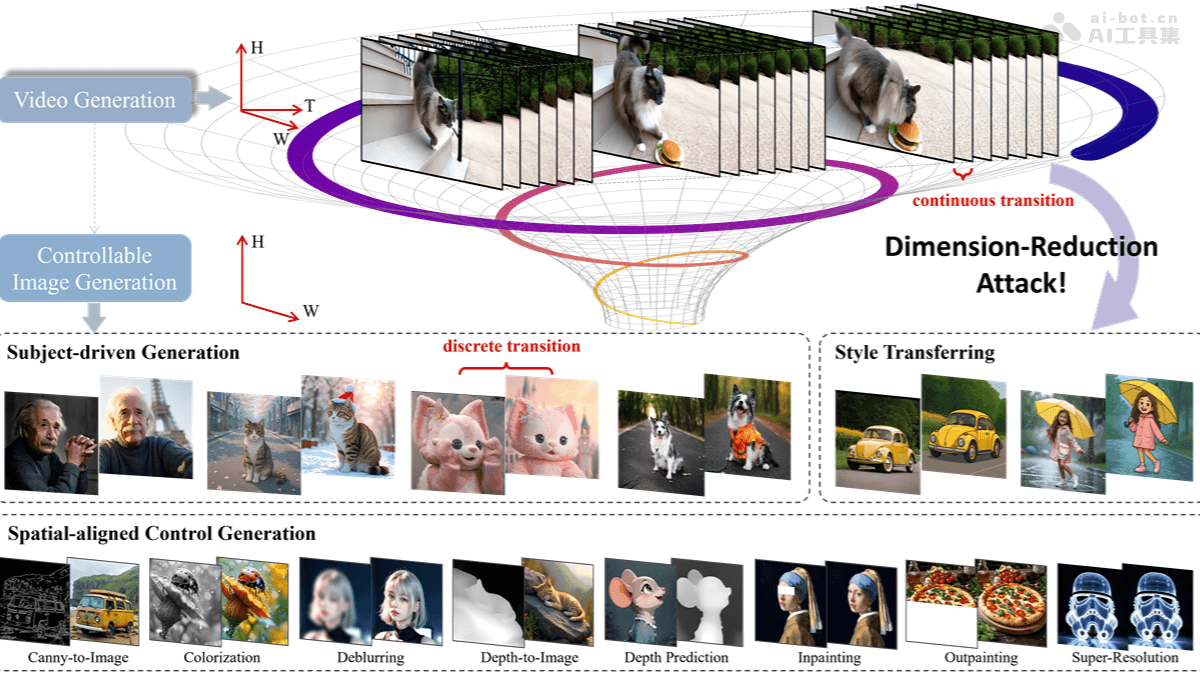
Main Features of DRA-Ctrl
- Multi-Task Support: Supports a variety of image generation tasks, covering subject-driven generation, spatial conditional generation, Canny-to-image, colorization, deblurring, depth-to-image, depth prediction, inpainting and outpainting, super-resolution, and style transfer, demonstrating strong cross-task adaptability.
- High-Quality Generation: Based on the high-dimensional feature representations of video generation models, DRA-Ctrl can generate high-quality images, outperforming models trained directly on images.
- Cross-Modal Adaptation: DRA-Ctrl can compress and adapt the knowledge of video generation models to image generation tasks, achieving cross-modal knowledge transfer.
Technical Principles of DRA-Ctrl
- High-Dimensional Feature Representations of Video Generation Models: Video generation models can capture dynamic, continuously changing high-dimensional information, including visual, temporal, spatial, and causal dimensions. These high-dimensional feature representations provide rich contextual information for image generation tasks.
- Video-to-Image Knowledge Compression: Based on video-to-image knowledge compression, the capabilities of video generation models are transferred to image generation tasks. The compression is implemented using multiple strategies, including a mixup-based transformation strategy, frame-skipping positional embedding (FSPE), loss reweighting, and attention masking strategies.
- Mixup-Based Transformation Strategy: To address the gap between continuous video frames and discrete image generation, a mixup-based transformation strategy is introduced to ensure a smooth transition from video to image.
- Frame-Skipping Positional Embedding (FSPE): Based on positional embeddings that skip certain frames, DRA-Ctrl can better handle the discontinuity between video frames and improve the quality of image generation.
- Loss Reweighting: During training, DRA-Ctrl reweights the losses of different frames to ensure that the model can better learn the features required for image generation tasks.
- Attention Masking Strategy: Redesigns the attention structure and introduces a customized masking mechanism to better align text prompts with image-level control.
Project Addresses of DRA-Ctrl
- Project Official Website:https://dra-ctrl-2025.github.io/DRA-Ctrl/
- GitHub Repository:https://github.com/Kunbyte-AI/DRA-Ctrl
- HuggingFace Model Library:https://huggingface.co/Kunbyte/DRA-Ctrl
- arXiv Technical Paper:https://arxiv.org/pdf/2505.23325
- Online Experience Demo:https://huggingface.co/spaces/Kunbyte/DRA-Ctrl
Application Scenarios of DRA-Ctrl
- Content Creation: Artists and designers can quickly generate creative images, accelerating the creation process and improving creative efficiency.
- Film and Television Production: Generate high-quality backgrounds, characters, and scenes in film and television special effects and animation production, reducing the workload of manual drawing.
- Game Development: Game developers generate characters, props, and environments in games, enhancing the visual effects and immersion of the game.
- Advertising and Marketing: Advertising agencies quickly generate attractive advertising images to meet the needs of different clients.
- Education and Training: In the field of education, it is used to generate teaching materials, such as scientific illustrations, historical scenes, etc., enhancing teaching effectiveness.