
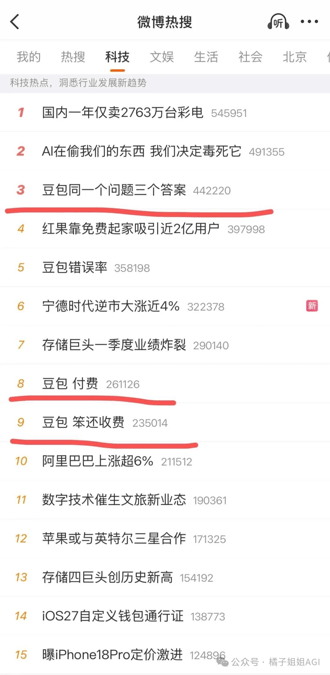
During the May Day holiday, unexpectedlyDoubaotrended on social media because it is going to charge fees. The buzz has lasted for two days.
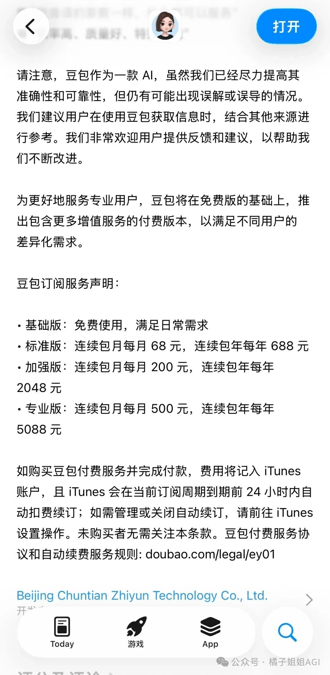
Search for Doubao in the App Store, open it, and scroll down to see the paid service description. There are three pricing tiers:
Standard version: 68 yuan per month with continuous subscription, 688 yuan per year;
Enhanced version: 200 yuan per month with continuous subscription, 2,048 yuan per year;
Professional version: 500 yuan per month with continuous subscription, 5,088 yuan per year.
The comment section about Doubao's paid service is also lively. Some people say, "Isn't this just the trick used by video websites? They wait until you can't live without it and then charge you."
Others say, "Even Doubao is charging now; other AI services will probably follow soon."
Everyone should not worry too much. Doubao is not forcing charges; it has kept free services.
The difference between free and paid
I also asked Doubao myself, "Are you going to charge fees?"
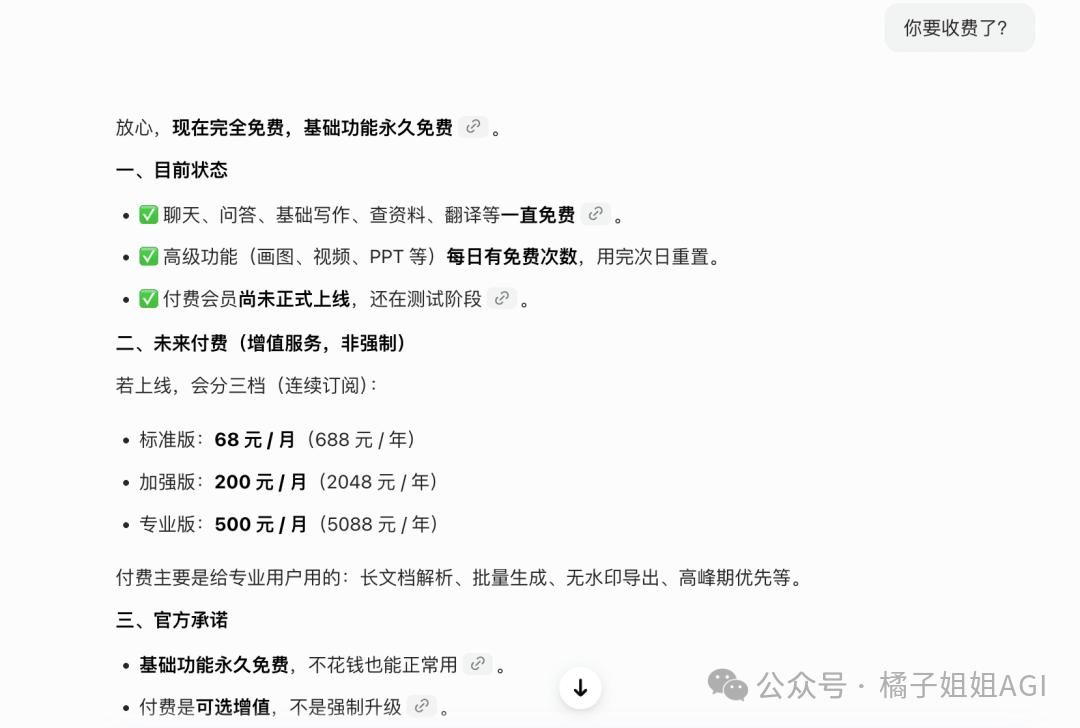
Doubao said: Rest assured,it is currently completely free, and basic functions are free forever.
The paid version is a value-added service on top of the free version, mainly targeting complex task scenarios, such as PPT generation, data analysis, and film and television production, which are functions with high computing power consumption.
Specifically at the execution level, what is the difference between paid and free?
For chatting with Doubao, doing homework, writing short essays, and generating simple images, the free version is completely sufficient.
But if you are a designer or content creator who needs AI for long-form writing, frequent generation of high-definition images, and batch processing of documents, the computing power consumed in these scenarios is not on the same level as simple use, so you need to consider the paid version.
The paid entry is still in gray testing and has not been fully opened. After it is fully launched, if you want to subscribe to the service, you can go to the mobile App, tap "Me" in the lower left corner → "Settings" → "Subscribe to Doubao Membership"; or immediately activate it after triggering a payment pop-up when using advanced functions (such as PPT or long documents).
On the web version, in the lower left corner, click your avatar → "Subscribe to Doubao Membership" → choose a plan and pay.
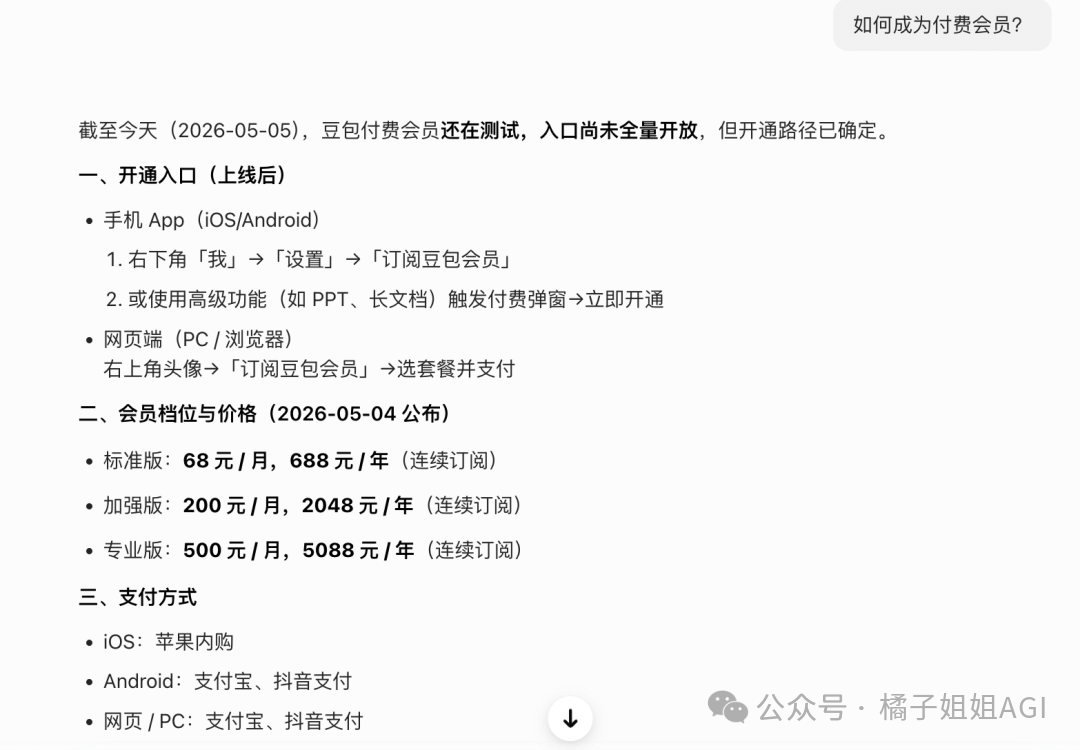
That is roughly the activation path.
Why launch paid services now
Doubao chose this time to launch paid services, not on a whim. There are several key signals behind it.
The first signal: computing power consumption is already very high
According to public information, as of March this year, the average daily token calls of the Doubao large model have exceeded 120 trillion. Compared with 120 billion when it was first officially opened to the public in May 2024, that is an increase of more than 1,000 times.
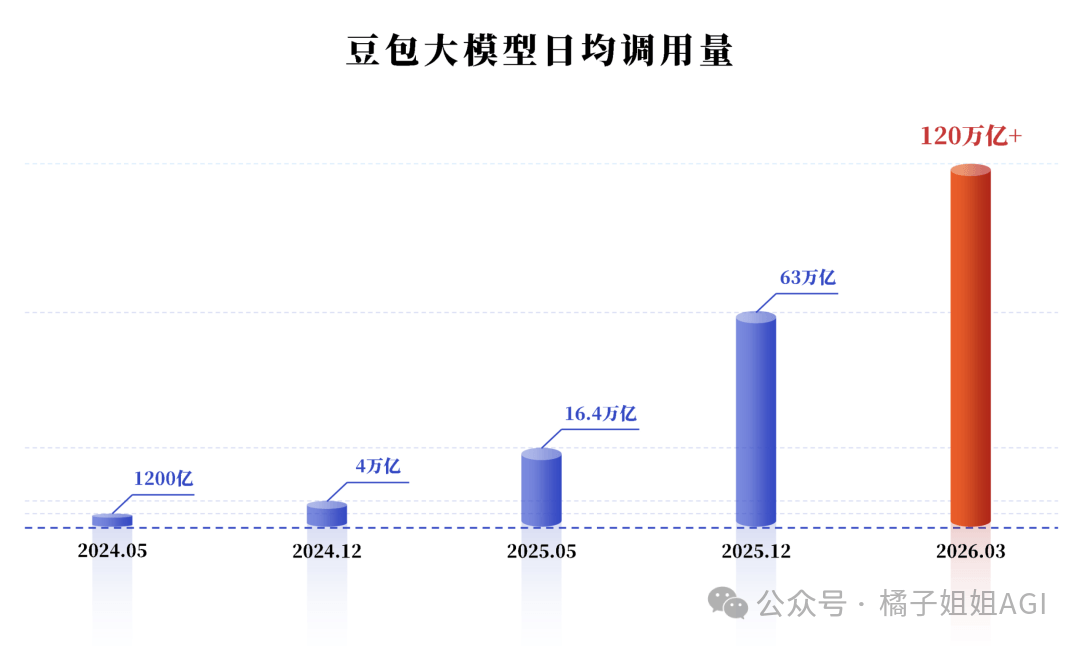
The amount of text, images, and code the Doubao team has to process every day is already an astronomical figure.
ByteDance's net profit fell by more than 70% last year. It spent 150 billion on AI, and Doubao serves more than 300 million people every day. Every time you ask Doubao to write something or generate an image, it faces computing power costs for more than 300 million users. When there were few users, it could subsidize to grab the market. Now that the user base has grown 1,000 times and it still continues to subsidize, the financial pressure is extraordinary. Continuing to burn money is like an endless pit.
The second signal: cloud service prices have begun to rise collectively
AI companies do not just pay their own server bills; they rely on infrastructure such as Alibaba Cloud, Tencent Cloud, and Baidu Cloud. Starting last year, the three major cloud vendors collectively raised service prices, by as much as about 30%.
If upstream prices rise and downstream is still free, that is pressure from both sides.
The third signal:AI Agent computing power demand is hundreds of times
Over the past six months,OpenClaw AI Agent products have risen rapidly. Compared with ordinary conversational bots, Agents need to complete complex task chains, and the amount of data they need to process is hundreds of times that of traditional chat conversational bots.
The price difference in tokens is essentially a difference in capability. As models become more and more powerful, each token can create greater economic value, so a corresponding price increase is reasonable.
It's not that Doubao wants to charge, it's that the cost of heavy tasks is really high.
The fourth signal: cultivating domestic payment habits
Many people think domestic users are unwilling to pay for AI.
The Tencent Research Institute conducted a survey: 96.2% of respondents had used generative AI, but only 16.1% had used paid services. This shows that most users are still freeloading with the free version, but that small portion who pay has already proven that the demand is real.
In the international market, ChatGPT started charging long ago. The Plus version is $20 per month, and Claude Pro is also $20 per month.Anthropic, and Grok paid subscriptions have long become standard.
Domestically,Zhipu GLM has already raised prices three times this year. In February it raised prices by 30%, in March by 20%, and in April by another 10%. Zhipu itself wrote frankly in its price adjustment letter: market demand is too strong, the user scale and call volume are growing too fast, and it cannot hold on without raising prices.
Zhipu raised prices three times, and users still kept using it. This shows that people willing to pay for high capability do exist.
Overall, Doubao's launch of paid services is the result of multiple factors stacking together.
Are the three pricing tiers expensive
ChatGPT Plus is $20 a month, about 145 yuan, and Claude Pro is also $20. Doubao's standard version is 68 yuan, about half the price of these products, so compared with international peers it is not expensive.
But Doubao's professional version at 500 yuan a month is indeed not cheap. The actual target users for this price may be compressed to the band of professional creators and small and medium-sized enterprise users.
The pricing of Doubao's three tiers has quite large jumps: from 68 yuan to 200 yuan is 2.94 times, and from 200 yuan to 500 yuan is 2.5 times. This looks more like the result of functional layering + model layering + computing power layering stacked together.
The 200 yuan price is exactly the same as the monthly fees of Volcano Ark Pro and Alibaba Cloud Bailian Pro. The two subscription prices within ByteDance were deliberately aligned. Does this mean that the same tier'scomputing power configurationmay share the underlying resource pool.
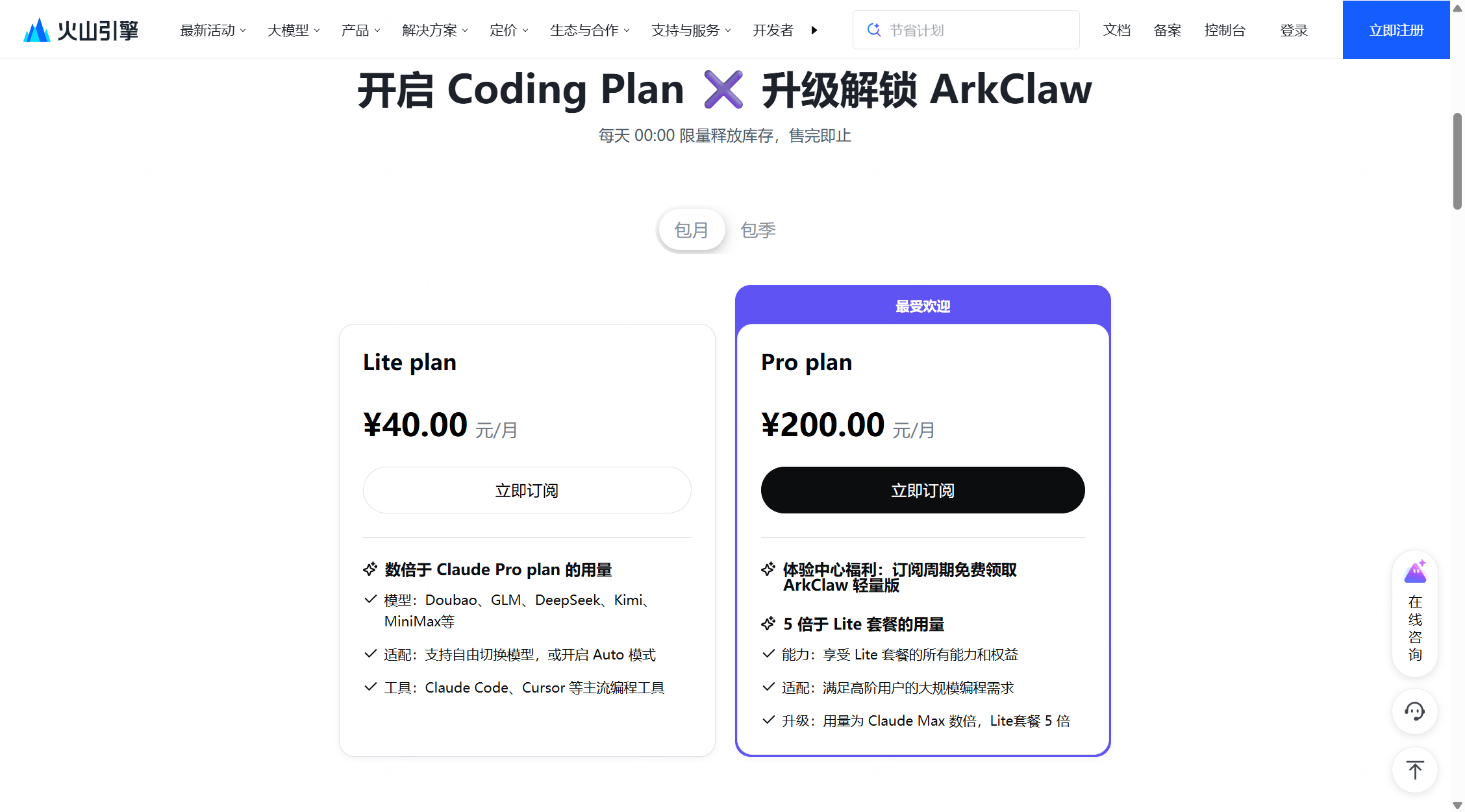
This pricing logic is imperceptible to ordinary users. They just see the number, and the psychological threshold suddenly goes up.
Some thoughts
The big public opinion wave around Doubao is actually because everyone is not yet ready to accept that the "free AI era" is really coming to an end.
Looking at it from another angle, this precisely shows that Doubao's value has already been verified by the market. If a product were dispensable, whether it charges or not would not trigger discussion at all. It is precisely because 345 million people are already using it and can no longer do without it that there is anxiety about uninstalling and an impulse to compare prices.
This step by Doubao is telling the entire industry: the free model maintained by subsidies has a ceiling, and the commercialization of AI must find its own pricing logic.
From inside ByteDance, Doubao choosing to charge at this point in time is also a proactive choice after pressure was transmitted. The computing power bill behind 345 million monthly active users has reached the point where it must be faced squarely. Now it is proactively drawing boundaries and using price to screen out users who are truly willing to pay for efficiency.
Those who criticize will keep criticizing, and those who use it will keep using it. In the end, paid subscriptions ultimately come down to product strength. Whether 68 yuan really brings a clear improvement over the free version, and what exactly the difference is between the 200 yuan and 500 yuan tiers—these questions are more critical than any pricing strategy.
I strongly agree with this comment:
「Computing power is so scarce. Using professional features to serve paying users and improving model capabilities also benefits free users. In the long run, this is a good thing.」
Original link:Why is Doubao stupid yet still charging? Three pricing tiers, up to 5,088 yuan per year