
What is dots.tts
dots.tts is a 2-billion-parameter fully continuous autoregressivespeech synthesisfoundation model jointly open-sourced by Xiaohongshu's dots team and Shanghai Jiao Tong University's X-LANCE Lab. The model directly generates 48kHz audio block by block in a continuous latent space, achieving SOTA timbre similarity and content accuracy on benchmarks such as Seed-TTS-Eval, and supports zero-shot cloning, streaming output, and low-latency duplex conversation. The project fully open-sources the code and weights, and extends the precise speech editing capability of dots.tts.edit.
Main features of dots.tts
- Zero-shot timbre cloning: With only 3–10 seconds of reference audio, it can replicate that timbre to read any new text, supports cross-lingual cloning, and achieves SOTA performance in content accuracy and speaker similarity on the Seed-TTS-Eval benchmark.
- Text-to-speech synthesis: Provides high-quality speech generation from random timbre sampling to a specified speaker, directly outputting 48 kHz audio based on a 2B-parameter continuous autoregressive model.
- Streaming generation and low-latency interaction: Naturally supports streaming output, generating audio block by block after the text prefix is input; in the 1T1A dual-stream mode, the speech side responds immediately each time the upstream LLM outputs a text Token, with audio first-packet latency as low as 54.4 milliseconds, suitable for real-time speech agents and duplex conversations.
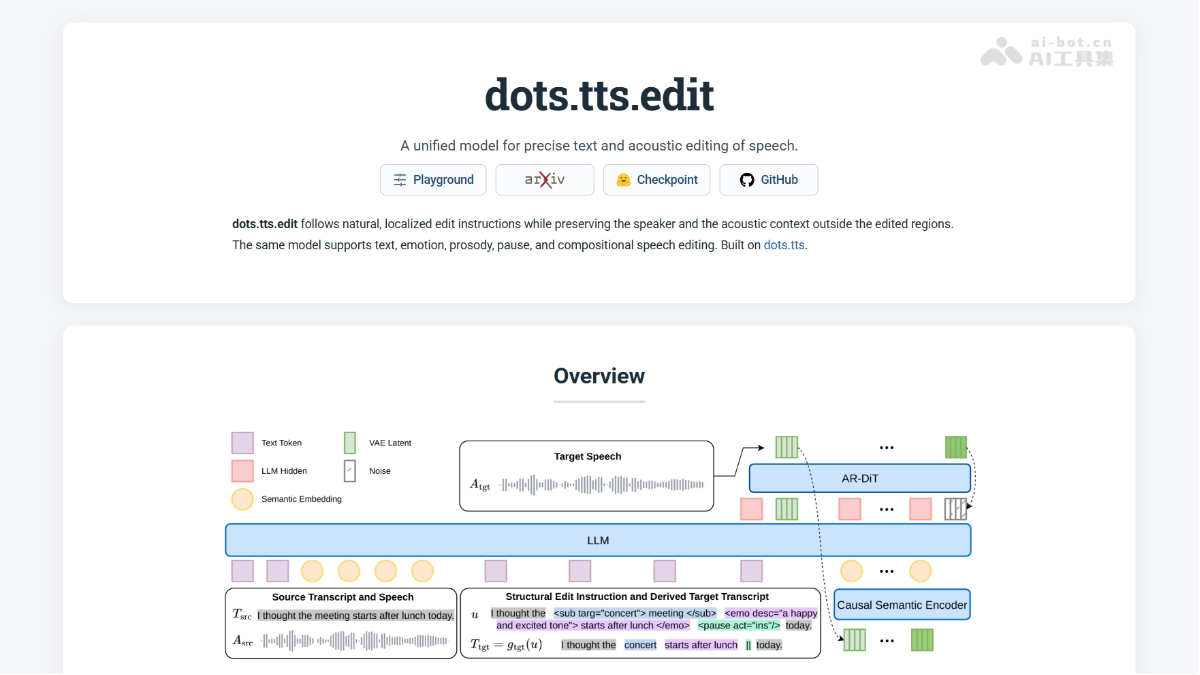
- Precise speech editing: Supports text replacement, emotion adjustment, pitch and speaking rate modification, pause insertion or deletion on existing recordings, and supports combining multiple operations in a single instruction at once, with unedited regions remaining unchanged.
- Multilingual support: Covers 24 languages, with an average speaker similarity of 83.9 in the MiniMax multilingual evaluation, among which 19 languages rank first in individual categories.
- Multiple inference speeds: Provides multiple checkpoints such as Base, SOAR, MeanFlow (4-step), two-step sCM, and single-step DMD, allowing users to choose as needed between audio quality and inference speed.
Technical principles of dots.tts
- Fully continuous autoregressive architecture: dots.tts abandons the traditional approach of quantizing speech into discrete Tokens; the entire generation pipeline operates completely in a continuous latent space: the model autoregressively predicts acoustic segments block by block and restores them to 48 kHz waveforms through a BigVGAN-style decoder, fundamentally avoiding the information bottleneck and timbre detail loss caused by discrete quantization.
- Semantic continuous representation: The model uses an AudioVAE designed based on HoliTok to compress raw waveforms into continuous latent variables at 25 FPS. The encoder achieves a balance between reconstruction fidelity and latent space structure through semantic training, bringing the speaker similarity after reconstruction to 0.969, preserving a rich upper limit of timbre and acoustic details for subsequent autoregressive generation.
- Error control mechanism: To address the inherent problem in continuous autoregression where small deviations in previous steps accumulate and spread backward, dots.tts introduces a causal semantic encoder that compresses generated VAE patches in real time into a compact semantic history and feeds it back to the large language model; by stripping high-variance local acoustic variations and retaining only long-range semantic summaries, it effectively suppresses error propagation, howling, and timbre drift in long-sequence generation.
- Generation pipeline: The generation process is centered on a large language model, which is initialized based on Qwen2.5-1.5B, directly consumes BPE text tokens, and outputs the hidden state at each step; then an autoregressive flow matching head (18-layer DiT), conditioned on the LLM hidden states and the autoregressive prefix, performs denoising generation for the next acoustic patch, while a global x-vector provided by a frozen CAM++ speaker encoder ensures timbre consistency.
- Post-training acceleration: The team uses SOAR self-corrective alignment to let the model simulate deviation states in real inference during training and learn self-correction, improving stability without a reward model; MeanFlow distillation is used to compress the teacher's multi-step trajectory into an average velocity, achieving 4-step high-quality generation; it is compressed to 2 steps via a simplified consistency model (sCM); through reward-aware distribution matching distillation (DMD) combined with a dual-timescale update strategy, a natural, clear, high-quality one-step model is obtained.

Follow on WeChat and reply "Open Source" to jointhe AI Open Source Project Exchange Group
How to use dots.tts
-
Installation: Run
pip install dots.ttsto install, or clone the source code from GitHub and usepip install -e .for local development installation; for high-concurrency scenarios, SGLang Omni can additionally be deployed to obtain CUDA Graph acceleration and continuous batching support. -
Command-line synthesis: Use the
dots.ttsentry point and specify--model-name-or-path、--textand the target--prompt-audioand--prompt-textto achieve zero-shot timbre cloning; omitting--prompt-textdegrades to x-vector cloning, and omitting--prompt-audioperforms random timbre sampling. -
Command-line editing: Use the
dots.tts.editentry point, provide--source-audioand XML-style--instruction, and perform precise edits such as text replacement, emotion, or prosody modification on existing recordings. -
Basic Python API call: After loading the model via
DotsTtsRuntime.from_pretrained(), callgenerate(), pass in text and an optional reference audio to obtain the synthesized audio tensor and save it as a file. -
Python API streaming output: Calling
generate_stream()allows audio tensors to be obtained chunk by chunk and pushed to a player or WebSocket in real time, enabling a low-latency experience of generating and playing simultaneously. -
Python API dual-stream dialogue: After starting a session with
DotsTtsRuntimeDoubleStreaming, push text token by token, and the speech side starts generating immediately; the first audio packet latency can be as low as 54.4 milliseconds, making it suitable for real-time voice agents. -
Fine-tuning: Run
accelerate launch scripts/train_dots_tts.pyand configure your own data path to perform timbre or domain adaptation fine-tuning based on a public checkpoint. -
Distillation acceleration: Through
scripts/train_dots_tts_meanflow.py, use the SOAR checkpoint as the teacher for MeanFlow distillation to obtain 4-step, 2-step, or 1-step high-quality student models to suit different latency and concurrency requirements. -
Web interface: Run
python apps/gradio/app.pyto start the visual synthesis interface, or runapps/edit_playground/app.pyto start the Edit Playground, where you can upload audio, annotate edit intervals, and preview results in real time in the browser.
Core advantages of dots.tts
- Fully continuous latent space modeling: Abandons discrete acoustic tokens and directly performs autoregressive generation in a continuous latent space, preserving rich timbre details such as spectral texture and breathiness, with reconstructed speaker similarity reaching as high as 0.969.
- SOTA synthesis quality: Achieves SOTA in both content accuracy and timbre similarity on the Seed-TTS-Eval benchmark, with an average SIM of 83.9 in MiniMax evaluation across 24 languages, surpassing mainstream solutions in overall performance.
- Native streaming low latency: In 1T1A dual-stream mode, the audio first-packet latency is as low as 54.4 milliseconds, and with SGLang Omni on a single H100, concurrent throughput for 16 streams reaches 4.76 req/s, meeting the needs of real-time voice agents.
- Unified editing capability: dots.tts.edit is based on the same foundation, supports XML-structured instructions to precisely edit text, emotion, prosody, and pauses, and leads other open-source systems overall in the doteBench evaluation.
dots.tts project address
- GitHub repository:https://github.com/studio-dots-ai/dots.tts
- arXiv technical paper:https://arxiv.org/pdf/2608.02673
Comparison of dots.tts with similar competitors
| Comparison dimension | dots.tts | CosyVoice 3 |
|---|---|---|
| Technical approach | Fully continuous latent space autoregression, no discrete tokens | Hybrid discrete and continuous representation, relying on acoustic tokens |
| Parameter count | 2B | 1.5B |
| Seed-TTS-Eval average WER/CER | 2.95% | 3.06% |
| Seed-TTS-Eval average SIM | 79.2 | 75.3 |
| Multilingual evaluation | MiniMax 24-language average SIM 83.9, first in 19 languages | Focuses on Chinese-English bilingual, has not published 24-language results |
| Real-time interaction | Native streaming + 1T1A dual-stream, first packet as low as 54.4ms | Parallel generation, limited latency optimization |
| Inference acceleration | MeanFlow 4 steps / sCM 2 steps / DMD single step | Standard multi-step generation |
| Open-source scope | Apache 2.0 open source with 6 checkpoints + full training/fine-tuning/distillation code | Model and inference code open source |
Application scenarios of dots.tts
- Real-time voice Agent: 1T1A dual-stream mode has first-packet latency as low as 54.4 milliseconds, suitable for LLM-driven real-time duplex dialogue and voice assistants.
- Zero-shot timbre cloning: Only a few seconds of reference audio are needed to replicate any timbre, supports cross-language cloning, suitable for audiobooks, dubbing, and personalized content creation.
- Multilingual content generation: Covers 24 languages while maintaining high speaker similarity, suitable for multilingual voice announcements and localization services for global products.
- Precise speech editing: Through dots.tts.edit, existing recordings can undergo text replacement, emotion adjustment, prosody modification, and pause adjustment, suitable for podcast post-production and fine editing of audio content.
- Livestreaming and real-time broadcasting: Works with LLM streaming output to generate and play simultaneously, suitable for news broadcasting, livestream e-commerce, and real-time information broadcasting scenarios.