
What is DocMind?
DocMind is a document intelligence large model launched by Sima Yue. Based on the Transformer architecture, it integrates deep learning, NLP, and CV technologies, and can process the complex structure and visual information of rich-text documents to improve the accuracy of information extraction. DocMind supports accurately identifying document entities, capturing textual dependencies, and deeply understanding document content. It can be combined with knowledge bases to enhance professional document understanding. DocMind can automatically perform document-related tasks, such as question answering and document classification and organization, and is suitable for many fields such as law, education, and finance.
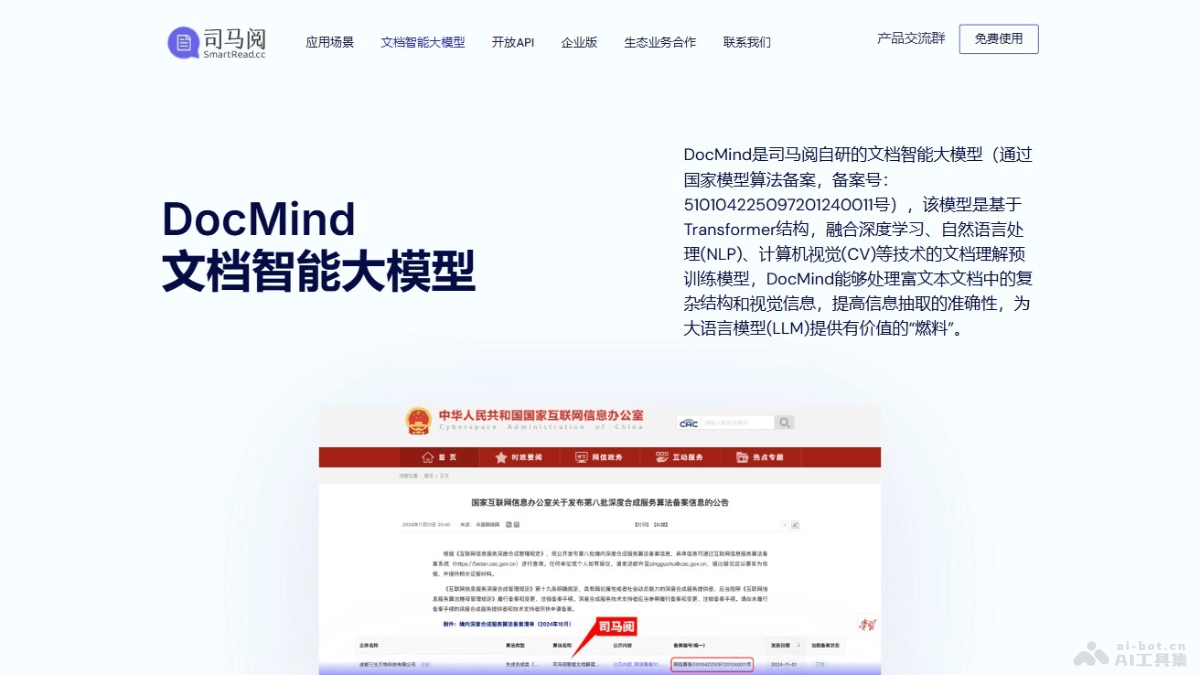
DocMind's main functions
- Information extraction: DocMind can accurately identify various entities in documents, such as person names, place names, and organization names, and accurately determine relationships such as affiliation and association between entities. DocMind can quickly locate important data in complex documents and integrate multimodal information to ensure that the extracted information is comprehensive and accurate.
- Feature representation: The model captures long-distance dependencies in text and generates precise vector representations for each word that fully take context into account. DocMind can combine text and visual information to create rich and comprehensive feature vectors for document elements and deeply understand the hierarchical structure of documents.
- Content understanding: DocMind performs in-depth semantic parsing of document content, gains insight into the true meaning behind the text, clearly grasps the overall structure and logical flow of the document, and understands the interrelationships and importance of each part.
- Knowledge fusion: Deep integration with domain-specific knowledge bases significantly improves the understanding of professional documents. DocMind assists in understanding document content based on common sense and background knowledge and makes reasonable assumptions and inferences.
- Task execution: DocMind automatically performs document-based tasks, such as natural language questioning, providing answers, document classification and organization, etc., improving work efficiency. It has the ability to continuously learn and continuously optimizes its own performance based on incremental learning.
DocMind's technical principles
- Transformer architecture: DocMind is based on the Transformer architecture, a deep learning model suitable for processing sequence data such as text. DocMind captures long-distance dependencies in sequences based on the self-attention mechanism.
- Multimodal fusion: DocMind integrates text and visual information. Based on multimodal fusion technology, it processes complex documents containing images, tables, and text, providing more comprehensive document understanding.
- Pre-training technology: DocMind uses pre-training technology to transfer information to downstream tasks based on learning from large amounts of unlabeled documents, improving the accuracy of information extraction.
- Locally invariant features: DocMind analyzes the locally invariant features of document layouts, which helps the model maintain stable performance under different document layouts.
- Context understanding: When generating the vector representation of each word, DocMind fully considers contextual information to provide more precise feature representations.
- Hierarchical structure understanding: DocMind handles multi-level feature extraction from words to paragraphs to the entire document, understanding the hierarchical structure of documents.
DocMind's project address
- Project official website:smartread.cc/docmind
DocMind's application scenarios
- Laws and regulations: Process and analyze large amounts of legal documents, such as contracts and regulations, for organization, parsing, and archiving. Support legal affairs and compliance management work.
- Bidding and tendering: Organize and analyze bidding documents, and extract key information and conditions. Intelligently evaluate bidding opportunities and the level of tender projects.
- Academic Education: Process academic papers and literature materials, conduct literature reviews, citation analysis, and knowledge integration. Support academic research and writing.
- Manufacturing: Intelligently organize and analyze various documents such as production plans, technical specifications, and quality control. Improve production efficiency and management levels.
- Financial Risk Control: Process compliance documents, review reports, risk assessment reports, etc. Support compliance risk control work and internal audits.