
What is DINO-X
DINO-X is a general-purpose vision large model launched by IDEA Research Institute, featuring open-world object detection and understanding capabilities. It supports text, visual, and customized prompts, and can recognize any object in an image without user prompts. Based on the Grounding-100M dataset with over 100 million samples, DINO-X has set new performance records on the COCO, LVIS-minival, and LVIS-val benchmarks. The model includes two versions: DINO-X Pro and DINO-X Edge. The former provides powerful perception capabilities, while the latter optimizes inference speed and is suitable for edge deployment. DINO-X performs excellently in long-tail object recognition and can be widely applied in fields such as autonomous driving and intelligent security, bringing new momentum to industrial upgrading.
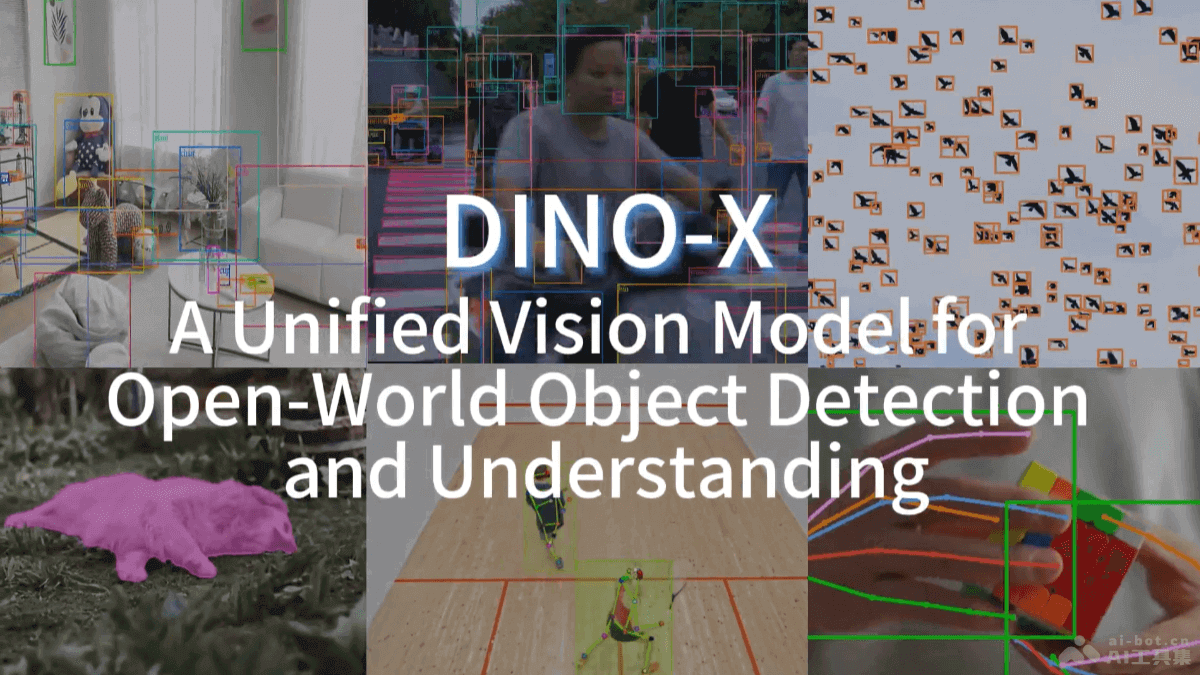
Main Features of DINO-X
- Open-World Object Detection and Segmentation: Detects and segments various objects in images, even uncommon objects in long-tail categories.
- Phrase Grounding: The model locates the corresponding object in an image based on a given text phrase.
- Visual Prompt Counting: Based on visual prompts such as drawing bounding boxes or points in an image, counts the number of specific objects.
- Pose Estimation: Predicts keypoints of people or specific categories in an image, such as human pose and hand pose.
- Prompt-Free Object Detection and Recognition: Supports detecting any object in an image without any prompts.
- Dense Region Captioning: Generates detailed descriptive captions for specific regions in an image.
- Object-Based Question Answering: Can answer questions about specific objects in an image.
Technical Principles of DINO-X
- Transformer Encoder-Decoder Architecture: Based on the Transformer architecture, using the encoder to extract image features and the decoder for object detection and understanding tasks.
- Multimodal Pretraining: Pretrained on the large-scale dataset Grounding-100M, DINO-X learns rich visual and language features, enhancing open-vocabulary detection capabilities.
- Prompt Expansion: Expands input options to support text prompts, visual prompts, and customized prompts, covering a broader range of detection scenarios.
- Multi-Perception Head Integration: Integrates multiple perception heads, such as bounding box heads, segmentation heads, keypoint heads, and language heads, supporting various perception and understanding tasks.
- Two-Stage Training Strategy:
- First Stage: Jointly trains text prompt detection, visual prompt detection, and object segmentation.
- Second Stage: Freezes the DINO-X backbone, adds keypoint heads and language heads for separate training, expanding the model's fine-grained perception and understanding capabilities.
- Knowledge Distillation and FP16 Inference Optimization: The model extracts knowledge from the Pro model based on knowledge distillation technology and uses FP16 quantization technology to improve inference speed.
- Language Head Design: DINO-X's language head uses a frozen DINO-X to extract object tokens, combines them with task tokens, and generates response outputs in an autoregressive manner.
DINO-X Project Address
- Project Official Website:deepdataspace.com
- arXiv Technical Paper:https://arxiv.org/pdf/2411.14347
Application Scenarios of DINO-X
- Autonomous Driving: Real-time recognition and understanding of the road environment in autonomous vehicles, including pedestrians, vehicles, traffic signs, etc., improving safety and responsiveness.
- Intelligent Security: In surveillance systems, it detects and identifies suspicious behavior, intruders, or other security threats, improving the level of intelligence in surveillance.
- Industrial Inspection: In manufacturing, it is used for quality control, detecting product defects, and ensuring production line efficiency and product quality.
- Robot Vision: Integrated into service robots and industrial robots, it helps robots better understand their surroundings and improves their interaction and operation capabilities.
- Assisting the Visually Impaired: Integrated into devices for the blind, it helps visually impaired people better understand and navigate their surroundings.