
What is DiffSplat
DiffSplat is a novel 3D generation method that rapidly generates 3D Gaussian Splats from text prompts and single-view images. By fine-tuning pre-trained text-to-image diffusion models, it builds on powerful 2D prior knowledge and introduces a 3D rendering loss to ensure that the generated 3D content remains consistent across multiple views. The core advantages of DiffSplat lie in its efficiency and flexibility, as it can generate high-quality 3D objects within 1-2 seconds and supports text conditions, image conditions, or a combination of both as input. A lightweight reconstruction model is used to build structured Gaussian representations, providing high-quality data support for training.
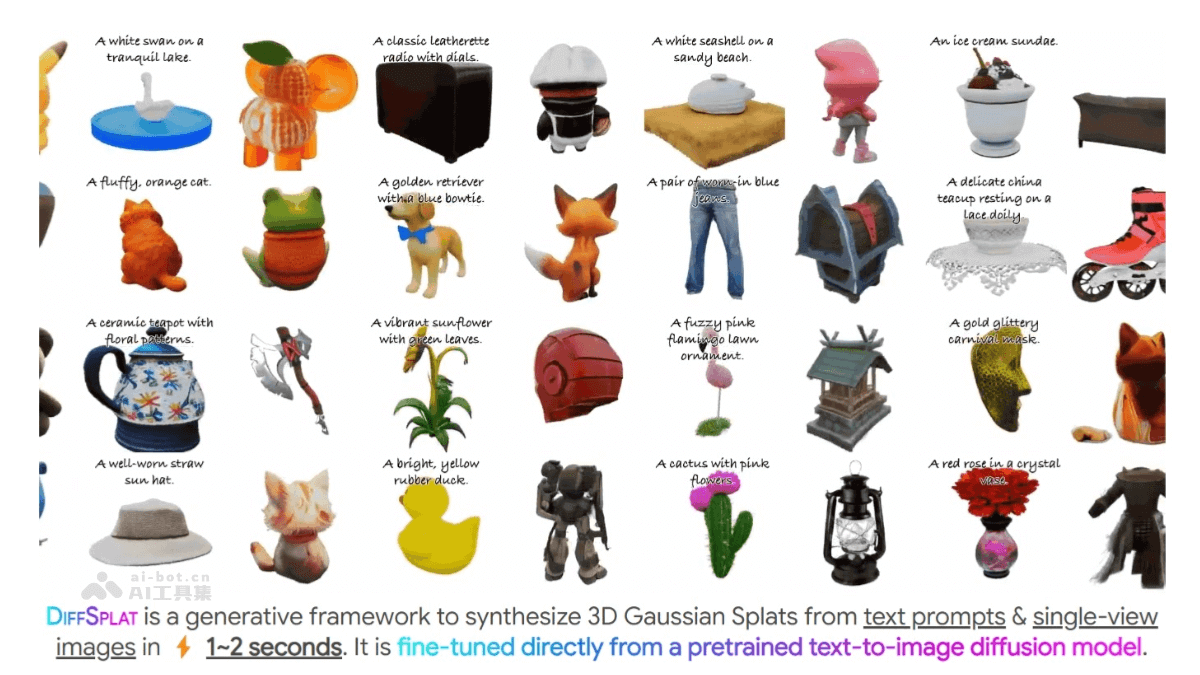
Main Features of DiffSplat
- Generate 3D Gaussian Splats from text or images: DiffSplat can directly generate 3D Gaussian Splats from text prompts or single-view images while maintaining 3D consistency.
- Efficient use of 2D prior knowledge: By fine-tuning large-scale text-to-image diffusion models, DiffSplat effectively builds on web-scale 2D prior knowledge while introducing a 3D rendering loss to ensure the 3D consistency of the generated content under arbitrary views.
- Support for multiple conditional inputs: DiffSplat supports text conditions, image conditions, or a combination of both as input, allowing users to choose suitable conditions as needed.
- Controllable generation capability: DiffSplat can be combined with technologies such as ControlNet to achieve controllable 3D generation based on text prompts and various formats (such as normal maps, depth maps, and Canny edge maps).
Technical Principles of DiffSplat
- Based on large-scale pre-trained text-to-image diffusion models: DiffSplat fine-tunes these models to directly generate 3D Gaussian Splats, effectively building on web-scale 2D prior knowledge.
- Lightweight reconstruction model: To initiate training, DiffSplat proposes a lightweight reconstruction model that can quickly generate multi-view Gaussian Splat meshes for scalable dataset construction.
- 3D rendering loss: DiffSplat introduces a 3D rendering loss to ensure that the generated 3D content remains consistent under arbitrary views.
DiffSplat Project Address
- Project official website:https://chenguolin.github.io/projects/DiffSplat/
- GitHub repository:https://github.com/chenguolin/DiffSplat
- arXiv technical paper:https://arxiv.org/pdf/2501.16764
Application Scenarios of DiffSplat
- 3D content creation: Suitable for rapid prototyping and content creation. Designers can use DiffSplat to quickly generate preliminary versions of 3D models for proof of concept or further fine-tuning.
- Text-to-3D generation: DiffSplat performs excellently in text-conditioned 3D generation tasks and can generate 3D models that match detailed text descriptions.
- Image-to-3D reconstruction: DiffSplat supports generating 3D models from a single image and can accurately reflect the shape and texture of the input image. It can quickly generate 3D models from existing image resources, for example in fields such as film and television special effects and game development.
- Support for downstream applications: The generation results of DiffSplat can be directly used in various downstream applications, such as 3D printing, virtual reality (VR), and augmented reality (AR).