
What is DGM
DGM (Darwin Gödel Machine) is a self-improving artificial intelligence system that improves performance by iteratively modifying its own code. DGM selects an agent from the coding agent archive it maintains, generates a new version based on the foundation model, and then validates the performance of the new agent on coding benchmarks. If performance improves, the new agent is added to the archive. DGM's design is inspired by Darwinian evolution. Through an open-ended exploration strategy, it explores multiple evolutionary paths from different starting points, avoiding getting trapped in local optima. In experiments, DGM achieved significant performance improvements on multiple benchmarks, for example improving performance from 20.0% to 50.0% on the SWE-bench benchmark and from 14.2% to 30.7% on the Polyglot benchmark. DGM's self-improvement process takes place in an isolated sandbox environment to ensure safety.
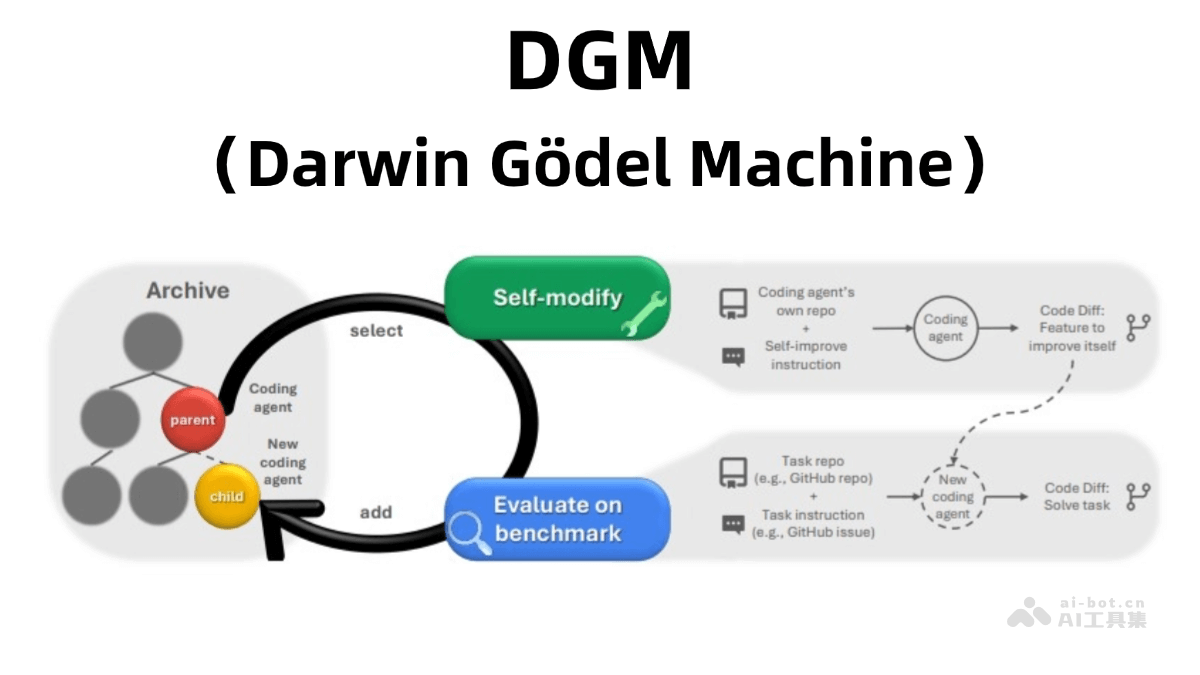
Main Features of DGM
- Self-improvement: DGM can iteratively modify its own code to optimize performance and functionality. Through a self-modification module, it reads its own source code and generates modification suggestions based on the foundation model.
- Empirical Validation: Each code modification is validated through coding benchmarks (such as SWE-bench and Polyglot) to ensure the effectiveness of the improvement. The evaluation engine isolates and evaluates the performance of the new version of the code through Docker containers.
- Open-ended Exploration: DGM is inspired by Darwinian evolution. Through an open-ended exploration strategy, it explores multiple evolutionary paths from different starting points, avoiding getting trapped in local optima. It maintains a coding agent archive, continuously accumulates all generated variants, and supports branching new evolutionary paths from any agent in the archive.
- Safety Considerations: DGM's execution and self-modification processes are carried out in an isolated sandbox environment, limiting the impact on the host system.
How DGM Works
- Self-modification Phase: DGM selects an agent from the coding agents archive it maintains, and generates a new version of that agent based on the foundation model.
- Validation Phase: The newly generated agent is evaluated on coding benchmarks to determine whether its performance has improved.
- Archive Update: Verified improved agents are added to the archive, and the archive continuously accumulates all generated variants.
DGM Project Address
- Github Repository:https://github.com/jennyzzt/dgm
- arXiv Technical Paper:https://arxiv.org/pdf/2505.22954
Application Scenarios of DGM
- Automated Programming: DGM can automatically generate and optimize code, reducing the burden on developers and improving programming efficiency. It can generate more efficient code through self-improvement, enhancing the overall performance of software.
- Code Optimization: DGM can automatically detect problems in code and optimize them, improving code readability and execution efficiency. Through continuous iterative improvement, DGM can generate better code versions, reducing development time and cost.
- Automatic Repair: Through self-evolution, DGM can automatically repair discovered problems, lowering software maintenance costs. It can identify potential issues in code, generate repair solutions, and reduce manual intervention.
- Research Platform: DGM provides a practical platform for researching self-improving systems, helping academic research in this field. Researchers can use DGM to explore new algorithms and models, promoting the development of artificial intelligence technology.