
What is DesignEdit
DesignEdit is an AI image editing framework jointly developed by researchers from Microsoft Research Asia and Peking University. It introduces the concept of layers from the design field and adopts multi-layered latent decomposition and fusion technology to achieve precise spatially aware image editing and processing without additional training. Through key-masking self-attention mechanisms and artifact suppression schemes, DesignEdit can flexibly process individual objects in images and perform complex operations such as moving, resizing, and removing.
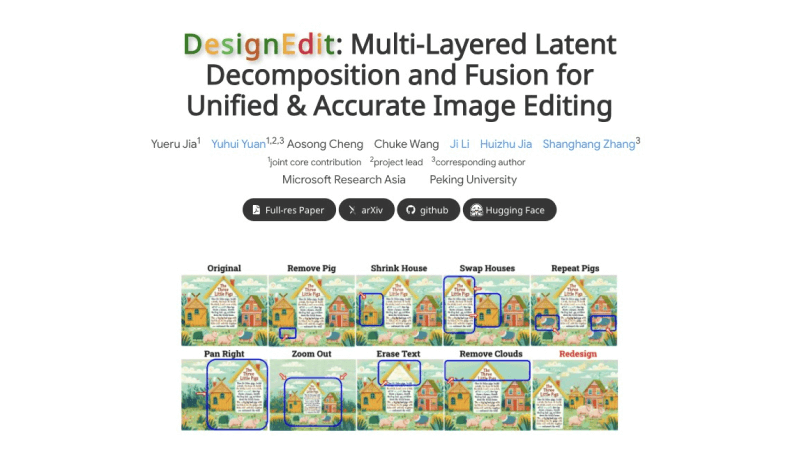
DesignEdit Official Website Entry
- Official Project Homepage:https://design-edit.github.io/
- arXiv Research Paper:https://arxiv.org/abs/2403.14487
- GitHub Source Code Repository:https://github.com/design-edit/DesignEdit
- Hugging Face Demo:https://huggingface.co/spaces/YuhuiYuan/DesignEdit
Main Features of DesignEdit
- Object Removal: DesignEdit can precisely remove specified objects from an image, whether single or multiple objects. Through multi-layered latent decomposition, the framework can process each object independently and naturally repair the background after removal.
- Object Moving: The framework allows users to move one or more objects in an image to new positions. Through instruction-guided latent fusion, objects can be repositioned on the canvas while maintaining harmony with the surrounding environment.
- Object Resizing and Flipping: DesignEdit can scale and flip objects in an image. Users can change the size or orientation of objects without affecting other parts of the image.
- Camera Panning and Zooming: Simulating changes in camera perspective, DesignEdit can achieve panning and zooming effects in images, allowing users to adjust the composition of the image, just like moving or adjusting the focal length when observing through a camera lens.
- Cross-Image Composition: DesignEdit supports combining elements from different images to create entirely new images. This feature is particularly suitable for creative work, allowing the combination of elements from multiple images to create new visual content.
- Design Image Editing: Specifically for design images/posters, DesignEdit can handle editing tasks for text, decorations, and other design elements. It can understand the special needs of design images, such as adjustments to layout and style, providing more refined editing control.
How DesignEdit Works
The working principle of DesignEdit is based on the combination of two core subtasks: Multi-Layered Latent Decomposition and Multi-Layered Latent Fusion.
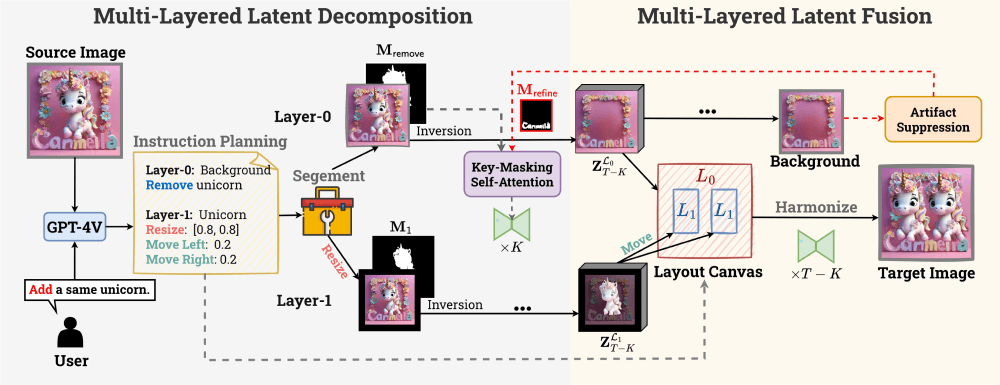
- Multi-Layered Latent Decomposition:
- Concept: DesignEdit splits the latent representation of the source image into multiple layers, each representing different objects or background parts in the image.
- Key-Masking Self-Attention: To edit specific regions without disrupting other areas of the image, DesignEdit employs a special self-attention mechanism called key-masking self-attention. This mechanism allows the model to ignore or modify pixels within the masked region while preserving contextual information from surrounding areas when processing the image.
- Background Repair: After removing objects, DesignEdit utilizes the intrinsic repair capability of the self-attention mechanism to fill in blank areas in the background, ensuring image coherence and natural transitions.
- Multi-Layered Latent Fusion:
- Instruction-Guided Fusion: After the decomposition step, DesignEdit fuses the multiple edited latent representations onto a new canvas according to the user's editing instructions. This process is carried out according to a specific layer order and the layout arrangement specified by the user.
- Artifact Suppression: To improve editing quality, DesignEdit introduces an artifact suppression scheme in the latent space. This scheme helps reduce visual artifacts that may appear during the editing process, making the image look more natural and realistic.
- Harmonization Processing: During the fusion process, DesignEdit harmonizes the fused multi-layer latent representations through an additional denoising step, further optimizing the integration of image edges and the smooth transition of interfaces.
The entire editing process is training-free, meaning that no additional training or fine-tuning is required for specific tasks. DesignEdit leverages advanced deep learning models, such as GPT-4V, to assist in generating precise editing instructions and layout arrangements, thereby achieving efficient and accurate image editing.