
What is Depth Anything 3
Depth Anything 3 (DA3) is a visual spatial reconstruction model launched by ByteDance's Seed team, which recovers 3D spatial geometric structures from visual input at any viewpoint through a single Transformer architecture. The model adopts a "depth-ray" representation method, eliminating the need for complex multi-task training and simplifying model design. Depth Anything 3 surpasses previous mainstream models in camera pose accuracy and geometric reconstruction accuracy, while maintaining efficient inference speed. The model is suitable for fields such as autonomous driving, robot navigation, and virtual reality, providing a new efficient solution for visual spatial reconstruction.
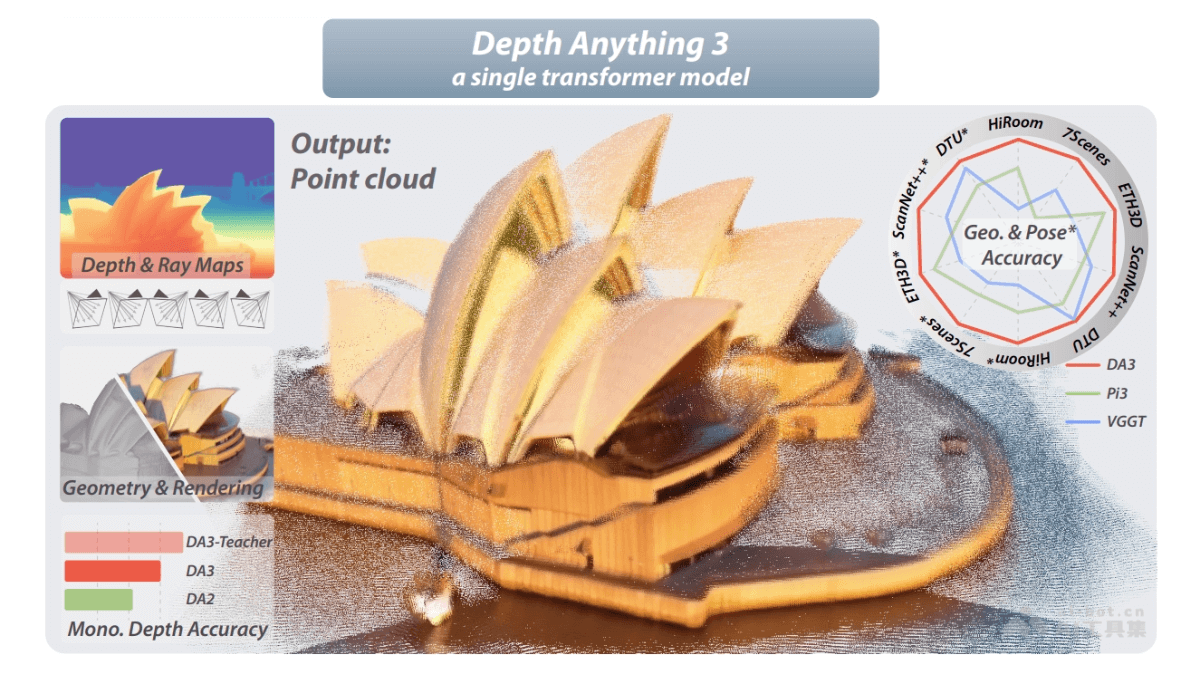
Main Features of Depth Anything 3
- Multi-view Spatial Reconstruction: Depth Anything 3 (DA3) can reconstruct 3D spatial structures from any number of visual inputs (such as a single image, multi-view images, or video streams).
- Camera Pose Estimation: The model can accurately estimate the camera pose (including position and orientation) of the input image, even without known camera parameters.
- Monocular Depth Estimation: The model performs excellently in monocular depth estimation tasks, capable of predicting pixel-level depth information from a single image, providing foundational support for 3D scene understanding.
- Novel View Synthesis: By combining with 3D Gaussian rendering technology, the model can generate high-quality images observed from unknown viewpoints, suitable for view rendering tasks in virtual reality and augmented reality.
- Efficient Inference and Deployment: The model's concise architecture design gives it significant advantages in inference speed and resource consumption, enabling rapid processing of large-scale scenes, suitable for deployment on mobile and embedded devices.
Technical Principles of Depth Anything 3
- Single Transformer Architecture: It adopts a single Transformer model (such as DINOv2) as the base architecture, without the need for complex customized designs. The Transformer's self-attention mechanism can flexibly handle any number of input views, dynamically exchange cross-view information, and achieve efficient global spatial modeling.
- Depth-Ray Representation Method: The model proposes a "depth-ray" representation method, which fully describes 3D space by predicting depth maps and ray maps. The depth map provides the distance from pixels to the camera, and the ray map describes the projection direction of pixels in 3D space. This representation naturally decouples spatial geometry from camera motion, simplifying model output while improving accuracy and efficiency.
- Input-Adaptive Cross-View Self-Attention Mechanism: It introduces an input-adaptive cross-view self-attention mechanism that dynamically rearranges tokens of input views to achieve efficient cross-view information exchange. This mechanism enables the model to flexibly handle various input scenarios from monocular to multi-view.
- Dual DPT Head Design: To jointly predict depth and ray maps, DA3 designs a dual DPT head structure. The two prediction heads share a feature processing module, and in the final fusion stage, they separately optimize the outputs of depth and ray maps, enhancing the interaction and consistency between the two tasks.
- Teacher-Student Training Paradigm: It adopts a teacher-student training paradigm, where a teacher model trained on synthetic data generates high-quality pseudo-labels to provide more accurate supervision for the student model.
- High-Precision Output in One Step: High-precision depth and ray maps can be generated through a single feedforward pass, without the multiple iterative optimizations required by traditional methods. This design significantly improves inference speed, simplifies the training and deployment process, and at the same time ensures the accuracy and efficiency of 3D reconstruction.
Project address of Depth Anything 3
- Project official website:https://depth-anything-3.github.io/
- GitHub repository:https://github.com/ByteDance-Seed/depth-anything-3
- arXiv technical paper:https://arxiv.org/pdf/2511.10647
- Online experience Demo:https://huggingface.co/spaces/depth-anything/depth-anything-3
Application scenarios of Depth Anything 3
- Autonomous driving: DA3 can quickly reconstruct the 3D environment from multi-view images captured by vehicle cameras, helping autonomous driving systems perceive the distance and position of surrounding objects more accurately, and improving the reliability and safety of decision-making.
- Robot navigation: By reconstructing the 3D structure of the environment in real time, DA3 can provide robots with accurate terrain and obstacle information, supporting efficient navigation and path planning in complex environments.
- Virtual reality (VR) and augmented reality (AR): Rapidly convert real-world scenes into high-precision 3D models for scene reconstruction in virtual reality or virtual object fusion in augmented reality, enhancing the user's sense of immersion.
- Architectural surveying and design: Reconstruct detailed 3D point clouds from multi-view images of architectural scenes, providing efficient data support for architectural surveying, interior design, and virtual architectural walkthroughs.
- Cultural heritage protection: Use DA3 to reconstruct the 3D structure of historical buildings or cultural relics, facilitating digital preservation, restoration research, and virtual display, and helping to pass on and promote cultural heritage.