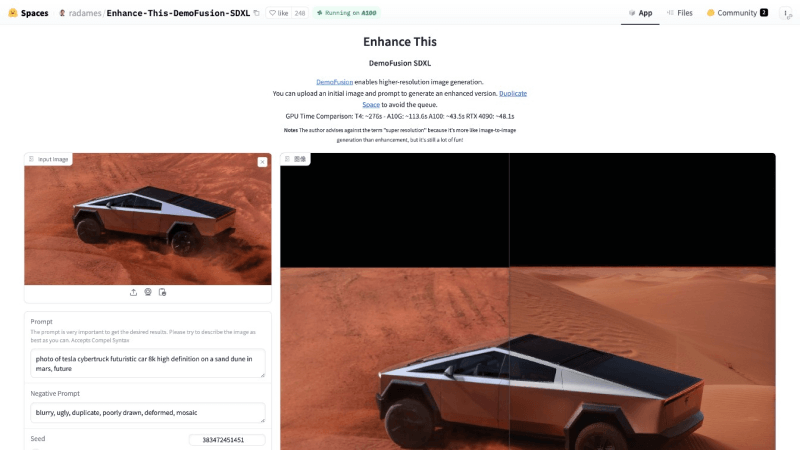
What is DemoFusion
DemoFusion is a technical framework designed for low-cost high-resolution image generation. By extending existing open-source generative AI models (such as Stable Diffusion), it enables these models to make blurry low-resolution images much clearer (4x, 16x, or even higher resolution magnification) without additional training or excessive memory requirements. DemoFusion employs progressive enhancement, skip residuals, and dilated sampling mechanisms to achieve higher-resolution image generation, allowing users with limited resources to achieve results similar toMagnific AIsolutions.
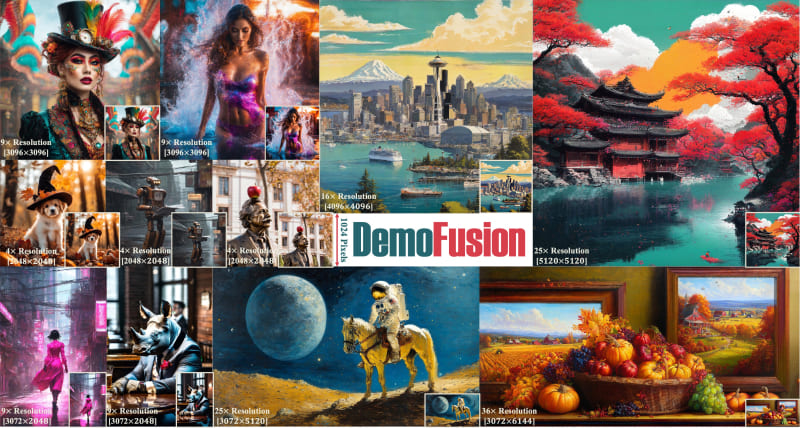
DemoFusion Official Website Entry
- Official Project Homepage:https://ruoyidu.github.io/demofusion/demofusion.html
- Arxiv Research Paper:https://arxiv.org/abs/2311.16973
- GitHub Code Repository:https://github.com/PRIS-CV/DemoFusion
- Hugging Face Running Address:
- Image to Image Version:https://huggingface.co/spaces/radames/Enhance-This-DemoFusion-SDXL
- Text to Image Version:https://huggingface.co/spaces/fffiloni/DemoFusion
- Replicate Running Address:
- Image to Image Version:https://replicate.com/lucataco/demofusion-enhance
- Text to Image Version:https://replicate.com/lucataco/demofusion
- Google Colab Running Address:https://colab.research.google.com/github/camenduru/DemoFusion-colab/blob/main/DemoFusion_colab.ipynb
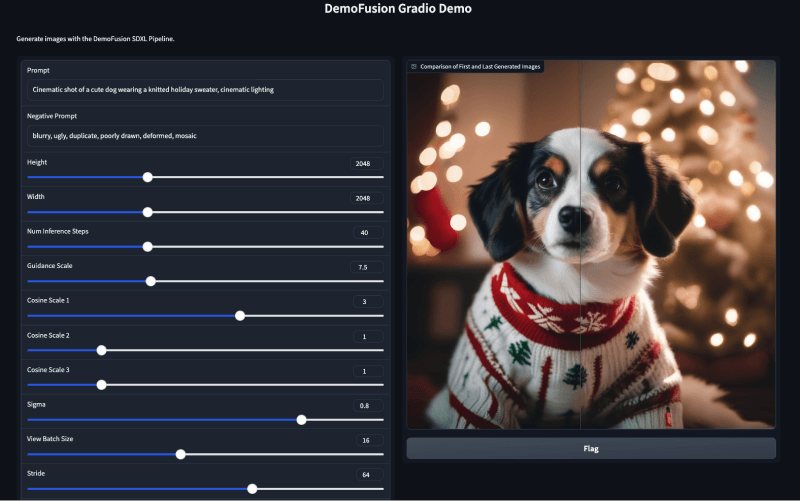
DemoFusion Features
- High-Resolution Image Generation: DemoFusion can extend the image generation capabilities of pre-trained GenAI models (such as SDXL) to higher resolutions, for example from 1024×1024 pixels to 4096×4096 pixels or higher, without additional training of the model.
- Progressive Upsampling: By gradually increasing image resolution, DemoFusion allows users to progressively refine image details during the generation process while maintaining the overall image quality and semantic consistency.
- Global Semantic Consistency: Through skip residuals and dilated sampling mechanisms, DemoFusion can maintain global semantic consistency when generating high-resolution images, avoiding repetition and structural distortion in local regions.
- Rapid Iteration: Due to the nature of progressive upsampling, DemoFusion allows users to quickly preview low-resolution results during the generation process, enabling rapid iteration and adjustment of image layout and style before waiting for high-resolution image generation to complete.
- No Additional Hardware Required: DemoFusion can run on consumer-grade hardware (such as RTX 3090 GPU), meaning users do not need expensive hardware investments to generate high-resolution images.
- Easy Integration: As a plug-in framework, DemoFusion can be easily integrated with existing AI generation models, enabling researchers and developers to quickly apply high-resolution image generation capabilities to their projects.
- Rich Application Scenarios: DemoFusion is not only suitable for artistic creation but can also be used in various fields requiring high-resolution images, such as game development, film production, virtual reality, etc.
How DemoFusion Works
The working principle of DemoFusion is based on several key steps and mechanisms that work together to generate high-resolution images. The following is its main workflow:
- Initialization:
- DemoFusion first starts with a low-resolution image, which is generated through a pre-trained latent diffusion model (such as SDXL).
- Progressive Upscaling:
- Starting from a low-resolution image, DemoFusion gradually increases the image resolution through an iterative process. This process involves upscaling the image at the current resolution to a higher resolution, then introducing noise through a diffusion process, and finally restoring the image through a denoising process. This process is repeated, each time at a higher resolution, to progressively increase the image details.
- Skip Residual:
- During the denoising process, DemoFusion uses the noise-inverted representations from previous iteration steps as skip residuals. This helps maintain the global structure of the image during generation while allowing optimization of local details.
- Dilated Sampling:
- To enhance the global context of each denoising path, DemoFusion introduces dilated sampling. This means that in the latent space, global representations are obtained through dilated sampling, and these global representations are then used to guide the local denoising paths to generate image content with global consistency.
- Fusing Local and Global Paths:
- At each iteration step, DemoFusion combines the local denoising path (local latent representations obtained through dilated sampling) and the global denoising path (global latent representations obtained through skip residuals) to generate the final high-resolution image.
- Decoding:
- Finally, a decoder converts the final latent representation back into image space to obtain the high-resolution output image.
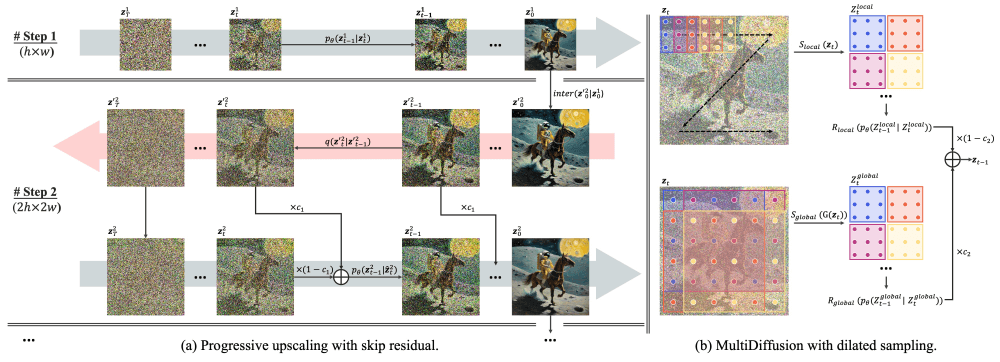
These steps and mechanisms of DemoFusion work together to enable it to effectively generate high-resolution images with rich details and good global consistency without additional training.
How to Use DemoFusion
- Visit DemoFusion's Replicate or Hugging Face run address
- Upload the image you want to upscale or use a sample image
- Enter a prompt to describe the image content
- Adjust the Seed value and set the Demofusion parameters
- Finally, click Run and wait for the image to be upscaled in high definition