
What is DeepWiki
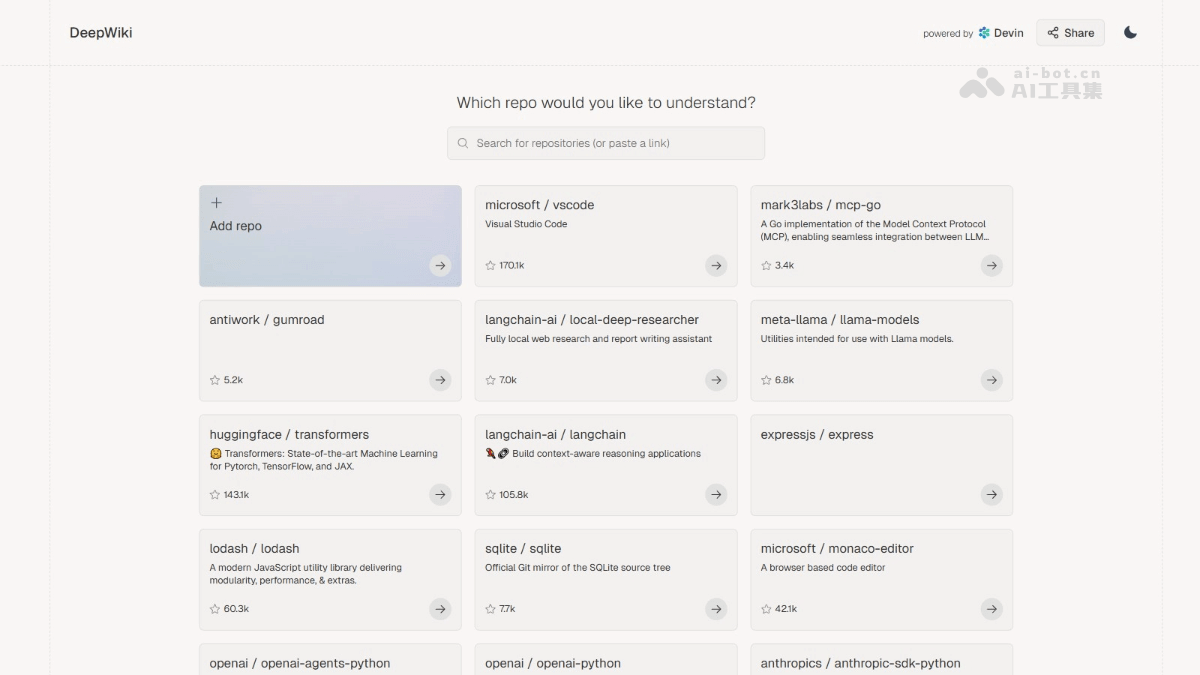
DeepWiki is an intelligent AI reading assistant for GitHub code repositories launched by the Devin team. Users can ask questions directly to codebases, and DeepWiki understands the questions based on natural language processing technology, providing detailed documentation-level answers. DeepWiki supports a deep research mode to help users analyze complex issues more thoroughly. DeepWiki has indexed over 30,000 GitHub repositories and processed more than 4 billion lines of code, and it is currently completely free for open-source projects.
Main features of DeepWiki
- Conversational documentation: Users ask questions directly to codebases, and DeepWiki provides detailed documentation-level answers.
- Deep research: For complex questions, the AI conducts deeper analysis and provides answers.
- On-demand indexing: Supports users in requesting DeepWiki to index public repositories that have not yet been included.
- Private repository support: Register a Devin account, and users can generate documentation for private repositories.
- Interactive diagrams: Generates interactive code architecture diagrams to help understand code structure.
- Sharing feature: Generated Wiki pages and Q&A results can be shared via links.
How to use DeepWiki
- Visit the DeepWiki official website: Visit DeepWiki directly official website, and browse the Wiki pages of popular open-source projects that have already been included.
- Access a specific repository by replacing the URL: Replace github.com in the URL of any GitHub repository you are browsing with deepwiki.com to jump directly to that repository's DeepWiki page.
Application scenarios of DeepWiki
- Learning open-source projects: Helps developers quickly understand the code structure and functionality of open-source projects.
- Codebase documentation generation: Automatically generates detailed wiki documentation for open-source projects that lack documentation.
- Team collaboration and knowledge sharing: Based on shared Wiki pages and Q&A results, it facilitates team members in synchronizing information.
- Code review and optimization: Assists developers in quickly locating code issues and provides optimization suggestions.
- Education and training: As a teaching tool, it helps students learn real-world code structure and development practices.