
What is DeepSeek-OCR
DeepSeek-OCR is DeepSeek a vision-language model launched by the team, focused on efficiently processing long text content through optical compression technology. The model consists of the DeepEncoder encoder and the DeepSeek3B-MoE decoder, and can significantly reduce activation memory and the number of visual tokens while maintaining high-resolution input. The model achieves up to 97% OCR accuracy at a 10x compression ratio, and can still maintain 60% accuracy at a 20x compression ratio. DeepSeek-OCR supports multiple resolution modes, is suitable for multilingual document processing, can parse complex content such as charts and chemical formulas, and provides an efficient solution for large-scale document processing.
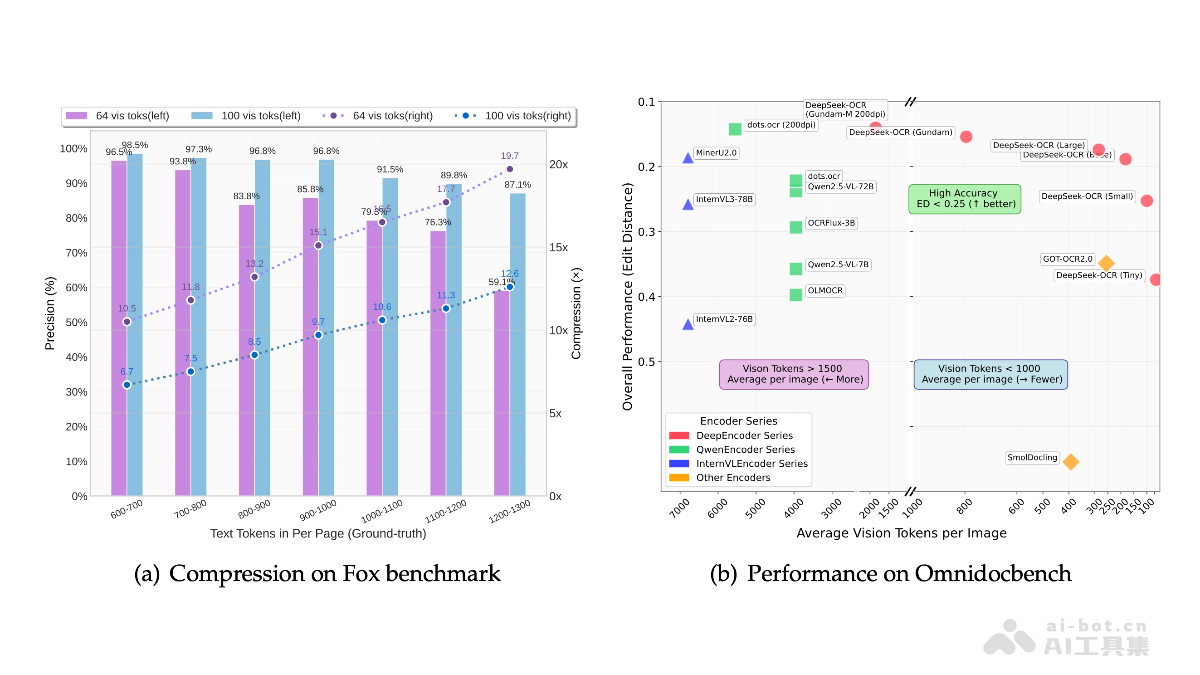
Main features of DeepSeek-OCR
- Visual text compression: Efficiently compresses long text content through the visual modality, achieving a compression ratio of 7-20x.
- Multilingual OCR: Supports document recognition in nearly 100 languages, including Chinese, English, Arabic, Sinhala, and more.
- Deep parsing: Can parse complex content such as charts, chemical formulas, and geometric figures.
- Multi-format output: Supports layout-preserving Markdown format and layout-free free OCR format.
Technical principles of DeepSeek-OCR
- Core architecture: DeepSeek-OCR consists of two parts:
- DeepEncoder: Responsible for encoding the input image (document) into visual tokens.
- DeepSeek-3B-MoE-A570M: As the decoder, responsible for decoding visual tokens into text.
- DeepEncoder: DeepEncoder is the core component of DeepSeek-OCR. Its design goal is to maintain low activation memory under high-resolution input while achieving a high compression ratio. It consists of the following parts:
- Dual-tower structure:
- SAM-base (80M): Based on window attention, mainly used to perceive local features, with low memory usage when processing high-resolution input.
- CLIP-large (300M): Based on global attention, used to extract global semantic information. Since the input is compressed, the memory usage of the global attention part can be effectively controlled.
- 16x convolutional compression layer: Between SAM and CLIP, DeepEncoder uses a 16x convolutional compression module. The module reduces the number of visual tokens from 4096 to 256 through two convolution layers (each with stride=2). This design significantly reduces the number of visual tokens and lowers memory usage without losing important information.
- Multi-resolution support: DeepEncoder supports multiple resolution modes, including Tiny, Small, Base, Large, and Gundam. Each mode corresponds to a different input resolution and number of visual tokens. For example:
- Tiny: 512x512 resolution, outputs 64 visual tokens.
- Small: 640x640 resolution, outputs 100 visual tokens.
- Base: 1024x1024 resolution, outputs 256 visual tokens.
- Large: 1280x1280 resolution, outputs 400 visual tokens.
- Gundam: Dynamic resolution, supports higher-resolution input, and further reduces activation memory through chunked processing.
- Dual-tower structure:
- Decoder: DeepSeek-3B-MoE-A570M: The decoder is based on the DeepSeek-3B-MoE architecture and has 570M activated parameters. It is responsible for decoding the compressed visual tokens into text. The decoder converts visual tokens into text representations through a nonlinear mapping. The specific formula is: fdec:Rn×dlatent→RN×dtext where n is the number of visual tokens,N is the number of text tokens,dlatent and dtext are the dimensions of visual tokens and text tokens, respectively.
DeepSeek-OCR project address
- GitHub repository:https://github.com/deepseek-ai/DeepSeek-OCR
- HuggingFace model library:https://huggingface.co/deepseek-ai/DeepSeek-OCR
- Technical paper:https://github.com/deepseek-ai/DeepSeek-OCR/blob/main/DeepSeek_OCR_paper.pdf
Application scenarios of DeepSeek-OCR
- Large-scale training data generation: automatically processes hundreds of thousands of document pages daily, providing massive high-quality training data for large language models and vision-language models.
- Enterprise-level document digitization: quickly and accurately converts various internal enterprise documents such as paper contracts and reports into searchable, editable digital formats.
- Academic research and literature processing: accurately parses complex content in academic papers, such as mathematical formulas, chemical formulas, and charts, converting it into structured machine-readable formats.
- Multilingual international document processing: easily handles the multilingual document processing needs encountered by multinational enterprises or organizations in globalized business operations.
- Financial and business intelligence analysis: can deeply parse charts in research reports and convert them into structured data, providing automated support for financial analysis and investment decisions.