
What is Decitron
Decitron is an AI multi-agent game simulation platform launched by Zhongke Wenge. Through world modeling, multi-agent simulation, and decision-solving technologies, it breaks down complex decision-making problems into agents, variables, paths, and trigger conditions. In the sandbox observation chamber, it simulates the actions and reactions of all parties in stages, generates multiple probabilistic paths and academic-grade reports, and helps users see the complete logic and probability distribution behind decisions.
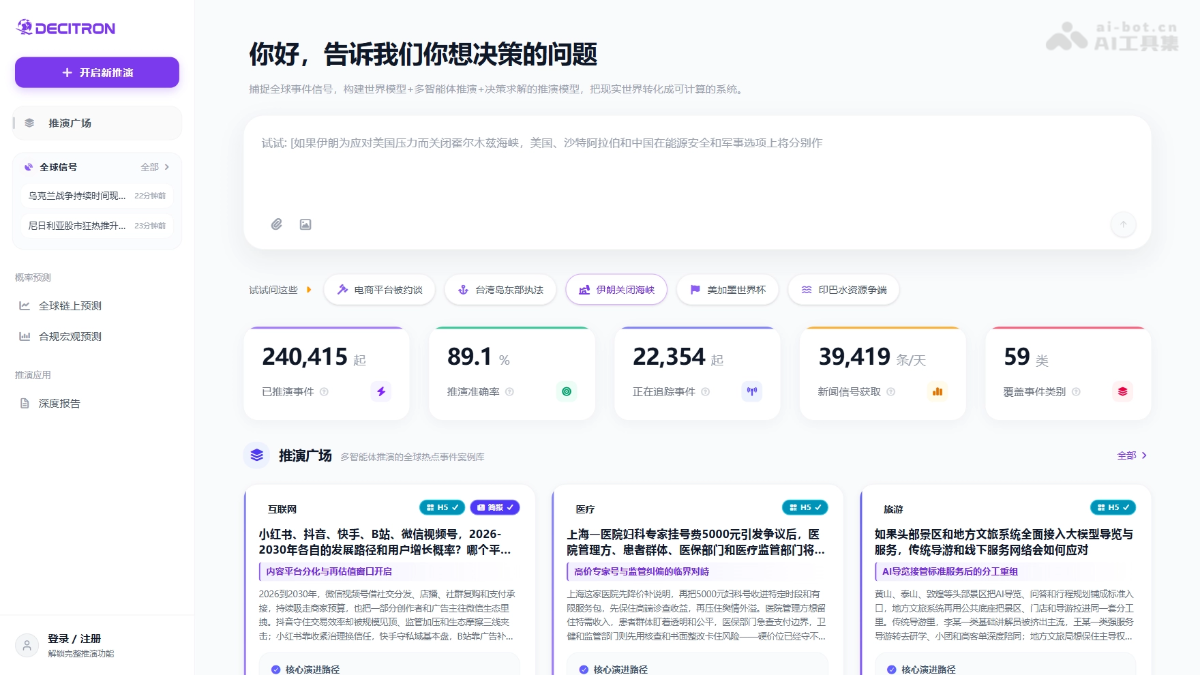
Decitron's main features
- Task understanding and condition locking: Automatically breaks down complex problems and, based on multi-dimensional understanding, provides multiple specific simulation directions for users to choose from, avoiding vague conclusions caused by too many factors.
- Intelligent modeling and role setting: Identifies core game agents, key variables, and event threads, and automatically builds a structured model including participating roles, simulation goals, and termination conditions.
- Multi-round sandbox simulation: In the visual sandbox observation chamber, simulates the strategic interaction and state evolution of all parties in stages, generating multiple possible paths with probability annotations and chain effects.
- Daily tracking: After the simulation is completed, 7-day continuous tracking can be enabled. AI automatically captures new signals to verify predictions and updates path probabilities and variable assessments in real time.
- Report generation and export: Outputs simulation process reports and comprehensive analysis reports, including executive summaries, risk matrices, sensitivity analyses, and other sections, with support for Markdown and PDF export.
How to use Decitron
- Enter the question: Visit the Decitron official website https://decitron.wenge.com/app,输入待决策的复杂问题。
- Choose a direction: From the multiple specific simulation directions generated by the system based on its understanding of the question, choose the scenario that best fits your needs.
- Confirm the model: Review the game agents, key variables, event threads, and simulation goals identified by the system, and confirm or adjust the role settings.
- Start the simulation: Click automatic simulation to enter the sandbox observation chamber and observe multi-stage path evolution and probability distribution.
- Tracking updates: After the simulation is completed, enable daily tracking to automatically verify predictions and receive probability corrections for 7 consecutive days.
- Export the report: Review the simulation summary, generate a brief, or export detailed simulation process reports and comprehensive analysis reports.
Decitron's core advantages
- Structured simulation: Transforms vague problems into computable multi-agent game models, clarifies variables, paths, and assumptions, and makes conclusions traceable.
- Visualized path diagrams: Intuitively displays each stage of evolution, branch probabilities, and the action strategies of all parties through the sandbox observation chamber, making it clearer than textual analysis.
- Dynamic tracking and verification: Supports continuous tracking of new signals and automatically corrects predictions, preventing one-time simulations from becoming invalid due to outdated information.
- Academic-grade reports: Outputs paper-style reports including research background, assessment objectives, risk matrix, sensitivity analysis, decision recommendations, and other sections.
- Convergence mechanism: Sets termination conditions for simulations to prevent infinite divergence and ensure that reasoning has boundaries and conclusions are actionable.
Comparison of Decitron with similar competitors
| Dimension | Decitron Decision Machine | AnyLogic |
|---|---|---|
| Core positioning | AI multi-agent game simulation platform, oriented toward complex event decision-making | Multi-method simulation modeling software, supporting agents, discrete events and system dynamics |
| Driving method | AI large model-driven, automatically understands problems, identifies variables and generates paths | Traditional modeling and simulation, requiring users to manually define rules, parameters and processes |
| Problem decomposition | Automatically splits agents, variables, paths, trigger conditions and termination conditions | Users need to build agent attributes, interaction rules and environmental variables by themselves |
| Simulation visualization | Built-in "sandbox observation chamber", displaying multi-path probability evolution in stages | Supports 2D/3D visualized simulation, but the model needs to be configured in advance |
| Output form | Multi-path probability map + academic-grade simulation report (including risk matrix and sensitivity analysis) | Simulation result statistical charts, animation replay and data export |
| Dynamic update | Supports 7-day daily tracking, automatically verifies predictions and corrects probabilities | After the model runs, parameters need to be manually adjusted and the simulation rerun, with no continuous tracking |
| Usage threshold | Natural language problem input, the system automatically builds the model, zero code | Requires mastery of modeling logic and software operation, with a steep learning curve |
| Applicable scenarios | Sports event prediction, investment decisions, business strategy, policy simulation | Supply chain optimization, traffic simulation, production and manufacturing, urban modeling |
Decitron application scenarios
- Sports event prediction: Evaluate a team's championship probability, the impact of key variables and advancement paths, such as analysis of World Cup championship prospects.
- Investment decisions: Analyze asset trends and risk ranges under market variables, policy changes and multi-party games.
- Business strategy simulation: Simulate competitor dynamics, industry landscape evolution and the chain reactions after strategic adjustments.
- Policy and public affairs: Evaluate multi-party reactions, implementation resistance and social impact paths after a policy is introduced.
- Major personal decisions: Conduct systematic multi-factor analysis for complex issues such as career transitions, home-buying timing and study abroad choices.