
What is DCEdit
DCEdit is a novel dual-layer controlled image editing method, jointly launched by Beijing Jiaotong University and Meitu 2MT Lab. DCEdit is based on the Precise Semantic Localization strategy (PSL), using visual and textual self-attention to optimize cross-attention maps, providing more precise regional cues to guide image editing. DCEdit introduces a Dual-Layer Control mechanism (DLC), incorporating regional cues at both the feature layer and the latent space layer to achieve finer editing control. DCEdit requires no additional training or fine-tuning and, when applied to existing Diffusion Transformer (DiT)-based editing methods, performs excellently in background preservation and editing accuracy.
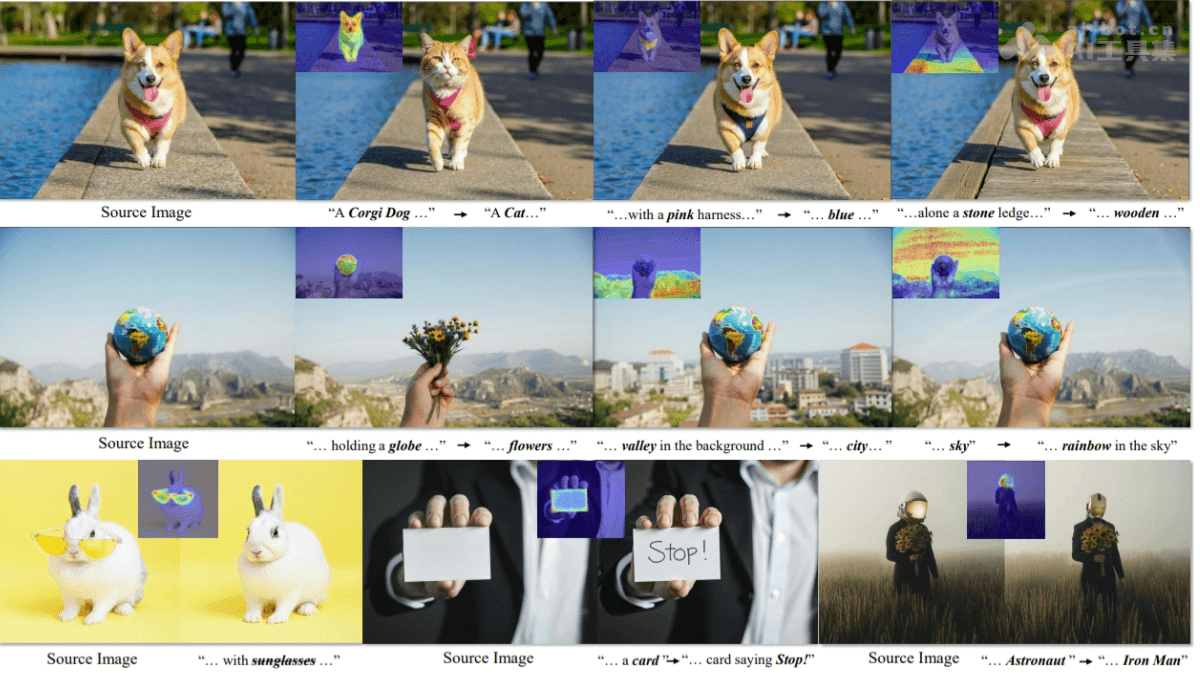
DCEdit's Main Features
- Precise Semantic Localization: Accurately locates the semantic regions in the image that need editing, while preserving the details of the background and other unedited regions.
- Dual-Layer Control Mechanism: Incorporates regional cues simultaneously at the feature layer and the latent space layer, achieving fine-grained control over the editing process and improving editing results.
- Supports Complex Image Editing: Suitable for real-world images with high resolution and complex backgrounds, and supports handling various editing tasks, such as changing colors, replacing objects, adding or removing objects, etc.
DCEdit's Technical Principles
- Precise Semantic Localization Strategy (PSL): Combines visual self-attention and textual self-attention to optimize cross-attention maps. The visual self-attention matrix captures the affinity relationships within the image, while the textual self-attention matrix is used to decouple the entanglement between semantics. Based on the reweighting of the visual self-attention matrix and the inverse operation of the textual self-attention matrix, the cross-attention map is optimized to more accurately reflect the target semantic region. The optimized cross-attention map serves as regional cues to guide the editing process, ensuring that the editing effect is concentrated in the target region.
- Dual-Layer Control Mechanism (DLC): In the feature layer, based on a soft fusion mechanism, the optimized cross-attention map is used to selectively preserve features activated by the editing text, avoiding the loss of editing effects caused by directly replacing features. In the latent space layer, based on a diffusion blending method, the binarized cross-attention map is used to preserve background information, preventing background regions from being incorrectly edited. The inversion process maps the source image to the initial noise, and the dual-layer control mechanism is applied during the sampling process to generate the edited image.
- RW-800 Benchmark: Contains high-resolution real-world images, ensuring the diversity and complexity of the test data. Provides detailed text descriptions and supports complex editing tasks.
DCEdit's Project Address
- arXiv Technical Paper:https://arxiv.org/pdf/2503.16795
DCEdit's Application Scenarios
- Advertising and Marketing: Quickly modify elements in advertising images (such as colors, backgrounds, logos, etc.), improving production efficiency.
- Film, Television, and Entertainment: Conveniently adjust props, costumes, or backgrounds in film and television scenes, saving time and cost.
- Social Media and Content Creation: Quickly modify images according to the theme, enhancing content appeal and diversity.
- Product Design and Development: Quickly generate different design solutions for products, accelerating the development process.
- Education and Training: Create personalized learning materials to help students better understand the teaching content.