
What is daVinci-MagiHuman?
daVinci-MagiHuman is an open-source joint audio-video generation foundation model jointly released by the GAIR Lab at Shanghai Innovation Institute and Sand.ai. The model adopts a 15-billion-parameter single-stream Transformer architecture that uniformly models three modalities—text, video, and audio—without requiring cross-attention mechanisms. The model excels at character-centric generation and supports multiple languages including Chinese, English, Japanese, Korean, German, and French. It can generate a 5-second 256p video in 2 seconds on a single H100. Compared with Ovi 1.1 and LTX 2.3, it achieves win rates of 80% and 60.9%, respectively. The code, model weights, and online demo have all been fully open-sourced.
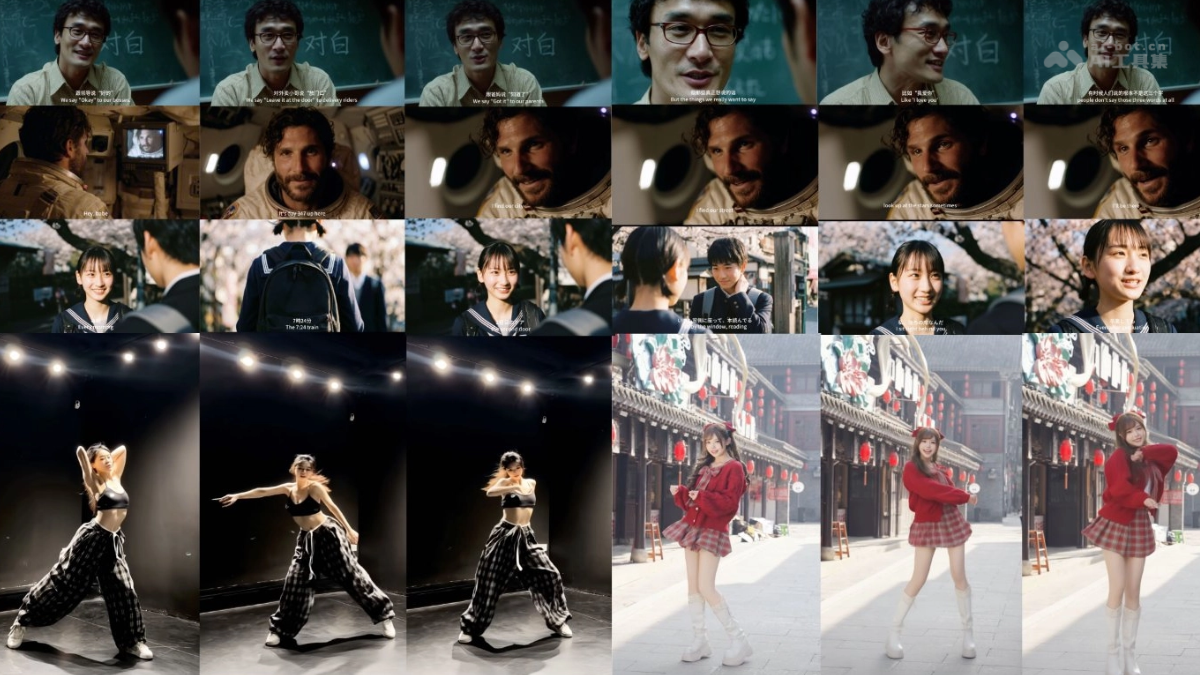
Main Features of daVinci-MagiHuman
-
Joint audio-video generation: Supports synchronized generation of character videos with natural speech and lip synchronization, achieving true integrated audio-visual output.
-
Multilingual support: Supports speech generation in multiple languages including Chinese (Mandarin and Cantonese), English, Japanese, Korean, German, and French.
-
Portrait performance generation: Focuses on character-centric scenes, generating expressive facial expressions, body movements, and emotional conveyance.
-
Ultra-fast inference: Supports generating a 5-second 256p video in 2 seconds on a single H100 GPU, meeting real-time interaction needs.
-
High-resolution output: Through latent-space super-resolution technology, it can be extended to 540p or 1080p HD video.
Technical Principles of daVinci-MagiHuman
- Single-stream unified architecture: daVinci-MagiHuman adopts a single-stream Transformer architecture that places text, video, and audio uniformly into the same 15-billion-parameter, 40-layer denoising network, using pure self-attention mechanisms for joint modeling and completely abandoning cross-attention or modality-specific branches. Architecturally, it uses a "sandwich" design: a few layers at the beginning and end retain modality-related parameters, while the middle backbone network shares parameters, achieving a balance between modality specialization and deep fusion; it also introduces mechanisms such as injection without explicit timestep conditioning and Attention-Head gating to improve training stability and expressive capability.
- Latent-space super-resolution: The model uses a two-stage pipeline: the base model first generates low-resolution audio-video latents, and then latent-space super-resolution directly performs high-resolution refinement in latent space, avoiding additional VAE encoding and decoding overhead. The audio latents continue to be fed as input into the super-resolution model to maintain lip-sync performance.
- Inference acceleration optimization: During inference, a lightweight Turbo VAE decoder is used to reduce latency, and the self-developed MagiCompiler is integrated for full-graph compilation optimization, bringing about 1.2x acceleration through cross-layer operator fusion; combined with DMD-2 distillation technology, it achieves high-quality generation with only 8 denoising steps.
Key Information and Usage Requirements of daVinci-MagiHuman
-
Model scale: 15 billion parameters, 40-layer Transformer
-
Architecture features: Single-stream unified architecture, pure self-attention, no cross-attention
-
Generation capabilities: Supports text/image-driven joint generation of portrait audio and video
-
Supported languages: Chinese (Mandarin, Cantonese), English, Japanese, Korean, German, French
-
Inference speed: Generates a 5-second 256p video in 2 seconds on a single H100, and a 1080p video in 38 seconds
-
Performance: 80.0% win rate against Ovi 1.1, 60.9% win rate against LTX 2.3
-
Hardware: NVIDIA GPU (H100 recommended), CUDA support required
-
Software Environment:Python 3.12,PyTorch 2.9.0,CUDA 12.x
-
Dependencies: Flash Attention (Hopper architecture), MagiCompiler (in-house compiler), Turbo VAE
Core Advantages of daVinci-MagiHuman
-
Simple and Efficient Architecture: Uses a single-stream Transformer to uniformly model text, video, and audio, eliminating cross-attention and modality branches, reducing system complexity, and making training and inference optimization more direct.
-
Precise Audio-Video Synchronization: Native joint modeling ensures high coordination among speech, lip movements, facial expressions, and actions, avoiding the insufficient audio-video semantic alignment of traditional solutions.
-
Extremely Fast Generation: Supports generating a 5-second 256p video in 2 seconds on a single H100, combining latent-space super-resolution, Turbo VAE, full-graph compilation, and model distillation to achieve real-time-level inference.
-
Strong Multilingual Generalization: Supports multiple languages including Chinese, English, Japanese, Korean, German, French, and Cantonese, meeting the needs of global content generation.
-
Outstanding Portrait Expressiveness: Focuses on character-centric scenes, generating emotionally rich facial expressions, natural speech, and realistic body movements, achieving performance-level quality.
How to Use daVinci-MagiHuman
- Method 1: Docker
-
Pull the pre-built image:
docker pull sandai/magi-human:latest。 -
Start the container and mount the local directory:
docker run -it --gpus all --network host --ipc host -v /path/to/repos:/workspace -v /path/to/checkpoints:/models sandai/magi-human:latest bash。 -
After entering the container, install MagiCompiler and clone the daVinci-MagiHuman code repository.
-
Download the model weights from HuggingFace and update the paths in the configuration file.
-
Run the corresponding script to start generation.
-
- Method 2: Manual Conda Installation
-
Create and activate a Python 3.12 environment:
conda create -n davinci python=3.12 && conda activate davinci。 -
Install PyTorch 2.9.0 and related components.
-
Compile and install Flash Attention (Hopper architecture version).
-
Clone and install the dependencies of the MagiCompiler and daVinci-MagiHuman projects.
-
Download external models such as T5 Gemma, Stable Audio, and Wan2.2 VAE, as well as the project weights.
-
After updating the model paths in the configuration file, run the generation script.
-
- Run Scripts
-
Basic 256p generation: run
bash example/base/run.sh。 -
Distilled fast version 256p (8-step denoising, no CFG): run
bash example/distill/run.sh。 -
Super-resolution to 540p: run
bash example/sr_540p/run.sh。 -
Super-resolution to 1080p: run
bash example/sr_1080p/run.sh。
-
Project Addresses of daVinci-MagiHuman
- GitHub Repository:https://github.com/GAIR-NLP/daVinci-MagiHuman
- HuggingFace Model Repository:https://huggingface.co/GAIR/daVinci-MagiHuman
- arXiv Technical Paper:https://arxiv.org/pdf/2603.21986
- Online Experience Demo:https://huggingface.co/spaces/SII-GAIR/daVinci-MagiHuman
Comparison of daVinci-MagiHuman with Similar Competitors
| Comparison Item | daVinci-MagiHuman | LTX 2.3 | Ovi 1.1 |
|---|---|---|---|
| Developer | Shanghai Innovation Institute GAIR + Sand.ai | Lightricks | Ovi Labs |
| Architecture Design | Single-stream Transformer, no cross-attention | Multi-stream or diffusion architecture | Multi-stream architecture |
| Model Scale | 15 billion parameters | Not disclosed | Not disclosed |
| Audio-Video Generation | Native joint modeling, synchronized generation | Supported | Supported |
| Generation speed | 2 seconds/5 seconds at 256p on H100 | Slower | Slower |
| Visual quality | 4.80 | 4.76 | 4.73 |
| Text alignment | 4.18 | 4.12 | 4.10 |
| Physical consistency | 4.52 | 4.56 | 4.41 |
| Audio quality (WER) | 14.60% | 19.23% | 40.45% |
| Human evaluation win rate | Baseline | 60.9% win rate | 80.0% win rate |
| Degree of open source | Fully open source (code + weights + toolchain) | Partially open source | Partially open source |
| Multilingual support | Chinese, English, Japanese, Korean, German, French + Cantonese | Limited | Limited |
Application scenarios of daVinci-MagiHuman
-
AI digital human anchor: Automatically generate product-selling or news-broadcasting videos with precise lip sync and natural expressions, supporting multilingual adaptation to different regional markets.
-
Virtual customer service and assistants: Create intelligent customer service personas with real voice interaction capabilities, enhancing service warmth and user experience.
-
Film, television, and advertising production: Quickly generate character close-up shots, voice-over samples, or storyboard previews, reducing pre-production costs and time.
-
Education and training content: Generate multilingual instructional videos, allowing virtual instructors to explain knowledge points with vivid expressions and clear lip sync.
-
Game and metaverse characters: Give virtual characters real-time voice-driven capabilities, enabling natural conversational interaction between players and NPCs.